


Pegatron Corp (和碩), one of Apple Inc’s iPhone assemblers, is to expand the production capacity of its plant in Kunshan, China, in the next two years to meet rising demand from its clients.
“Hypothetically speaking, if the Kunshan plant has 10,000 workers at the moment, the number would double next year and then quadruple the year after that,” Pegatron chairman Tung Tzu-hsien (童子賢) told reporters on the sidelines of the 2015 IT Month opening ceremony in Taipei.
IT Month, an annual fair, is to run through Sunday in Taipei, then move on to Taichung from Dec. 11 to Dec. 16, to Kaohsiung from Dec. 24 to Dec. 29 and to Tainan from Jan. 8 to Jan. 13.
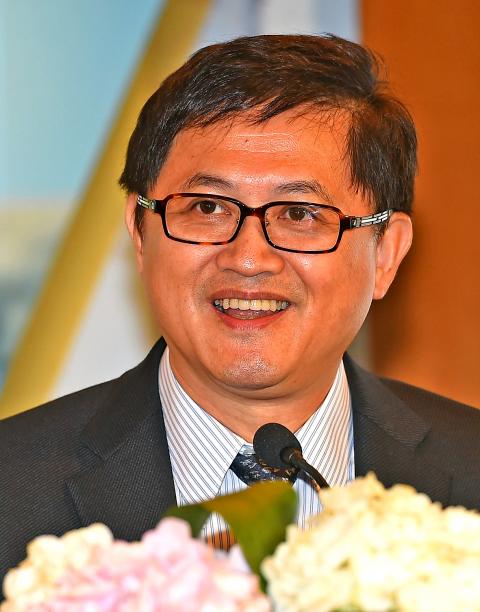
Photo: Chang Chia-ming, Taipei Times
Pegatron has allocated US$300 million for capital expenditure this year, mainly focusing on building new plants in China. The company is yet to finalize its capital expenditure plan for next year yet.
The Kunshan plant previously assembled older-generation iPhones, but Pegatron moved some of the new iPhone production lines from its Shanghai plant to Kunshan this quarter in a bid to ease the burden on the Shanghai plant, according to sources familiar with the matter.
Tung said that the two-year expansion plan for the Kunshan plant would not necessary involve the same product line, adding that if a strong demand for the product does not materialize in the market, Pegatron would adjust its product lines.
When asked if demand for the iPhone 6S is weaker than last year’s iPhone 6, Tung said: “The market is focusing too much on the new model and ignores the fact that the combined demand for new and previous models has not declined.”
“Let us not forget that the demand for the iPhone 4S was still very strong when the iPhone 5 hit the market,” Tung said, adding: “I could only say the situation now is quite similar. Overall, Pegatron has seen the combined orders for new and old iPhone models grow significantly from last year,” he said.
Pegatron chief financial officer Charles Lin (林秋炭) on Nov. 9 told investors that revenue this quarter is expected to jump 30 percent from last quarter’s NT$311.84 billion (US$9.5 billion) and reach a peak for this year.
CIMB Securities Ltd forecast Pegatron’s revenue would grow more than 35 percent quarterly this quarter, thanks to strong smartphone orders from Apple and Asustek Computer Inc (華碩), as well as contribution from new notebook computer models.
Moreover, being the sole assembler for Microsoft Corp’s Surface Pro 4 tablet and the Surface Book laptops, the income from the two products might contribute about 5 percent to Pegatron’s revenue this quarter, CIMB said in a note on Nov. 10.
In the first 10 months of this year, Pegatron’s revenues totaled NT$976.58 billion, increasing 24.12 percent from the same period last year.


Taiwan’s foreign exchange reserves fell below the US$600 billion mark at the end of last month, with the central bank reporting a total of US$596.89 billion — a decline of US$8.6 billion from February — ending a three-month streak of increases. The central bank attributed the drop to a combination of factors such as outflows by foreign institutional investors, currency fluctuations and its own market interventions. “The large-scale outflows disrupted the balance of supply and demand in the foreign exchange market, prompting the central bank to intervene repeatedly by selling US dollars to stabilize the local currency,” Department of Foreign

Intel Corp is joining Elon Musk’s long-shot effort to develop semiconductors for Tesla Inc, Space Exploration Technologies Corp and xAI, marking a surprising twist in the chipmaker’s comeback bid. Intel would help the Terafab project “refactor” the technology in a chip factory, the company said on Tuesday in a post on X, Musk’s social media platform. That is a stage in the development process that typically helps make chips more powerful or reliable. The chipmaker’s shares jumped 4.2 percent to US$52.91 in New York trading on Tuesday. The Terafab project is a grand plan by Musk to eventually manufacture his own chips for
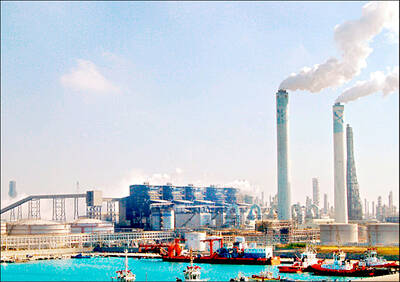
Taiwan Power Co (Taipower, 台電) yesterday said it plans to resume operations at two coal-fired power generators for three months to boost security of electricity supply as liquefied natural gas (LNG) supply risks are running high due to the Middle East conflict. The two coal-fired power generators are at Mailiao Power Plant in Yunlin County’s Mailiao Township (麥寮). The plant, operated by Formosa Plastics Group (台塑集團), supplied electricity to Taipower’s power grid until the end of last year. Taipower’s decision came about one month after Minister of Economic Affairs Kung Ming-hsin (龔明鑫) on March 10 said that the nation had no imminent

Some robotaxi passengers were left stranded in the middle of fast-moving traffic in a major Chinese city after their driverless vehicles stopped running, according to police and media reports on Wednesday. A preliminary investigation indicates more than 100 robotaxis came to a halt because of a “system malfunction,” police in the city of Wuhan said in a statement, without elaborating. No injuries were reported. One passenger told Chinese media that their robotaxi stopped after turning a corner. An instruction on a screen read: “Driving system malfunction. Staff are expected to arrive in 5 minutes.” After no one showed up, the passenger pushed


 RSS
RSS