


The nation’s semiconductor industry is expected to grow its revenue 4 percent next year on improving smartphone demand, market researcher the Industrial Economics and Knowledge Center (IEK) said yesterday.
Taiwanese semiconductor companies are to expand their revenues to NT$2.34 trillion (US$71.27 billion) next year, compared with this year’s estimated NT$2.24 trillion, the IEK said.
The growth is to be primarily supported by the foundry sector’s estimated 9.9 percent annual growth, while most sectors are to grow less than 5 percent next year, the IEK said.
The nation would continue to outpace the world in the semiconductor industry, which is only expected to see a growth of less than 2 percent next year, the center said.
Over the next five years, global semiconductor industry is expected to grow at a compound rate of 3 percent, the researcher added.
However, the Hsinchu-based research house warned of growing competition from China as it expands the scale and technological scope of the industry there, as well as strengthening its global presence, boosted by government support and the large domestic market.
“As most Taiwanese chip designers are small and medium-sized enterprises, they should work together to fend off competition as their Chinese rivals are improving their competitiveness via mergers and acquisitions,” IEK analyst Jerry Peng (彭茂榮) said yesterday, at a forum in Taipei.
China, which has more than 500 chip designers, would see its global market share rise to 11 percent next year, from this year’s 7 percent, while Taiwan, which is home to 245 chip designers, would find its global market share stay almost flat at 21 percent next year, compared with this year’s 22 percent, IEK said.
China’s major chip designers include handset chip supplier Hisilicon Technologies Co (海思半導體) owned by Huawei Technologies Co (華為), RDA Microelectronics Inc (銳迪科技) and Spreadtrum Communications Inc (展訊) under Tsinghua Unigroup Ltd (清華紫光).
Regarding technology and the scale of production, Chinese chip designers are to catch up with their Taiwanese competitors within the next two to three years, IEK said.
Local chip designers, led by mobile phone chip supplier MediaTek Inc (聯發科), are to grow their revenues by 2.2 percent next year to NT$589.5 billion, IEK said.
Intensifying competition and anemic demand are to erode local chip designers’ gross margin, which would drop to about 35 percent this year from last year’s 40 percent, IEK analyst Terry Fan (范哲豪) said.
Commenting on market speculation about MediaTek’s acquisition of the networking chip business from Realtek Semiconductor Corp (瑞昱半導體), Peng said that the acquisition “makes sense” as it would help MediaTek strengthen its wireless capabilities.
MediaTek, in a company statement filed with the Taiwan Stock Exchange yesterday, said the news about a possible Realtek acquisition were “media speculation,” according to. MediaTek has concluded four acquisition deals so far this year.
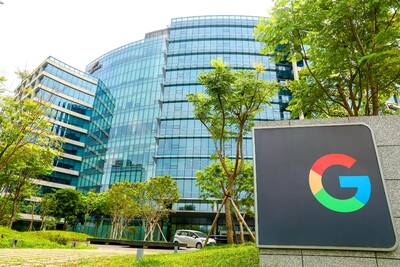
The government yesterday approved applications by Alphabet Inc’s Google to invest NT$27.08 billion (US$859.98 million) in Taiwan, the Ministry of Economic Affairs said in a statement. The Department of Investment Review approved two investments proposed by Google, with much of the funds to be used for data processing and electronic information supply services, as well as inventory procurement businesses in the semiconductor field, the ministry said. It marks the second consecutive year that Google has applied to increase its investment in Taiwan. Google plans to infuse NT$25.34 billion into Charter Investments Ltd (特許投資顧問) through its Singapore-based subsidiary Fructan Holdings Singapore Pte Ltd, and

SECOND-RATE: Models distilled from US products do not perform the same as the original and undo measures that ensure the systems are neutral, the US’ cable said The US Department of State has ordered a global push to bring attention to what it said are widespread efforts by Chinese companies, including artificial intelligence (AI) start-up DeepSeek (深度求索), to steal intellectual property from US AI labs, according to a diplomatic cable. The cable, dated Friday and sent to diplomatic and consular posts around the world, instructs diplomatic staff to speak to their foreign counterparts about “concerns over adversaries’ extraction and distillation of US AI models.” Distillation is the process of training smaller AI models using output from larger, more expensive ones to lower the costs of training a powerful new

Micron Technology Inc is a driving force pushing the US Congress to pass legislation that would put new export restrictions on equipment its Chinese competitors use to make their chips, according to people familiar with the matter. A US House of Representatives panel yesterday was to vote on the “MATCH Act,” a bill designed to close gaps in restrictions on chipmaking equipment. It would also pressure foreign companies that sell equipment to Chinese chipmaking facilities to align with export curbs on US companies like Lam Research Corp and Applied Materials Inc. The bill targets facilities operated by China’s ChangXin Memory Technologies Inc

Singapore-based ride-hailing and delivery giant Grab Holdings’ planned acquisition of Foodpanda’s Taiwan operations has yet to enter the formal review stage, as regulators await supplementary documents, the Fair Trade Commission (FTC) said yesterday. Acting FTC Chairman Chen Chih-min (陳志民) told the legislature’s Economics Committee that although Grab submitted its application on March 27, the case has not been officially accepted because required materials remain incomplete. Once the filing is finalized, the FTC would launch a formal probe into the deal, focusing on issues such as cross-shareholding and potential restrictions on market competition, Chen told lawmakers. Grab last month announced that it would acquire


 RSS
RSS