


The nation’s exports declined 11 percent year-on-year last month, down by double digits for five months running, but easing from a 14.6 percent fall in September, indicating a slow improvement in external demand, the Ministry of Finance said yesterday.
The results came in line with a market consensus that the global slowdown will continue to weigh on electronics shipments while price distortions caused by cheaper oil prices might not taper off until next year.
Exports, which account for 70 percent of GDP, dropped for the ninth consecutive month this year to NT$785.99 billion (U$23.94 billion) last month, the ministry’s report showed.
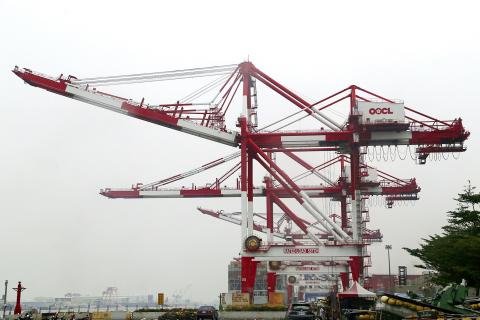
Photo: CNA
“All product categories recorded a retreat due to protracted inventory adjustments and the falling oil prices deepened conservative sentiment among firms,” Department of Statistics Director-General Yeh Maan-tzwu (葉滿足) said.
The economic landscape might brighten a bit going forward, but not fast enough to elevate exports back to a positive zone in the foreseeable future in light of lingering price concerns, Yeh said.
OPEC crude oil averaged US$75 a barrel in November last year, 40 percent higher than the current US$45 a barrel, suggesting a continued and steep drag on exports of mineral, plastic and basic metal products this month and beyond, Yeh said.
Likewise, the decline in imports narrowed to 20 percent year-on-year to US$17.82 billion last month, as firms shied away from buying capital equipment or raw material products, the report said.
That rendered a trade surplus of US$6.12 billion last month, widening from US$5.25 billion in September, the report showed.
Shipments to all trade partners saw double-digit declines, with the exception of Japan, which increased imports from Taiwan by 0.2 percent from a year earlier, the report found.
Exports to China dropped 11.7 percent to US$9.56 billion last month and fell 9.1 percent to the US at US$2.79 billion, the report said.
“Demand for information and communications devices panned out softer than expected as the economy in China slows,” Yeh said.
Electronics products, which drove 36.7 percent of all exports, shrank 4 percent to US$8.79 billion last month from a year earlier, the report said.
The figure is a significant improvement from a 9.9 percent decline to US$8.01 billion in September, lending support to expectations that the worst is likely over for the technology cycle, Yeh said.
KGI Securities Co (凱基證券) economist Andrew Tsai (蔡耀德) said that a rebound is taking place, though at a snail’s pace.
The advent of the Christmas sales season might spur demand for consumer electronic devices, easing the decline in exports in coming months, Tsai said by telephone.
Against this backdrop, the central bank might cut interest rates by another 12.5 basis points next month to encourage economic activity, he said.

Taichung reported the steepest fall in completed home prices among the six special municipalities in the first quarter of this year, data compiled by Taiwan Realty Co (台灣房屋) showed yesterday. From January through last month, the average transaction price for completed homes in Taichung fell 8 percent from a year earlier to NT$299,000 (US$9,483) per ping (3.3m²), said Taiwan Realty, which compiled the data based on the government’s price registration platform. The decline could be attributed to many home buyers choosing relatively affordable used homes to live in themselves, instead of newly built homes in the city’s prime property market, Taiwan Realty
The government yesterday approved applications by Alphabet Inc’s Google to invest NT$27.08 billion (US$859.98 million) in Taiwan, the Ministry of Economic Affairs said in a statement. The Department of Investment Review approved two investments proposed by Google, with much of the funds to be used for data processing and electronic information supply services, as well as inventory procurement businesses in the semiconductor field, the ministry said. It marks the second consecutive year that Google has applied to increase its investment in Taiwan. Google plans to infuse NT$25.34 billion into Charter Investments Ltd (特許投資顧問) through its Singapore-based subsidiary Fructan Holdings Singapore Pte Ltd, and

JET JUICE: The war on Iran’s secondary effects have seen fuel prices skyrocket, knocking flight schedules down to earth in return as airlines struggle with costs Airline passengers should brace for more irritation in the next few months as carriers worldwide cancel flights and ground planes to cope with stratospheric increases in jet-fuel prices. Dutch flag carrier KLM is the latest company to cut its schedule, saying on Thursday that it would scrap 80 return flights at Amsterdam’s Schiphol Airport in the coming month. That puts it in the same league as United Airlines Holdings Inc, Deutsche Lufthansa AG and Cathay Pacific Airways Ltd, which have all pruned itineraries to mitigate costs. Global capacity for next month has been reduced by about 3 percentage points, with all

Micron Technology Inc is a driving force pushing the US Congress to pass legislation that would put new export restrictions on equipment its Chinese competitors use to make their chips, according to people familiar with the matter. A US House of Representatives panel yesterday was to vote on the “MATCH Act,” a bill designed to close gaps in restrictions on chipmaking equipment. It would also pressure foreign companies that sell equipment to Chinese chipmaking facilities to align with export curbs on US companies like Lam Research Corp and Applied Materials Inc. The bill targets facilities operated by China’s ChangXin Memory Technologies Inc


 RSS
RSS