


The official manufacturing purchasing managers’ index (PMI) stood at 46 last month, virtually unchanged from 46.1 in September, indicating the operating conditions for local manufacturers remained soft without concrete signs of improvement, the Chung-Hua Institution for Economic Research (CIER, 中華經濟研究院) said yesterday.
It is the fourth consecutive month of downturn for the indicator which, aims to gauge the health of the manufacturing industry.
“It is too early to tell if the worst is over given the poor PMI value, though some component measures showed signs of easing,” CIER president Wu Chung-shu (吳中書) said at a media briefing.
Economists and officials said that the nation’s export-reliant economy might have hit the bottom last quarter and could improve with the advent of high season sales for technology products in the West.
A PMI score more than 50 indicates expansion and values less than the threshold suggest contraction after factoring in sub-indices on new orders, output, employment, suppliers’ delivery times and stocks of purchases.
The CIER findings are consistent with a private PMI reading of 47.8 by Nikkei and Markit, up from 46.9 in September, which confirmed an extended soft patch, but the decline slackened slightly, the Hong Kong-based research body said in a report.
The sub-indices on new orders and production continue to contract at 45.9 and 46.4 last month respectively, as domestic and internationally clients continued to adjust inventory for fear of a supply glut, the CIER survey said.
Demand related to Apple Inc’s iPhone 6S already peaked in the first half and might not create a big splash going forward, Supply Management Institute in Taiwan ( 中華採購與供應管理協會) executive director Steve Lai (賴樹鑫) said.
Lai said he had seen offers of discounts for the new smartphone in Taiwan. In the past, such deals suggested a lack of excitement on the part of local users, despite the device boasting record sales worldwide, Lai said.
Taiwanese technology firms are responsible for the manufacture of iPhone chips, casings, touchscreens, sensors, camera lenses and other components.
“Companies in the supply chain are waiting for next-generation applications and features to drive growth next year,” Lai said.
“Hopefully, local technology firms can take part and facilitate innovations that would excite consumers,” he said.
The sub-index on employment dropped further in September from 48.4 to 47.8, reflecting a more conservative hiring approach by companies to cope with slowing business, the survey said.
Non-manufacturing sectors fared better last month, with the non-manufacturing index recovering to the expansion zone at 50.8, ending two months of decline, the Taipei-based think tank said in a separate survey.
Firms involved in non-manufacturing business built up inventory and hired more staff last month, a trend that is most evident among retailers and restaurant and hotel operators, the survey said.
However, they had a bleak view about operations in the coming six months.
Against the backdrop, Annabel Fiddes, an economist at Markit that compiled the private PMI report, said the central bank might cut interest rates again next month to help prop up the economy.
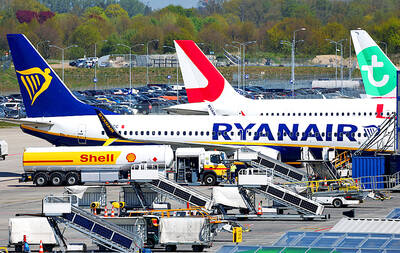
Ryanair, Transavia, Volotea and other low-cost airlines are feeling the financial pain from high jet fuel prices as a result of the Middle East war and are cutting flights. The closure of the Strait of Hormuz has taken a huge chunk of oil supplies off the market, sending the price of jet fuel soaring and triggering fears of shortages that could force airlines to cancel flights. Airlines are not waiting for a lack of supplies to react. “Travel alert: Airlines are cutting thousands of flights right now,” Travel Therapy host Karen Schaler said in an Instagram reel this past weekend.
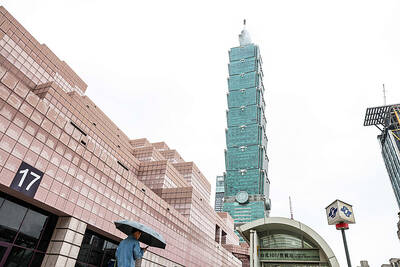
MANAGING RISKS: Taiwan has secured LNG sufficient to cover 95 percent of electricity demand for next month, UBS said, describing the government’s approach as proactive UBS Group AG has raised its forecast for Taiwan’s economic growth this year to 8 percent, up from 6.9 percent previously, and said expansion could reach as high as 8.6 percent if external energy shocks are avoided. The upgrade reflects a stronger-than-expected first-quarter performance and sustained momentum in artificial intelligence (AI)-driven exports, which UBS said are providing a firm foundation for growth despite geopolitical and energy risks. Taiwan’s GDP expanded 13.69 percent year-on-year in the first quarter, the fastest growth since the second quarter of 1987, the Directorate-General of Budget, Accounting and Statistics (DGBAS) reported on Thursday. On a seasonally

The Fair Trade Commission’s (FTC) ongoing review of Grab Holdings Ltd’s US$600 million acquisition of Foodpanda Taiwan’s operations, announced on March 23, has taken on fresh urgency as industry experts warn that the transaction could embed significant Chinese cybersecurity vulnerabilities into Taiwan’s digital infrastructure through Grab’s deep ties to autonomous-driving firm WeRide (文遠知行). Less than 16 months after the FTC blocked Uber Eats’ direct attempt to acquire Foodpanda Taiwan — citing potential combined market shares of 80 to 90 percent — the emergence of Grab as the buyer has prompted questions about whether the same competitive harm is simply being rerouted

The list of Asian stocks that benefit from business partnership with Nvidia Corp is getting longer, as the region further integrates into the artificial intelligence (AI) chip giant’s business ecosystem. Just in the past week, South Korea’s LG Electronics Inc, Taiwan’s Nanya Technology Corp (南亞科技), as well as China’s Huizhou Desay SV Automotive Co (德賽西威) and Pateo Connect Technology Shanghai Corp (博泰車聯) have become the latest to rally on news of tie-ups, supply-chain participation or product collaboration with the US chip designer. Asian suppliers account for about 90 percent of Nvidia’s production costs, up from about 65 percent last year, data compiled


 RSS
RSS