


E Ink Holdings Inc (元太科技), which supplies e-paper displays for Amazon.com’s Kindle series, yesterday announced a strategic partnership with Chinese LCD panel maker Jiangxi Holitech Technology Co Ltd (江西合力泰科技) aimed at gaining a stronger foothold in China’s e-paper display market.
The partnership is the latest progress made by E Ink to promote its small-sized e-paper displays as demand for e-readers slows.
E Ink said it would collaborate with Jiangxi Holitech to expand the use of e-paper displays to mobile phones, retail electronic labels and digital price-tags, as well as to wearable devices, according to a joint statement issued in China.

Photo: Chen Mei-ying, Taipei Times
“The strategic cooperation with Jiangxi Holitech will help the company boost its market share and shipments of different segments of China’s e-paper display market,” E Ink chairman and chief executive officer Frank Ko (柯富仁) said in the statement.
Based on the agreement, E Ink is to supply e-paper displays and modules to Jiangxi Holitech as well as providing advanced technologies to help the Chinese firm develop end products that utilize its e-paper displays.
Two weeks ago, E Ink said Italian packaging supplier Palladio Group had adopted its e-paper displays for a smart packaging solution for pharmaceuticals to monitor the quality of medicines shipped to patients.
Last month, the company said Germany luggage manufacturer Rimowa had applied its e-paper displays to its electronic luggage tags, which provide the same information as paper luggage tags, but with extra benefits such as allowing passengers to update the information on the electronic tags via their smartphones.
E Ink said in August that revenue from e-paper displays for e-readers would drop to about 70 percent of its total revenue this year, while revenue from electronic tags, traffic signs and displays for mobile phones would make up a higher share of about 30 percent from last year.
In the quarter ending Sept. 30, E Ink’s revenue grew 7.87 percent to NT$4.39 billion (US$134.22 million), compared with NT$4.07 billion in the same period last year. The growth matched the company’s expectation of a 5 percent to 10 percent annual increase in revenue last quarter.
E Ink shares rallied 2.47 percent to NT$16.6 yesterday, outperforming the TAIEX, which rose 0.82 percent.

NEW MARKET: The partnership opens up India to the Dutch company, which already has a strong hold in the semiconductor market of South Korea, Taiwan and China ASML Holding NV entered into a partnership agreement with Tata Electronics Pvt Ltd aimed at ramping up India’s goal to develop domestic chip-manufacturing capabilities. The Dutch company’s technology would help power Tata Electronics’ planned 300 millimeter (mm) semiconductor foundry in Gujarat, according to a joint statement from the two companies on Saturday. The signing of a memorandum of understanding coincides with a visit by Indian Prime Minister Narendra Modi to the Netherlands, which is looking to deepen bilateral relations with New Delhi. ASML, whose top customers include Taiwan Semiconductor Manufacturing Co (台積電) and Samsung Electronics Co, makes lithography machines that can print

Tokyo Electron's Taiwan unit today said in a written response that it respects the judicial process, takes the court ruling seriously and would not appeal in the Taiwan Semiconductor Manufacturing Co (TSMC, 台積電) trade secrets case. Last month, a court fined the Taiwan unit of Japan's Tokyo Electron NT$150 million (US$4.74 million) in a case involving trade secrets related to TSMC's sensitive chip technology.

TECH RELIANCE: Growth is increasingly reflecting an unequal K-shaped distribution, where technology sectors outperform and other industries struggle, an expert said Standard Chartered Bank has significantly raised its forecast for Taiwan’s economic growth to 9.5 percent this year, up from 7.6 percent previously, citing surging artificial intelligence (AI) demand driving exports, semiconductor production and investment. The upgrade reflects a sustained AI supercycle that continues to fuel demand for advanced chips and technology infrastructure, which form the backbone of Taiwan’s exports, the bank said in a report this week. “We raise our 2026 growth forecast to reflect a much stronger-than-expected first-quarter GDP figure,” Standard Chartered senior economist for greater China and Asia Tommy Wu (胡東安) said in the report. Driven largely by a 35.3 percent
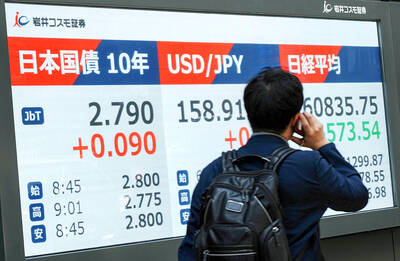
ROUGH RECORDS: Bonds in Japan, as well is in New Zealand, Australia and the US, are seeing the effects of a nervy market as stock exchanges across Asia edge down A deepening slump in Japanese government bonds added fuel to the selloff in global debt markets as rising oil prices stoked inflation fears and pushed yields to multi-decade highs. Japan’s 30-year yield yesterday surged as much as 20 basis points to the highest level since the tenor’s debut in 1999, before paring some of the move. Shorter-maturity Japanese debt was also under pressure, underscored by weak demand at a sale of five-year notes that offered a record-high coupon of 2 percent. Concerns over inflation and government spending rippling through markets including the US, Australia and New Zealand are being amplified in Japan,


 RSS
RSS