


The nation’s industrial output contracted by 5.32 percent last month from a year earlier, virtually unchanged from a revised 5.75 percent decline in August, as inventory digestion dragged on for all makers except chemical product suppliers, the Ministry of Economic Affairs said yesterday.
“The data show the industry has yet to emerge from a protracted inventory adjustment, which has extended into the current quarter,” Department of Statistics Deputy Director-General Yang Kuei-hsien (楊貴顯) told a media briefing.
The situation might improve with the advent of Christmas sales season in the West, but could remain soft compared with levels a year earlier, Yang said.
The government’s industrial production gauge measures output in five major industries — manufacturing, mining and quarrying, electricity and gas supply, water supply, and architectural engineering — and is expressed as a percentage of real output in the base year of 2011 with a score of 100.
The latest production gauge showed that output from the manufacturing sector — which accounts for more than 90 percent of industrial output — dropped 5.6 percent last month from a year earlier.
A closer look at the various sectors within the manufacturing industry show that output from the electronics sector dropped 7.46 percent last month from a year earlier, with semiconductor makers posting a 7.68 percent decline and flat-panel and critical components suppliers printing an 18.81 percent fall, the report showed.
Electronics firms weighed 31.68 percent of total manufacturing output as the nation is home to the world’s leading contract chipmakers, display vendors and camera lens vendors.
Solar battery suppliers proved to be the exception with production jumping 24.64 percent last month from a year earlier, thanks to demand from China, the report said.
During the July-to-September period, industrial production weakened 4.56 percent from a year earlier, while output from the manufacturing sector dropped 4.65 percent annually, the report showed, boding ill for third-quarter GDP figures that are to be announced on Friday next week.
For the first nine months, industrial production shrank by a mild 0.19 percent from a year earlier, while the manufacturing sector’s output managed 0.13 percent gain year-on-year, the report said.
An outlook survey printed 45.1 percent for this month, suggesting a continued inventory adjustment event though the output value might grow modestly, Yang said.
In particular, car and auto-parts makers are upbeat about business prospects after emerging from the lunar Ghost Month and typhoons that dented production by 4.41 percent last month and by 5.7 percent last quarter, Yang said.
Revenues from non-manufacturing sectors — including wholesale, retailers and restaurant operators — dropped 4.5 percent year-on-year to NT$1.19 trillion (US$36.60 billion) last month, a separate report showed.
Wholesale revenue amounted to NT$833.9 billion last month, dropping 5.3 percent from a year earlier, weighed by lower demand for building materials, memory chips, flat panels and steel products, the report said.
Retail sales registered a 3 percent annual decline to NT$321 billion, attributable to lackluster car and fuel purchases, the report added.
Dining expenditure gained 1.5 percent year-on-year to NT$33.2 billion last month, slowing from pickups of 2.3 percent and 2.9 percent in August and July, the report said.
The ministry said its survey among local retailers and restaurant operators showed that they expect business to strengthen this month, but wholesale companies have adopted a conservative view.
The ongoing anniversary promotions among department stores might spur demand in line with the high season, Yang said.
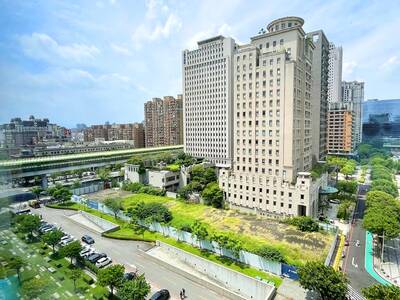
Taichung reported the steepest fall in completed home prices among the six special municipalities in the first quarter of this year, data compiled by Taiwan Realty Co (台灣房屋) showed yesterday. From January through last month, the average transaction price for completed homes in Taichung fell 8 percent from a year earlier to NT$299,000 (US$9,483) per ping (3.3m²), said Taiwan Realty, which compiled the data based on the government’s price registration platform. The decline could be attributed to many home buyers choosing relatively affordable used homes to live in themselves, instead of newly built homes in the city’s prime property market, Taiwan Realty
The government yesterday approved applications by Alphabet Inc’s Google to invest NT$27.08 billion (US$859.98 million) in Taiwan, the Ministry of Economic Affairs said in a statement. The Department of Investment Review approved two investments proposed by Google, with much of the funds to be used for data processing and electronic information supply services, as well as inventory procurement businesses in the semiconductor field, the ministry said. It marks the second consecutive year that Google has applied to increase its investment in Taiwan. Google plans to infuse NT$25.34 billion into Charter Investments Ltd (特許投資顧問) through its Singapore-based subsidiary Fructan Holdings Singapore Pte Ltd, and

JET JUICE: The war on Iran’s secondary effects have seen fuel prices skyrocket, knocking flight schedules down to earth in return as airlines struggle with costs Airline passengers should brace for more irritation in the next few months as carriers worldwide cancel flights and ground planes to cope with stratospheric increases in jet-fuel prices. Dutch flag carrier KLM is the latest company to cut its schedule, saying on Thursday that it would scrap 80 return flights at Amsterdam’s Schiphol Airport in the coming month. That puts it in the same league as United Airlines Holdings Inc, Deutsche Lufthansa AG and Cathay Pacific Airways Ltd, which have all pruned itineraries to mitigate costs. Global capacity for next month has been reduced by about 3 percentage points, with all

The US said it plans to help build a first-of-its-kind industrial hub in the Philippines to boost production of inputs crucial to US supply chains. The 4,000-acre hub is intended to be “a purpose-built platform for allied manufacturing” and “an investment acceleration hub where the specific industrial activities are shaped by market demand,” the US Department of State said on Thursday. The project — touted as an “economic security zone” — would be within the Luzon Economic Corridor, a flagship economic project backed by the US and Japan on the main Philippine island. The project was also described as “the first artificial intelligence


 RSS
RSS