


The nation’s commercial property market might continue to stall unless financial regulators agree to lower yield requirements for life insurance companies, analysts said yesterday after two top-tier office buildings this week failed to secure any buyers.
The Financial Supervisory Commission’s Insurance Bureau said it would review the restriction by the end of the year after Taiwan Insurance Institute (保發中心) wraps up a study on the issue.
“The yield requirement should have an inverse relationship with investment risks and a 2.5 percent minimum is more reasonable,” from the current 2.805 percent, in regulating property investments by domestic life insurance companies, said Tony Chao (趙正義), managing director of international property consultancy Jones Lang LaSalle’s Taiwan office.
The threshold accounted for the failed auctions of two office buildings in Taipei’s Xinyi District (信義), although both guarantee long-term stable rental incomes, Chao said, referring to the Shinkong Manhattan World Trade Building auction on Thursday last week and Shin Kong Mitsukoshi Department Store (新光三越百貨) A8 building auction on Tuesday.
Shin Kong Life Insurance Co (新光人壽), owner of the two buildings, aims to divest the assets to make up for losses from equity investments, company executives said earlier.
Yield requirements stand at about 2.1 percent and 2.2 percent for prime-location properties in Hong Kong and Singapore, but rise to 3 percent in Tokyo and 4 percent in Beijing and Shanghai, Chao said.
However, properties in Taiwan carry permanent ownership, making them safer investments, compared with leasehold rights for properties in Singapore and China, he said.
Market observers said the asking prices of the two buildings were reasonable at NT$9 billion (US$276.43 million) and NT$28 billion respectively, given their central location and the sharp inflation of liquidity worldwide following the global financial crisis in 2008.
Shin Kong Life is willing to concede a little bit, but will not cut prices drastically to meet the yield requirement, Chao said.
Though swamped with cash totaling about NT$4 trillion, local insurance companies have not acquired a full office building for the past three years, he said.
“Sitting on excessive idle cash is not favorable for insurance companies or their policyholders,” Chao said by telephone.
Michael Wang (王維宏), an account manager at Global Asset Management Co (全球資產), an asset management unit of Sinyi Realty Inc (信義房屋), agreed that the yield requirement is having a chilling effect on the market.
That CTBC Bank (中信銀行), the main subsidiary of CTBC Financial Holding Co (中信金控), postponed the auction of its old headquarters building in the same district, after lowering the floor price by NT$5 billion to NT$15.2 billion, is likely due to concerns over a failed auction, Wang said.
Insurance Bureau Deputy Director-General Shih Chiung-hwa (施瓊華) said that the blame for the failed auctions should not be solely pinned on the yield requirement.
Rather, the sluggish market might have more to do with soaring property prices and the economic slowdown, she said.
“The bureau will review the restriction later this year and adjustments are pending the result of a study by the insurance institute,” Shih said by telephone.
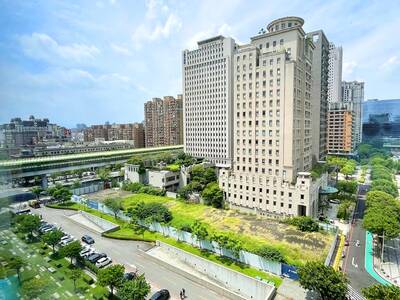
Taichung reported the steepest fall in completed home prices among the six special municipalities in the first quarter of this year, data compiled by Taiwan Realty Co (台灣房屋) showed yesterday. From January through last month, the average transaction price for completed homes in Taichung fell 8 percent from a year earlier to NT$299,000 (US$9,483) per ping (3.3m²), said Taiwan Realty, which compiled the data based on the government’s price registration platform. The decline could be attributed to many home buyers choosing relatively affordable used homes to live in themselves, instead of newly built homes in the city’s prime property market, Taiwan Realty
The government yesterday approved applications by Alphabet Inc’s Google to invest NT$27.08 billion (US$859.98 million) in Taiwan, the Ministry of Economic Affairs said in a statement. The Department of Investment Review approved two investments proposed by Google, with much of the funds to be used for data processing and electronic information supply services, as well as inventory procurement businesses in the semiconductor field, the ministry said. It marks the second consecutive year that Google has applied to increase its investment in Taiwan. Google plans to infuse NT$25.34 billion into Charter Investments Ltd (特許投資顧問) through its Singapore-based subsidiary Fructan Holdings Singapore Pte Ltd, and

JET JUICE: The war on Iran’s secondary effects have seen fuel prices skyrocket, knocking flight schedules down to earth in return as airlines struggle with costs Airline passengers should brace for more irritation in the next few months as carriers worldwide cancel flights and ground planes to cope with stratospheric increases in jet-fuel prices. Dutch flag carrier KLM is the latest company to cut its schedule, saying on Thursday that it would scrap 80 return flights at Amsterdam’s Schiphol Airport in the coming month. That puts it in the same league as United Airlines Holdings Inc, Deutsche Lufthansa AG and Cathay Pacific Airways Ltd, which have all pruned itineraries to mitigate costs. Global capacity for next month has been reduced by about 3 percentage points, with all
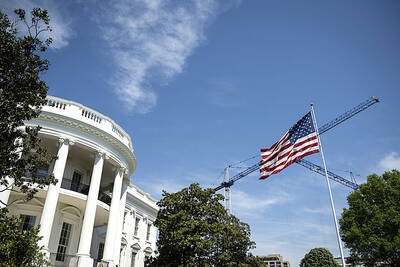
The US said it plans to help build a first-of-its-kind industrial hub in the Philippines to boost production of inputs crucial to US supply chains. The 4,000-acre hub is intended to be “a purpose-built platform for allied manufacturing” and “an investment acceleration hub where the specific industrial activities are shaped by market demand,” the US Department of State said on Thursday. The project — touted as an “economic security zone” — would be within the Luzon Economic Corridor, a flagship economic project backed by the US and Japan on the main Philippine island. The project was also described as “the first artificial intelligence


 RSS
RSS