


FIH Regent Group (FIH, 晶華國際酒店集團), which runs the Formosa Regent Taipei (晶華酒店), expects food and beverage revenue to stay flat this year from last year due to an economic slowdown and a NT$100 million (US$3.08 million) renovation of a popular buffet restaurant, senior executives said yesterday.
The five-star hotel on Taipei’s Zhongshan E Road houses eight restaurants and a dozen banquet facilities to meet the needs of wedding receptions and other functions.
“We expect food and beverage revenue this year to be about the same as last year’s figure of NT$2.3 billion” having spent two months renovating the buffet restaurant, FIH food and beverage general manager Simon Wu (吳偉正) told a media briefing.
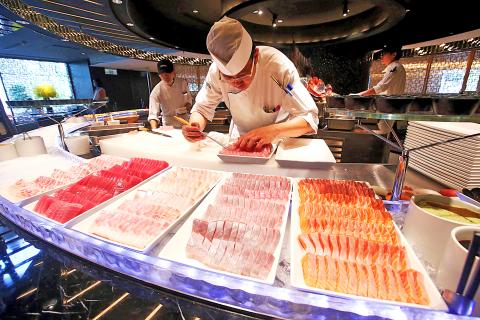
Photo: CNA
FIH, the nation’s top hospitality service provider, last year saw a 6 percent increase in food and beverage sales, and aims to achieve a 10 percent growth next year, with the addition of independent steakhouse Just Grill and an upcoming beef noodle restaurant in the city’s Xinyi District (信義) next month, Wu said during an event to commence the reopening of its buffet restaurant “Brasserie.”
Dubbed Taipei’s hottest all-you-can-eat restaurant, Brasserie generates about NT$370 million in revenue per year and is seeking to raise that total to NT$400 million next year, following cuisine refinements and a modest price increase, Wu said.
Brasserie is on the first floor of the hotel and can seat 318 diners.
The restaurant now charges an extra NT$100 for dinner, totaling NT$1,190 per head on weekdays, and NT$1,290 per head on weekends and holidays. Breakfast remains unchanged at NT$690 per head seven days a week.
The adjustments translate into a price increase of between 8.4 percent and 9 percent respectively for dinner, but prices remain competitive in light of rivals in Xinyi charging NT$1,500 per head.
“Brasserie intends to maintain its leading position with offers on signature dishes at all Regent restaurants, such as spicy tofu from Silks House (晶華軒), Thai style seafood salad from Spice Market (泰市場), roast beef from Just Grill and more,” Wu said.
An economic slowdown has weakened dining interest, but FIH is seeking to offset the impact with a series of promotional campaigns, Wu said.
FIH chairman Steven Pan (潘思亮) said the economy remains healthy, but a lack of confidence on the part of the government, companies and consumers contribute to a slowdown.
Pan called for increased liberalization in education policies and deregulation on imports of foreign professionals.
Hospitality staff in Singapore, the Philippines and other major cities across Asia possess English proficiency, Pan said.
FIH posted NT$503.45 million in revenue last month, down 6.35 percent from the same period last year, attributable to the cost of Brasserie’s renovation, the company said in a filing with the stock exchange.
Cumulative earnings totaled NT$4.92 billion for the first nine months, a 7.5 percent increase from a year earlier, the filing showed.
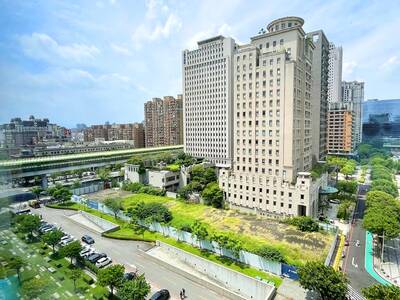
Taichung reported the steepest fall in completed home prices among the six special municipalities in the first quarter of this year, data compiled by Taiwan Realty Co (台灣房屋) showed yesterday. From January through last month, the average transaction price for completed homes in Taichung fell 8 percent from a year earlier to NT$299,000 (US$9,483) per ping (3.3m²), said Taiwan Realty, which compiled the data based on the government’s price registration platform. The decline could be attributed to many home buyers choosing relatively affordable used homes to live in themselves, instead of newly built homes in the city’s prime property market, Taiwan Realty
The government yesterday approved applications by Alphabet Inc’s Google to invest NT$27.08 billion (US$859.98 million) in Taiwan, the Ministry of Economic Affairs said in a statement. The Department of Investment Review approved two investments proposed by Google, with much of the funds to be used for data processing and electronic information supply services, as well as inventory procurement businesses in the semiconductor field, the ministry said. It marks the second consecutive year that Google has applied to increase its investment in Taiwan. Google plans to infuse NT$25.34 billion into Charter Investments Ltd (特許投資顧問) through its Singapore-based subsidiary Fructan Holdings Singapore Pte Ltd, and
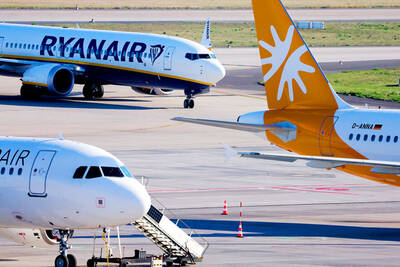
JET JUICE: The war on Iran’s secondary effects have seen fuel prices skyrocket, knocking flight schedules down to earth in return as airlines struggle with costs Airline passengers should brace for more irritation in the next few months as carriers worldwide cancel flights and ground planes to cope with stratospheric increases in jet-fuel prices. Dutch flag carrier KLM is the latest company to cut its schedule, saying on Thursday that it would scrap 80 return flights at Amsterdam’s Schiphol Airport in the coming month. That puts it in the same league as United Airlines Holdings Inc, Deutsche Lufthansa AG and Cathay Pacific Airways Ltd, which have all pruned itineraries to mitigate costs. Global capacity for next month has been reduced by about 3 percentage points, with all

The US said it plans to help build a first-of-its-kind industrial hub in the Philippines to boost production of inputs crucial to US supply chains. The 4,000-acre hub is intended to be “a purpose-built platform for allied manufacturing” and “an investment acceleration hub where the specific industrial activities are shaped by market demand,” the US Department of State said on Thursday. The project — touted as an “economic security zone” — would be within the Luzon Economic Corridor, a flagship economic project backed by the US and Japan on the main Philippine island. The project was also described as “the first artificial intelligence


 RSS
RSS