


Taiwan Semiconductor Manufacturing Co (TSMC, 台積電), which supplies chips for Apple Inc’s iPhone 6S smartphones, yesterday slashed this year’s capital spending by 27 percent, after weak demand for smartphone chips drove down quarterly net profits to their lowest in five quarters.
TSMC plans to spend US$8 billion on new equipment and facilities this year, rather than allocating a capital budget of between US$10.5 billion and US$11 billion as it estimated in June. This year’s spending is the lowest since 2011.
Earlier this week, Intel Corp cut its capital spending for the fourth time to US$7.3 billion amid a slowing market demand.
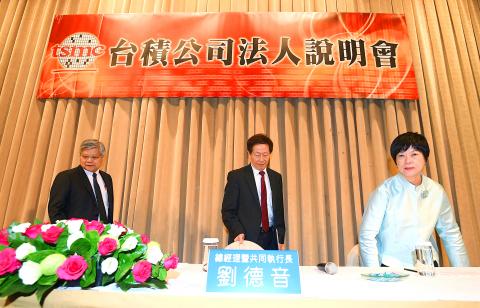
Photo: Chang Chia-ming, Taipei Times
“This year, due to weaker global economy, a stronger US dollar and volatile financial markets, consumer electronics market has been negatively effected. This results in a lack of growth in the overall semiconductor market,” TSMC co-chief executive Mark Liu (劉德音) said.
Liu cut his growth forecast for the world’s semiconductor industry to zero this year, from an annual growth of 3 percent that he estimated in June. He attributed the flat performance to customers’ adjusting their inventories amid sluggish demand for smartphone chips.
Chip designers are expected to see their revenues drop by 5 percent annually this year, Liu said.
However, TSMC will grow its revenue by about 10 percent this year from last year’s NT$762.81 billion (US$23.5 billion), partly because of strong US dollar against the New Taiwan dollar, Liu said.
Liu said he expected customers to reduce their inventories to a normal level at the end of this quarter.
TSMC chief financial executive Lora Ho (何麗梅) said the capital reduction reflects the company’s improving operational efficiency and favorable foreign exchange rate, rather than losses in orders or market share.
The company expects a higher capital budget next year as it is to ramp up its advanced 10-nanometer chip production in the fourth quarter of next year as scheduled.
“TSMC’s capital reduction indicates the company has better operational efficiency as its depreciation costs will only increase 11 percent annually,” said an analyst from an European brokerage firm, who declined to be named.
The analyst said TSMC might continue to outperform its peers even during the current slowdown and the company has a good chance to extend its partnership with Apple next year.
TSMC said revenue this quarter is expected to shrink moderately, by between 4 percent and 5.42 percent, from last quarter to a range from NT$201 billion to NT$204 billion. A significant ramp up of its 16-nanometer chips this quarter will partly offset slowing demand, the chipmaker said.
Gross margin is expected be between 47.5 percent and 49.5 percent this quarter, from 48.2 percent last quarter, it said.
Last quarter, net profit fell 5.1 percent to NT$76.33 billion from NT$79.42 billion in the previous quarter. Last quarter’s figure included a loss of NT$2.8 billion from the company’s solar business.
Commenting on potential investments in China, Ho said the company is cautiously evaluating the possibilities. The company is in no rush to build another factory there in the short term, Ho said.
Shares of contract chipmaker Taiwan Semiconductor Manufacturing Co (TSMC, 台積電) came under pressure yesterday after a report that Apple Inc is looking to shift some orders from the Taiwanese company to Intel Corp. TSMC shares fell NT$55, or 2.4 percent, to close at NT$2,235 on the local main board, Taiwan Stock Exchange data showed. Despite the losses, TSMC is expected to continue to benefit from sound fundamentals, as it maintains a lead over its peers in high-end process development, analysts said. “The selling was a knee-jerk reaction to an Intel-Apple report over the weekend,” Mega International Investment Services Corp (兆豐國際投顧) analyst Alex Huang
Taiwan Semiconductor Manufacturing Co (TSMC, 台積電) is expected to remain Apple Inc’s primary chip manufacturing partner despite reports that Apple could shift some orders to Intel Corp, industry experts said yesterday. The comments came after The Wall Street Journal reported on Friday that Apple and Intel had reached a preliminary agreement following more than a year of negotiations for Intel to manufacture some chips for Apple devices. Taiwan Institute of Economic Research (台灣經濟研究院) economist Arisa Liu (劉佩真) said TSMC’s advanced packaging technologies, including integrated fan-out and chip-on-wafer-on-substrate, remain critical to the performance of Apple’s A-series and M-series chips. She said Intel and Samsung
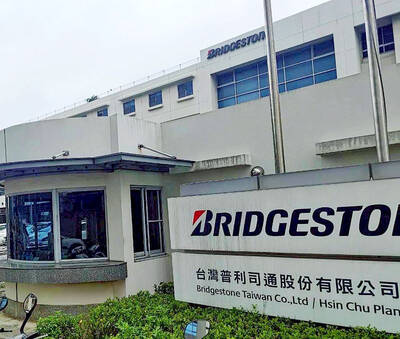
TRANSITION: With the closure, the company would reorganize its Taiwanese unit to a sales and service-focused model, Bridgestone said Bridgestone Corp yesterday announced it would cease manufacturing operations at its tire plant in Hsinchu County’s Hukou Township (湖口), affecting more than 500 workers. Bridgestone Taiwan Co (台灣普利司通) said in a statement that the decision was based on the Tokyo-based tire maker’s adjustments to its global operational strategy and long-term market development considerations. The Taiwanese unit would be reorganized as part of the closure, effective yesterday, and all related production activities would be concluded, the statement said. Under the plan, Bridgestone would continue to deepen its presence in the Taiwanese market, while transitioning to a sales and service-focused business model, it added. The Hsinchu
Taiwan Semiconductor Manufacturing Co (TSMC, 台積電) has approved a capital budget of US$31.28 billion for production expansion to meet long-term development needs during the artificial intelligence (AI) boom. The company’s board meeting yesterday approved the capital appropriation plan for purposes such as the installation of advanced technology capacity and fab construction, the world’s largest contract chipmaker said in a statement. At an earnings conference last month, TSMC forecast that its capital expenditure for this year would be at the higher end of the US$52 billion to US$56 billion range it forecast in January in response to robust demand for 5G, AI and


 RSS
RSS