


A joint venture controlled by Hong Kong billionaire Li Ka-shing (李嘉誠) agreed to buy the Portuguese wind-farm developer Iberwind Group in a deal worth as much as 288 million euros (US$324 million), the purchasers said on Friday in a regulatory filing.
Li’s Power Assets Holdings Ltd (電能實業) and his Cheung Kong Infrastructure Holdings Ltd (長江基建) each own half of the venture, according to a filing with the Hong Kong Stock Exchange.
Iberwind is owned by venture capital firm Magnum Capital Industrial Partners, which is based in Spain and Portugal.
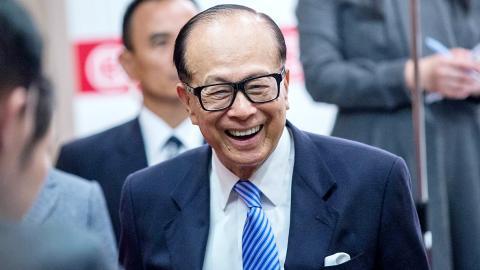
Photo: Bloomberg
The deal is subject to regulatory approvals.
Each of the partners will pay a “maximum commitment” of 144 million euros, according to the filing.
Iberwind produces about 684 megawatts of power from 31 wind farms, representing about 15 percent of the Portuguese wind market by installed capacity, Power Assets Holdings said.
The acquisition allows Li’s venture to “expand its existing renewable energy platform globally, and is consistent with the group’s strategy of investing in power infrastructure opportunities around the world,” the companies said in the filing.
Meanwhile, Britain’s antitrust regulator triggered a possible tug-of-war with the EU over who should probe CK Hutchison Holdings Ltd’s (長和集團) plan to acquire Telefonica SA’s O2 unit in the UK.
The UK’s Competition and Markets Authority (CMA) on Friday said that it asked the European Commission for jurisdiction over the review because the deal’s impact would be most felt by UK customers.
The commission in Brussels has already started to examine the tie-up and set an Oct. 16 deadline for an initial decision.
Li’s CK Hutchison Holdings agreed to acquire the O2 unit in March, creating Britain’s biggest wireless provider by customers.
The CMA said it has received support from the telecom industry in making the request, according to the statement.
Given the clear links with a separate deal it is probing between BT Group PLC and EE Ltd, “it would be more efficient to also examine the merger between Three and O2, in particular to avoid duplication and fragmentation,” the CMA said.
The commission generally rejects such requests, as it develops ground rules for mobile-phone competition.
EU regulators spurned a similar UK bid for jurisdiction over the deal that created EE five years ago.
“We have had open and constructive discussions with both the European Commission and the relevant authorities in the UK over several months,” CK Hutchison Holdings said in a statement.
“We remain confident that the proposed acquisition will be cleared,” it added.
The commission said by e-mail that it “has received the referral request and will assess it.”

The domestic unit of the Chinese-owned, Dutch-headquartered chipmaker Nexperia BV will soon be able to produce semiconductors locally within China, according to two company sources. Nexperia is at the center of a global tug-of-war over critical semiconductor technology, with a Dutch court in February ordering a probe into alleged mismanagement at the company. The geopolitical tussle has disrupted supply chains, with some carmakers reportedly forced to cut production due to chip shortages. Local production would allow Nexperia’s domestic arm, Nexperia Semiconductors (China) Ltd (安世半導體中國), to bypass restrictions in place since October on the supply of silicon wafers — etched with tiny components to

Singapore-based ride-hailing and delivery giant Grab Holdings Ltd has applied for regulatory approval to acquire the Taiwan operations of Germany-based Delivery Hero SE's Foodpanda in a deal valued at about US$600 million. Grab submitted the filing to the Fair Trade Commission on Friday last week, with the transaction subject to regulatory review and approval, the company said in a statement yesterday. Its independent governance structure would help foster a healthy and competitive market in Taiwan if the deal is approved, Grab said. Grab, which is listed on the NASDAQ, said in the filing that US-based Uber Technologies Inc holds about 13 percent of

Taiwan is open to joining a global liquefied natural gas (LNG) program if one is created, but on the condition that countries provide delivery even in a scenario where there is a conflict with China, an energy department official said yesterday. While Taiwan’s priority is to have enough LNG at home, the nation is open to exploring potential strategic reserves in other countries such as Japan or South Korea, Energy Administration Deputy Director-General Chen Chung-hsien (陳崇憲) said. While the LNG market does not have a global reserve for emergencies like that of oil, the concept has been raised a few times —

Taiwan Semiconductor Manufacturing Co (TSMC, 台積電) yesterday received government approval to deploy its advanced 3-nanometer (3nm) process at its second fab currently under construction in Japan, the Ministry of Economic Affairs said in a news release. The ministry green-lit the plan for the facility in Kumamoto, which is scheduled to start installing equipment and come online in 2028 with a monthly production capacity of 15,000 12-inch wafers, the ministry said. The Department of Investment Review in June 2024 authorized a US$5.26 billion investment for the facility, slated to manufacture 6- to 12nm chips, significantly less advanced than 3nm process. At a meeting with


 RSS
RSS