

Aerospace Industrial Development Corp (AIDC, 漢翔航空工業), the nation’s largest civilian and military aircraft manufacturer, yesterday demonstrated two new prototype trainer jets at a Taipei aerospace trade fair in a move to show its resolve in vying for the Republic of China Air Force’s NT$69 billion (US$2.1 billion) project to upgrade its aging fleet of 66 trainer aircraft.
The two new advanced trainer jets — the XAT-5, a stripped-down variant of the F-CK1, and the AT-3MAX, an upgraded variant of the aging AT-3 featuring revamped radar systems and an improved engine — were on display at the biennial Taipei Aerospace and Defense Technology Exhibition, which began yesterday.
In response to rumors that the armed forces might be favoring the Italian-built M-346 trainer, AIDC chairman Anson Liao (廖榮鑫) said President Ma Ying-jeou (馬英九) had pledged that even if the procurement deal fell to a foreign bidder, the aircraft would still be built in Taiwan.
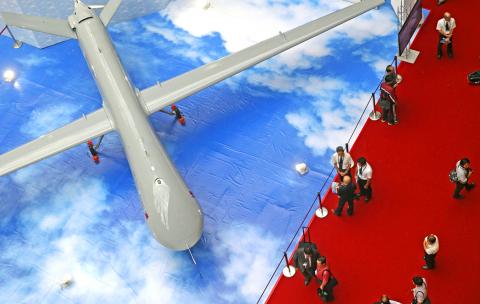
Photo: AP
AIDC is also facing competition from the South Korean-built T-50.
“Given AIDC’s track record of building and designing the indigenously developed F-CK1s and AT-3 trainer jets, the company is the ideal choice to build the nation’s next generation of trainer aircraft,” said Liao, a former air force pilot.
The deal is crucial for AIDC, as it is expected to yield revenue of NT$200 billion for parts and maintenance over their service life spanning the next two decades, Liao said.
However, with delivery of the jets to begin in 2019, the armed forces has not indicated a clear timetable for AIDC, Liao said.
“Uncertainties remains in the Ministry of National Defense’s final decision on combat specifications and budget, but AIDC is fully capable of overcoming all technical challenges,” he said.
AIDC is pushing for at least 50 percent domestic production for the next-generation aircraft, although it is difficult to gauge what the air force’s decision will be regarding the training aircraft, Liao said.
“If the goal is to train our pilots for the Lockheed Martin F-35, a certain type of trainer jet would be required, while other fighters require different training aircraft,” he said.
Seperately, Yuanta Securities Investment Consulting Co (元大投顧) said AIDC would not be affected by Lockheed Martin’s acquisition of Sikorsky, a major client of the Taiwanese firm with a 6 percent revenue contribution last year.
“In addition, the company has broken into the supply chain for the China-built C919, making company immune to competition between the Airbus A320 and the Boeing B737 short-to-medium range narrow-body airliner,” Yuanta analyst Livia Wu (吳靚芙) said in a report on Wednesday, adding that she is positive over AIDC’s commercial aircraft and general aviation businesses.
Last quarter, AIDC recorded net income of NT$444.6 million, or NT$0.49 per share, on sales of NT$6.9 billion. Net income in the first half came to NT$868 million, or NT$0.95 per share, on sales of NT$12.8 billion.
AIDC shares gained 0.27 percent to close at NT$37.65 in Taipei trading yesterday.
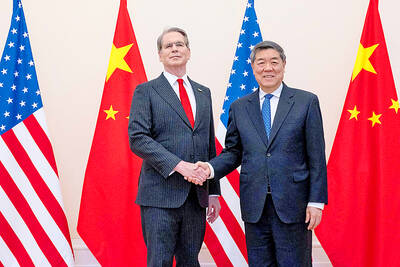
MINIMAL EXPECTATIONS: Analysts think that the two sides are likely to aim for ‘status quo’-level agreements, maintaining civility, without major trade breakthroughs US Secretary of the Treasury Scott Bessent and Chinese Vice Premier He Lifeng (何立峰) were set to meet yesterday to try to set up potential agreements on artificial intelligence (AI), tariffs and critical minerals for a summit in Washington this week between US President Donald Trump and Chinese President Xi Jinping (習近平). The meetings at JPMorgan Chase & Co’s headquarters in Manhattan, which included US Trade Representative Jamieson Greer, were due to start at about 10:30am on Sunday morning and were expected to run all day. Key topics would be the status of a US-China trade truce that is set to expire
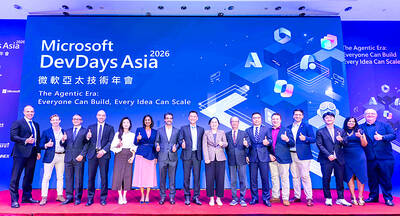
MORE DATA CENTERS: Microsoft’s Taiwan-area general manager said the corporation is looking to add two more data centers in northern Taiwan over the next few years Microsoft Corp plans to double its data centers in Taiwan from two facilities to four, Microsoft Taiwan general manager Sean Pien (卞志祥) said yesterday. “Over the past two to three years, we have consistently seen demand outstrip supply, and we expect that situation to continue over the next two to three years,” Pien said on the sidelines of a news conference in Taipei. The data center sites would mainly be in northern Taiwan to meet customer demand and reduce the risk of operational disruptions caused by a single event, he said, without saying their exact locations. Microsoft enabled the first phase of
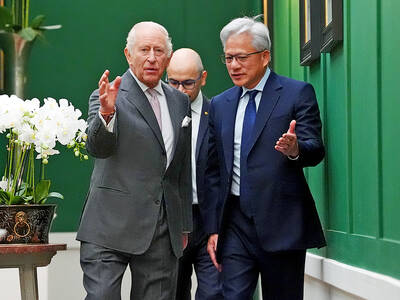
SAFEGUARDING AI: Nvidia CEO Jensen Huang maintained a bullish stance despite concerns about artificial intelligence safety and growing calls for an industry slowdown Nvidia Corp chief executive officer Jensen Huang (黃仁勳) expects to sell twice as many chips in the coming year, fueled by the spread of artificial intelligence (AI) across different industries. AI is of great benefit to a variety of sectors, Huang told reporters on the sidelines of an event convened by King Charles III in Scotland on Thursday. Nvidia is the top seller of AI accelerators, chips used to develop and run AI models. Huang is maintaining his bullish stance at a time when concerns are growing about AI. Industry leaders have discussed slowing down development of the technology over fears that
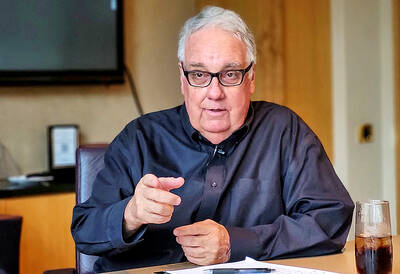
Berkshire Hathaway Inc has been synonymous with Warren Buffett. It falls to his oldest son, Howard Buffett, to keep the conglomerate’s “culture” alive. Friday’s announcement that Warren Buffett, 96, stepped down as chairman means the longtime investor would no longer have a management role at the company he took over in 1965, or be a regular sounding board for Greg Abel, who succeeded him as chief executive officer in January. Howard Buffett, 71, is assuming a different role as non-executive chairman, focused on preserving Berkshire’s culture and values. It is the latest move in a years-long leadership transition. “This one is really about


 RSS
RSS