


The consumer price index (CPI) declined 0.66 percent last month from the same period the previous year as cheaper fuel costs depressed the inflationary gauge, the Directorate-General of Budget, Accounting and Statistics (DGBAS) said yesterday.
The absence of inflationary pressure gave the central bank room to extend its loose stance on monetary policy and weaken the local currency to shore up exports and the economy as a whole, economists said.
“The CPI lost 0.66 percent last month because energy and communications cost reductions more than erased food price increases,” DGBAS Deputy Director Tsai Yu-tai (蔡鈺泰) said at a press conference.
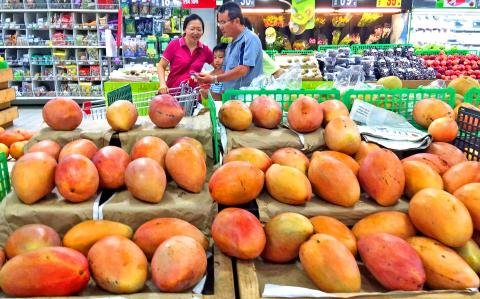
Photo: CNA
Overall, transportation and communications costs contracted 5.95 percent year-on-year last month, subdued mainly by a 24.74 percent fall in fuel prices, the DGBAS said in a report.
It was the eighth consecutive month that fuel prices dropped by more than 20 percent and that subtracted 0.92 percentage points from the CPI, the report said, adding that the reading would have registered a 0.26 percent increase if the oil price distortions were stripped out.
Household living costs shed 0.76 percent due to lower gas and electricity prices, the report said.
However, food prices gained 1.77 percent on the back of higher vegetable, meat and dining costs, though cheaper eggs and fruit eased the pickup, it said.
The CPI slid into negative territory after a seasonal adjustment with a 0.78 percent decline last month, compared with a 0.17 percent gain in June.
For the first seven months of the year, the index contracted 0.65 percent from the previous year as international crude oil prices continued to weaken, the report said.
However, Tsai dismissed concerns over deflation, saying that the core CPI remains in the positive zone as a result of healthy consumer activity.
Core CPI, a more reliable inflationary reference because it excludes volatile items, posted a 0.66 percent increase, from a revised 0.59 percent uptick in June, the report said.
The absence of inflationary pressure means the central bank can ease its monetary policy with comfort if necessary, as the global slowdown saps exports and GDP growth, Yuanta-Polaris Research Institute (元大寶華研究院) chairman Liao Kuo-yuan (梁國源) said.
“A weak New Taiwan dollar can surely help raise profit margins for exporters amid tepid demand, as the market has ample liquidity,” Liang said by telephone.
The central bank is likely to maintain its policy rates in the foreseeable future, but the chance of a rate cut is rising given disappointing GDP growth in the second quarter.
The wholesale price index (WPI), a measure of commercial production costs, retreated 9.98 percent, the steepest fall in 71 months, widening from a revised 9.43 percent decline in June, the DGBAS said.
The latest WPI figure stemmed from sustained declines in the prices of crude oil, basic metals and chemical products, the agency’s report said.

The domestic unit of the Chinese-owned, Dutch-headquartered chipmaker Nexperia BV will soon be able to produce semiconductors locally within China, according to two company sources. Nexperia is at the center of a global tug-of-war over critical semiconductor technology, with a Dutch court in February ordering a probe into alleged mismanagement at the company. The geopolitical tussle has disrupted supply chains, with some carmakers reportedly forced to cut production due to chip shortages. Local production would allow Nexperia’s domestic arm, Nexperia Semiconductors (China) Ltd (安世半導體中國), to bypass restrictions in place since October on the supply of silicon wafers — etched with tiny components to

Singapore-based ride-hailing and delivery giant Grab Holdings Ltd has applied for regulatory approval to acquire the Taiwan operations of Germany-based Delivery Hero SE's Foodpanda in a deal valued at about US$600 million. Grab submitted the filing to the Fair Trade Commission on Friday last week, with the transaction subject to regulatory review and approval, the company said in a statement yesterday. Its independent governance structure would help foster a healthy and competitive market in Taiwan if the deal is approved, Grab said. Grab, which is listed on the NASDAQ, said in the filing that US-based Uber Technologies Inc holds about 13 percent of

Taiwan is open to joining a global liquefied natural gas (LNG) program if one is created, but on the condition that countries provide delivery even in a scenario where there is a conflict with China, an energy department official said yesterday. While Taiwan’s priority is to have enough LNG at home, the nation is open to exploring potential strategic reserves in other countries such as Japan or South Korea, Energy Administration Deputy Director-General Chen Chung-hsien (陳崇憲) said. While the LNG market does not have a global reserve for emergencies like that of oil, the concept has been raised a few times —

Taiwan Semiconductor Manufacturing Co (TSMC, 台積電) yesterday received government approval to deploy its advanced 3-nanometer (3nm) process at its second fab currently under construction in Japan, the Ministry of Economic Affairs said in a news release. The ministry green-lit the plan for the facility in Kumamoto, which is scheduled to start installing equipment and come online in 2028 with a monthly production capacity of 15,000 12-inch wafers, the ministry said. The Department of Investment Review in June 2024 authorized a US$5.26 billion investment for the facility, slated to manufacture 6- to 12nm chips, significantly less advanced than 3nm process. At a meeting with


 RSS
RSS