


McDonald’s Corp swears up and down that the little yellow Minions Happy Meal toy is speaking only nonsense words and not something a little more adult.
Experts said the company might be right, and the curse words many hear might be tied to how our brains are primed to find words even when they are not really there.
The world’s largest hamburger chain on Friday said it does not plan to take the talking Happy Meal toy out of distribution, even though some customers said it sounds like it is cursing.
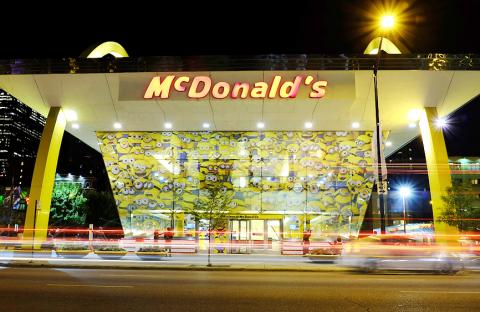
Photo: AP
A toy bought by reporters made a sound that could be interpreted as the phrase often abbreviated as “WTF.” Another phrase sounded like it could be “Well I’ll be damned.”
The sound quality of the toy makes it hard to say definitively who is right.
The little yellow Minion characters speak a nonsense language and McDonald’s Corp said the Minion Caveman toy makes three sounds — “ha ha ha,” “para la bukay” and “eh eh.”
McDonald’s said in a statement that it had received only a few comments from customers about the toy, which was introduced on July 3.
Nonsense speech sometimes sounds a bit like a real language, and experts said human brains are also wired to look for meaning in noise and images. So people sometimes hear words in gibberish — including words they might think are inappropriate.
The technical name for the phenomenon is pareidolia, hearing sounds or seeing images that seem meaningful, but are actually random. It leads people to see shapes in clouds, a man in the moon or the face of Jesus on a grilled cheese sandwich.
The audio form of pareidolia has been causing confusion for years and years. In the 1960s, the FBI investigated The Kingsmen’s version of the song Louie Louie after concerned citizens complained that the lyrics were obscene.
The band denied it, but hardly anybody could figure out the lyrics, including the FBI.
The agency officially declared the words unintelligible.

In Italy’s storied gold-making hubs, jewelers are reworking their designs to trim gold content as they race to blunt the effect of record prices and appeal to shoppers watching their budgets. Gold prices hit a record high on Thursday, surging near US$5,600 an ounce, more than double a year ago as geopolitical concerns and jitters over trade pushed investors toward the safe-haven asset. The rally is putting undue pressure on small artisans as they face mounting demands from customers, including international brands, to produce cheaper items, from signature pieces to wedding rings, according to interviews with four independent jewelers in Italy’s main

Japanese Prime Minister Sanae Takaichi has talked up the benefits of a weaker yen in a campaign speech, adopting a tone at odds with her finance ministry, which has refused to rule out any options to counter excessive foreign exchange volatility. Takaichi later softened her stance, saying she did not have a preference for the yen’s direction. “People say the weak yen is bad right now, but for export industries, it’s a major opportunity,” Takaichi said on Saturday at a rally for Liberal Democratic Party candidate Daishiro Yamagiwa in Kanagawa Prefecture ahead of a snap election on Sunday. “Whether it’s selling food or

CONCERNS: Tech companies investing in AI businesses that purchase their products have raised questions among investors that they are artificially propping up demand Nvidia Corp chief executive officer Jensen Huang (黃仁勳) on Saturday said that the company would be participating in OpenAI’s latest funding round, describing it as potentially “the largest investment we’ve ever made.” “We will invest a great deal of money,” Huang told reporters while visiting Taipei. “I believe in OpenAI. The work that they do is incredible. They’re one of the most consequential companies of our time.” Huang did not say exactly how much Nvidia might contribute, but described the investment as “huge.” “Let Sam announce how much he’s going to raise — it’s for him to decide,” Huang said, referring to OpenAI
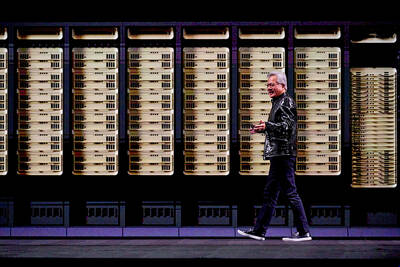
The global server market is expected to grow 12.8 percent annually this year, with artificial intelligence (AI) servers projected to account for 16.5 percent, driven by continued investment in AI infrastructure by major cloud service providers (CSPs), market researcher TrendForce Corp (集邦科技) said yesterday. Global AI server shipments this year are expected to increase 28 percent year-on-year to more than 2.7 million units, driven by sustained demand from CSPs and government sovereign cloud projects, TrendForce analyst Frank Kung (龔明德) told the Taipei Times. Demand for GPU-based AI servers, including Nvidia Corp’s GB and Vera Rubin rack systems, is expected to remain high,


 RSS
RSS