


The Financial Supervisory Commission (FSC) and the Taiwan Stock Exchange yesterday acted to sooth jittery investors, hoping to restore market confidence amid rocky trading this week.
However, the TAIEX still lost another 61.98 points, or 0.69 percent, to close at 8,914.13 points on the main bourse, despite a general rebound in neighboring markets in Japan, South Korea, Hong Kong and Shanghai.
“There is a lack of confidence in the Taiwan market,” Securities and Futures Bureau Deputy Director-general Chang Li-chen (張麗真) said.
Yesterday’s decline came a day after Wednesday’s steep 274.05-point tumble that sent the TAIEX below the 9,000-point mark for the first time this year.
However, the commission on Wednesday said that turnover expanding to NT$141.79 billion (US$45.4 billion) indicated that some investors were still seeking opportunities, unhindered by difficulties with liquidity.
As of Wednesday, the amount of margin calls totaled NT$54 million, while the average maintenance ratio among local investors stood at 156.57 percent, which was well above the 130 percent threshold requirement, the commission said.
In addition, Taiwan’s exposure to potential spill-over effects from recent dramatic declines in Chinese equities is limited, with NT$83.3 billion by Taiwanese brokerage and insurance companies and NT$113.1 billion by local securities investment trusts and consultation firms as of Wednesday, the commisson said.
Taiwanese banks’ Chinese stock exposure was NT$2.8 billion, it added.
“A survey of several fund companies this week revealed no irregularities in investors’ ability to redeem shares from exchange traded funds,” Chang said.
To help support the market, the commission said the government would encourage several listed companies to implement stock repurchase programs.
The suggestion, made during the trading session yesterday, appeared to be an unsual move, after the recent selloff in the local market has led investors to underestimate listed companies’ fundamentals.
According to the commission, between January and May this year, the nation’s listed companies listed on the main bourse and the over-the-counter market recorded combined revenue of NT$11.9 trillion, up 2.12 percent compared to last year. As of Wednesday, 68 companies had filed to repurchase their shares on the open market and the commission said it estimated that about NT$18 billion worth of treasury shares would be repurchased in the next two months.
As stock repurchasing needs to be approved by companies’ board of directors, the decisions by the 68 companies might have been reached by the outcome of Greece’s debt referendum early this week, a TWSE official said by telephone.
Still, the TWSE official said listed companies should hold more earnings conferences to better inform investors about the financial health of companies.


Taiwan’s foreign exchange reserves fell below the US$600 billion mark at the end of last month, with the central bank reporting a total of US$596.89 billion — a decline of US$8.6 billion from February — ending a three-month streak of increases. The central bank attributed the drop to a combination of factors such as outflows by foreign institutional investors, currency fluctuations and its own market interventions. “The large-scale outflows disrupted the balance of supply and demand in the foreign exchange market, prompting the central bank to intervene repeatedly by selling US dollars to stabilize the local currency,” Department of Foreign

Intel Corp is joining Elon Musk’s long-shot effort to develop semiconductors for Tesla Inc, Space Exploration Technologies Corp and xAI, marking a surprising twist in the chipmaker’s comeback bid. Intel would help the Terafab project “refactor” the technology in a chip factory, the company said on Tuesday in a post on X, Musk’s social media platform. That is a stage in the development process that typically helps make chips more powerful or reliable. The chipmaker’s shares jumped 4.2 percent to US$52.91 in New York trading on Tuesday. The Terafab project is a grand plan by Musk to eventually manufacture his own chips for
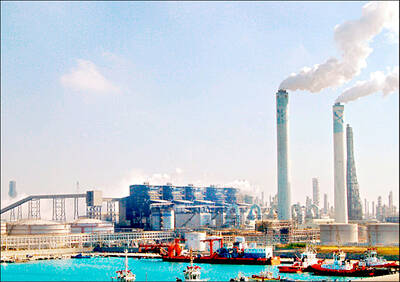
Taiwan Power Co (Taipower, 台電) yesterday said it plans to resume operations at two coal-fired power generators for three months to boost security of electricity supply as liquefied natural gas (LNG) supply risks are running high due to the Middle East conflict. The two coal-fired power generators are at Mailiao Power Plant in Yunlin County’s Mailiao Township (麥寮). The plant, operated by Formosa Plastics Group (台塑集團), supplied electricity to Taipower’s power grid until the end of last year. Taipower’s decision came about one month after Minister of Economic Affairs Kung Ming-hsin (龔明鑫) on March 10 said that the nation had no imminent

Some robotaxi passengers were left stranded in the middle of fast-moving traffic in a major Chinese city after their driverless vehicles stopped running, according to police and media reports on Wednesday. A preliminary investigation indicates more than 100 robotaxis came to a halt because of a “system malfunction,” police in the city of Wuhan said in a statement, without elaborating. No injuries were reported. One passenger told Chinese media that their robotaxi stopped after turning a corner. An instruction on a screen read: “Driving system malfunction. Staff are expected to arrive in 5 minutes.” After no one showed up, the passenger pushed


 RSS
RSS