


Taiwan’s energy operating reserve margin yesterday dropped to a 10-year low of 2.46 percent due to a breakdown of four power generation units, state-run Taiwan Power Co (Taipower, 台電) said.
The operating reserve plunged from an estimated 1.58 million kilowatt-hours (kWh) to only 860,000kWh, prompting speculation about the possibility of a power shortages in the coming days or weeks.
“If the operating reserve drops to below 500,000kWh, or 1.5 percent of the energy operating reserve margin, the government would first apply power-rationing measures on industrial users with large electricity consumption,” Bureau of Energy Director Lee Chun-li (李君禮) told a news conference.
If the energy operating margin drops below 1.5 percent, the government would form an emergency task force, led by Vice Minister of Economic Affairs Shen Jong-chin (沈榮津), to carry out the power rationing, Lee said.
The task force is mulling a cut of between 5 percent and 15 percent of electricity supply for more than 2,700 industrial users, including 600 manufacturers that use more than 5,000kWh of power per month, Lee said.
Taipower contacted the 2,700 industrial users at the end of May, informing them of the possibility of facing electricity rationing between last month and September, he said.
If the nation still faces a power shortage after implementing measures to lower electricity supply to the 2,700 industrial users, the government would broaden the rationing measures to all users, including household users, on a daily rotation basis, he added.
Taipower official Lan Hong-wei (籃宏偉) said three electricity generation units in different power plants — two privately owned power plants and one operated by Taipower — yesterday encountered steam-pipe leaks mainly due to high temperatures.
As the steam pipes are decades old, their conditions are vulnerable to hot weather, he said.
Elsewhere, a voltage transformer in the Taipower-owned Sinda power plant in Kaohsiung broke down yesterday, Lan said.
Fixing the pipe leaks and the failed voltage transformer would take about one week, he said.
However, the nation’s energy operating reserve margin is likely to rise today, as one of the power generation units in the Tongxiao natural gas-fired power plant is to complete an annual examination and resume operations today, Lan added.
In addition to the Taichung Power Plant running at full production capacity, Taipower expects the electricity operating reserve to increase to an estimated 1 million kWh, with the operating reserve margin rising to 3.11 percent, he said.
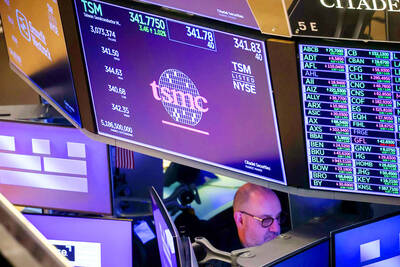
STRONG INTEREST: Analysts have pointed to optimism in TSMC’s growth prospects in the artificial intelligence era as the cause of the rising number of shareholders The number of people holding shares of chipmaker Taiwan Semiconductor Manufacturing Co (TSMC, 台積電) hit a new high last week despite a decline in its stock price, the Taiwan Depository and Clearing Corp (TDCC, 台灣集保) said. The number of TSMC shareholders rose to 2.46 million as of Friday, up 75,536 from a week earlier, TDCC data showed. The stock price fell 1.34 percent during the same week to close at NT$1,840 (US$57.55). The decline in TSMC’s share price resulted from volatility in global tech stocks, driven by rising international crude oil prices as the war against Iran continues. Dealers said
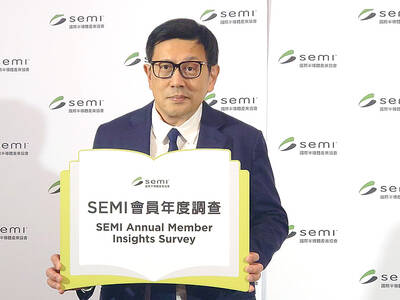
PRICE HIKES: The war in the Middle East would not significantly disrupt supply in the short term, but semiconductor companies are facing price surges for materials Taiwan’s semiconductor companies are not facing imminent supply disruptions of essential chemicals or raw materials due to the war in the Middle East, but surges in material costs loom large, industry association SEMI Taiwan said yesterday. The association’s comments came amid growing concerns that supplies of helium and other key raw materials used in semiconductor production could become a choke point after Qatar shut down its liquefied natural gas (LNG) production and helium output earlier this month due to the conflict. Qatar is the second-largest LNG supplier in the world and accounts for about 33 percent of global helium output. Helium is
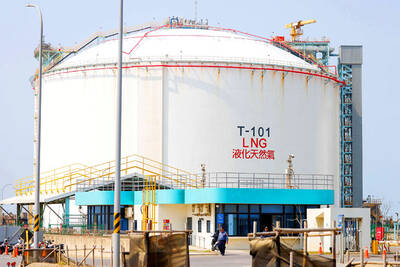
Taiwan’s natural gas supply remains stable through the end of May, despite rising concerns about potential disruptions to Qatari liquefied natural gas (LNG) supplies due to escalating conflicts in the Middle East, the Ministry of Economic Affairs said yesterday. The ministry in a statement said that Taiwan has completed preparations for natural gas supply and shipping schedules through the end of May. It has also made plans to increase natural gas imports from regions outside the Middle East in June to ensure a stable supply, it added. Taiwan sources natural gas from 14 countries and is not solely dependent on the Middle East,

China is clamping down on fertilizer exports to protect its domestic market, industry sources said, putting an additional strain on global markets that were already grappling with shortages caused by the US-Israeli war on Iran. China is among the largest fertilizer exporters — shipping more than US$13 billion of it last year — and it has a history of controlling exports to keep prices low for farmers. Shipments through the war-blocked Strait of Hormuz account for about one-third of the sea-borne supply. This month, Beijing banned exports of nitrogen-potassium fertilizer blends and certain phosphate varieties, sources said. The ban, which has not


 RSS
RSS