


The New Taiwan dollar fell this week as economic data that trailed estimates added to speculation the central bank would step up efforts to weaken the local currency.
Export orders dropped last month by the most in more than two years and industrial production fell for the first time in 16 months.
The NT dollar is the best performing currency in Asia this year, harming the competitiveness of local exporters. The central bank held its policy rate at 1.875 percent on Thursday, resisting joining a wave of global easing to spur growth.
The local currency fell 0.2 percent this week and 0.3 percent on Friday to NT$31.132 against its US counterpart. It has dropped by an average of 0.5 percent in the final hour of trading in the past five days amid suspected central bank intervention.
“Export orders deteriorated, and Taiwan’s dollar has appreciated versus the won and the yen,” Ta Chong Bank (大眾銀行) economist Woods Chen said. “The central bank will be watching the actions of other central banks.”
Diverging monetary policies in advanced nations have led to rapid moves in global funds, affecting the stability of Taiwan’s currency and financial markets, the monetary authority said in a statement on Thursday. Central bank Governor Perng Fai-nan (彭淮南) said that the NT dollar’s nominal effective exchange rate is still lower than that of the won’s. Taiwanese and South Korean exporters compete in international markets.
Across the region, Asian currencies completed a weekly loss, led by the Singapore dollar and the won, amid speculation emerging markets would see volatility in capital flows should Greece default.
The Bloomberg-JPMorgan Asia Dollar Index dropped 0.4 percent from June 19, the biggest decline in three weeks.
The won fell 0.8 percent in the past five days versus the US dollar, its biggest retreat in four weeks. The Singapore dollar lost 1 percent.
Malaysia’s ringgit weakened 0.7 percent in five days and 0.3 percent on Friday to 3.7680 per US dollar, according to data compiled by Bloomberg. The currency has dropped 2.7 percent this month amid speculation the nation is facing its first credit-rating downgrade since 1998.
Fitch Ratings will review Malaysia’s “A-” ranking before the end of the month, Andrew Colquhoun, head of Asia Pacific sovereign ratings, said on Tuesday. The country is “more than 50 percent likely” to be downgraded because of the worsening trade balance and concern about the ability of a state investment company to pay its debts, he said in March.
The yuan was little changed at 6.2090 per US dollar in Shanghai this week, China Foreign Exchange Trade System prices show.
Indonesia’s rupiah gained 0.2 percent this week. India’s rupee weakened 0.1 percent and Thailand’s baht fell 0.4 percent.
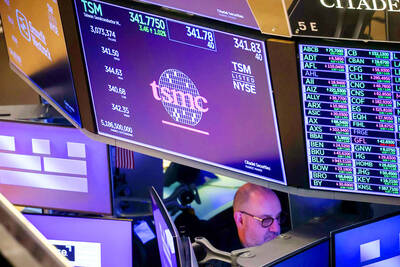
STRONG INTEREST: Analysts have pointed to optimism in TSMC’s growth prospects in the artificial intelligence era as the cause of the rising number of shareholders The number of people holding shares of chipmaker Taiwan Semiconductor Manufacturing Co (TSMC, 台積電) hit a new high last week despite a decline in its stock price, the Taiwan Depository and Clearing Corp (TDCC, 台灣集保) said. The number of TSMC shareholders rose to 2.46 million as of Friday, up 75,536 from a week earlier, TDCC data showed. The stock price fell 1.34 percent during the same week to close at NT$1,840 (US$57.55). The decline in TSMC’s share price resulted from volatility in global tech stocks, driven by rising international crude oil prices as the war against Iran continues. Dealers said
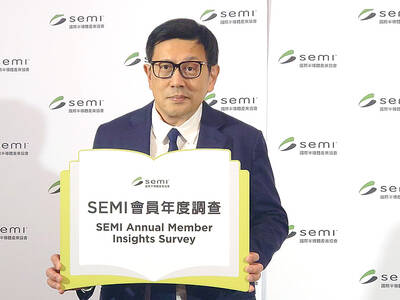
PRICE HIKES: The war in the Middle East would not significantly disrupt supply in the short term, but semiconductor companies are facing price surges for materials Taiwan’s semiconductor companies are not facing imminent supply disruptions of essential chemicals or raw materials due to the war in the Middle East, but surges in material costs loom large, industry association SEMI Taiwan said yesterday. The association’s comments came amid growing concerns that supplies of helium and other key raw materials used in semiconductor production could become a choke point after Qatar shut down its liquefied natural gas (LNG) production and helium output earlier this month due to the conflict. Qatar is the second-largest LNG supplier in the world and accounts for about 33 percent of global helium output. Helium is

China is clamping down on fertilizer exports to protect its domestic market, industry sources said, putting an additional strain on global markets that were already grappling with shortages caused by the US-Israeli war on Iran. China is among the largest fertilizer exporters — shipping more than US$13 billion of it last year — and it has a history of controlling exports to keep prices low for farmers. Shipments through the war-blocked Strait of Hormuz account for about one-third of the sea-borne supply. This month, Beijing banned exports of nitrogen-potassium fertilizer blends and certain phosphate varieties, sources said. The ban, which has not
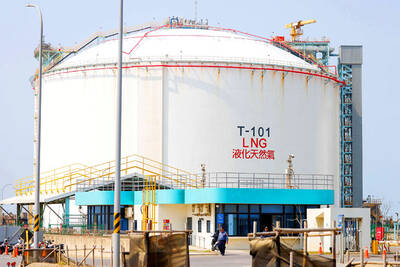
Taiwan’s natural gas supply remains stable through the end of May, despite rising concerns about potential disruptions to Qatari liquefied natural gas (LNG) supplies due to escalating conflicts in the Middle East, the Ministry of Economic Affairs said yesterday. The ministry in a statement said that Taiwan has completed preparations for natural gas supply and shipping schedules through the end of May. It has also made plans to increase natural gas imports from regions outside the Middle East in June to ensure a stable supply, it added. Taiwan sources natural gas from 14 countries and is not solely dependent on the Middle East,


 RSS
RSS