


Storefront prices have soared by double-digit percentages for the past year despite sluggish housing transactions, thanks to record influxes of foreign tourists who have helped boost demand for retail space, analysts said yesterday.
Storefronts in locations popular with Chinese and Japanese tourists have gained at least 10 percent to 20 percent so far this year, which has led builders to hold on to their inventory despite the risk of having to pay higher income taxes on property gains beginning next year, the Chinese-language Housing Monthly said.
“Fast-growing tourist numbers and a limited supply lend support to storefront prices even though they generate moderate rental yields,” Housing Monthly’s research manager Ho Shih-chang (何世昌) said by telephone.
A newly completed storefront on Taipei’s Linsheng N Road has an asking price of NT$2.8 million (US$90,142) per ping (3.3m2), up 12 percent from NT$2.5 million last year for similar locations, Ho said.
Another storefront the Shilin Night Market area, a top tourist attraction, was recently sold for about NT$5 million per ping, Ho said.
Expectations of price hikes have prompted developers and builders to put just 10 percent of their new storefronts on the market to avoid underestimating their properties’ value, Ho said.
As of Monday last week, only six of 73 presale projects offer to sell storefronts, which means supplies are limited and driving up values, Ho said.
On average, storefronts cost 1.95 times the worth of housing units, the magazine said, adding that roadside retail space rates may reach 2.2 times of residential space in prime locations.
“Solid demand is leading building companies to wait for the highest offer for storefronts rather than setting prices on their own,” Ho said.
The low entry barriers required to owning small storefronts have boosted their popularity and market rates, said Taiwan Realty Co (台灣房屋), a major housing broker.
It takes about NT$10 million to buy a small storefront of 3 to 4 ping in downtown Taipei, a relatively affordable amount even for salaried investors, Taiwan realty spokeswoman Charlene Chang (張旭嵐) said.
Small storefronts near the Taipei Railway Station are the most expensive, valued at NT$2.51 million per ping, based on the government’s real-price registration Web site for deals between last year and the first four months of this year.
Retail space near the Shilin Night Market ranks second at NT$2.23 million per ping, while a small storefront in the Xinyi District cost NT$1.53 million per ping, the Web site said.
Storefronts in Zhongshan District (中山) came next at NT$1.26 million per ping, or NT$8.1 million for a storefront of 6.4 pings, according to official figures.
Rents average NT$2,500 to NT$3,000 per ping for retail space in the Zhongshan District, suggesting a modest return of 2.5 percent in addition to potential capital gains a few years later, Chang said.
Prospective buyers should focus on storefronts in first-tier locations, even though they are expensive, because properties elsewhere are vulnerable to price corrections in bad times, Chang said.
Rents for the latter also tend to stall, she added.
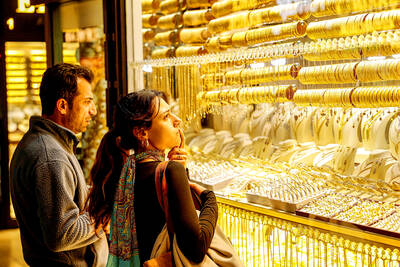
In Italy’s storied gold-making hubs, jewelers are reworking their designs to trim gold content as they race to blunt the effect of record prices and appeal to shoppers watching their budgets. Gold prices hit a record high on Thursday, surging near US$5,600 an ounce, more than double a year ago as geopolitical concerns and jitters over trade pushed investors toward the safe-haven asset. The rally is putting undue pressure on small artisans as they face mounting demands from customers, including international brands, to produce cheaper items, from signature pieces to wedding rings, according to interviews with four independent jewelers in Italy’s main

Japanese Prime Minister Sanae Takaichi has talked up the benefits of a weaker yen in a campaign speech, adopting a tone at odds with her finance ministry, which has refused to rule out any options to counter excessive foreign exchange volatility. Takaichi later softened her stance, saying she did not have a preference for the yen’s direction. “People say the weak yen is bad right now, but for export industries, it’s a major opportunity,” Takaichi said on Saturday at a rally for Liberal Democratic Party candidate Daishiro Yamagiwa in Kanagawa Prefecture ahead of a snap election on Sunday. “Whether it’s selling food or

CONCERNS: Tech companies investing in AI businesses that purchase their products have raised questions among investors that they are artificially propping up demand Nvidia Corp chief executive officer Jensen Huang (黃仁勳) on Saturday said that the company would be participating in OpenAI’s latest funding round, describing it as potentially “the largest investment we’ve ever made.” “We will invest a great deal of money,” Huang told reporters while visiting Taipei. “I believe in OpenAI. The work that they do is incredible. They’re one of the most consequential companies of our time.” Huang did not say exactly how much Nvidia might contribute, but described the investment as “huge.” “Let Sam announce how much he’s going to raise — it’s for him to decide,” Huang said, referring to OpenAI
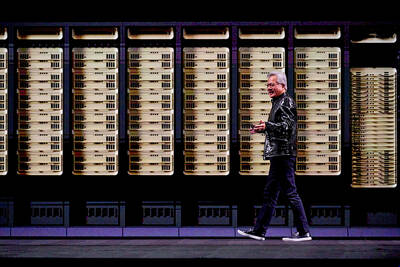
The global server market is expected to grow 12.8 percent annually this year, with artificial intelligence (AI) servers projected to account for 16.5 percent, driven by continued investment in AI infrastructure by major cloud service providers (CSPs), market researcher TrendForce Corp (集邦科技) said yesterday. Global AI server shipments this year are expected to increase 28 percent year-on-year to more than 2.7 million units, driven by sustained demand from CSPs and government sovereign cloud projects, TrendForce analyst Frank Kung (龔明德) told the Taipei Times. Demand for GPU-based AI servers, including Nvidia Corp’s GB and Vera Rubin rack systems, is expected to remain high,


 RSS
RSS