


Largan Precision Co (大立光) yesterday said sales for next month would be higher than this month, thanks to increasing orders from clients.
“This month’s sales are likely to stay flat from last month, but the figure will pick up next month,” Largan chief executive officer Adam Lin (林恩平) told a media briefing after the annual shareholders’ meeting held at the company’s headquarters in Taichung.
Largan manufactures lenses used in cameras for smartphones and information technology products and it counts Apple Inc among its main clients. Smartphone camera lenses account for more than 80 percent of the firm’s total revenue.
Lin expects the company’s revenue to grow quarter-by-quarter this year, given the company’s seasonal pattern of strong growth momentum in the second half.
“Overall, the second half of this year is expected to outperform the first half due to traditional peak season,” he said.
Shipments of 10-megapixel and above products accounted for between 20 percent and 30 percent of last month’s sales of NT$4.41 billion (US$141.55 million), Largan said.
As the migration to higher megapixel modules in the smartphone industry continues, many clients are ordering 12-megapixel or 13-megapixel lenses, while orders for 16-megapixel lenses are also increasing, Lin said.
India increasingly appears a promising land for the smartphone industry and Largan has entered the supply chains for lens products in that market, he said.
Several other Taiwanese companies have invested in India in recent years, such as Hon Hai Precision Industry Co (鴻海精密).
“In the beginning, our products entered the Indian market along with Taiwanese smartphone brands, but now we are working directly with Indian brands,” Lin said.
He declined to elaborate on the Indian market’s contribution to the firm’s revenues, but said the company has no plan to build a new plant there for the time being.
The company’s two rented plants in Taichung are to become operational in the fourth quarter this year, and a newly built plant in Taichung is to start shipping products in the first quarter of next year, Lin said.
Current production capacity is sufficient to meet clients’ demand for this and next quarter, he added.
Shareholders yesterday approved the company’s proposal to distribute a NT$51 cash dividend per share based on last year’s net income of NT$19.43 billion, or earnings per share of NT$144.91. The distribution translates into a payout ratio of 35.19 percent, down from last year’s 39.78 percent.
Lin said Largan prefers to maintain a policy of only distributing cash dividends, because “offering cash dividends lets shareholders have more money to pay their taxes.”
The company might consider issuing stock dividends in the future, if it has a larger share capital.
“We are considering all possibilities to increase share capital,” Lin said, without elaborating.
The company has a share capital of NT$1.34 billion.
Largan’s cash dividend of NT$51 represents a dividend yield of 1.55 percent, based on the stock’s closing price of NT$3,270 yesterday in Taipei trading.
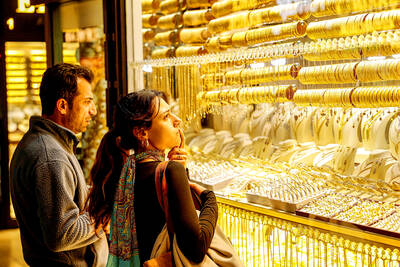
In Italy’s storied gold-making hubs, jewelers are reworking their designs to trim gold content as they race to blunt the effect of record prices and appeal to shoppers watching their budgets. Gold prices hit a record high on Thursday, surging near US$5,600 an ounce, more than double a year ago as geopolitical concerns and jitters over trade pushed investors toward the safe-haven asset. The rally is putting undue pressure on small artisans as they face mounting demands from customers, including international brands, to produce cheaper items, from signature pieces to wedding rings, according to interviews with four independent jewelers in Italy’s main

Japanese Prime Minister Sanae Takaichi has talked up the benefits of a weaker yen in a campaign speech, adopting a tone at odds with her finance ministry, which has refused to rule out any options to counter excessive foreign exchange volatility. Takaichi later softened her stance, saying she did not have a preference for the yen’s direction. “People say the weak yen is bad right now, but for export industries, it’s a major opportunity,” Takaichi said on Saturday at a rally for Liberal Democratic Party candidate Daishiro Yamagiwa in Kanagawa Prefecture ahead of a snap election on Sunday. “Whether it’s selling food or

CONCERNS: Tech companies investing in AI businesses that purchase their products have raised questions among investors that they are artificially propping up demand Nvidia Corp chief executive officer Jensen Huang (黃仁勳) on Saturday said that the company would be participating in OpenAI’s latest funding round, describing it as potentially “the largest investment we’ve ever made.” “We will invest a great deal of money,” Huang told reporters while visiting Taipei. “I believe in OpenAI. The work that they do is incredible. They’re one of the most consequential companies of our time.” Huang did not say exactly how much Nvidia might contribute, but described the investment as “huge.” “Let Sam announce how much he’s going to raise — it’s for him to decide,” Huang said, referring to OpenAI
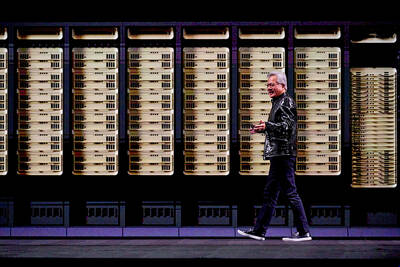
The global server market is expected to grow 12.8 percent annually this year, with artificial intelligence (AI) servers projected to account for 16.5 percent, driven by continued investment in AI infrastructure by major cloud service providers (CSPs), market researcher TrendForce Corp (集邦科技) said yesterday. Global AI server shipments this year are expected to increase 28 percent year-on-year to more than 2.7 million units, driven by sustained demand from CSPs and government sovereign cloud projects, TrendForce analyst Frank Kung (龔明德) told the Taipei Times. Demand for GPU-based AI servers, including Nvidia Corp’s GB and Vera Rubin rack systems, is expected to remain high,


 RSS
RSS