

Chinese tech firms have fallen out of love with the US and it shows — a growing number of them are looking to drop their listings in New York and head back home.
Many Chinese tech executives are betting on higher share valuations in China where stock markets have recently caught fire. They also hope to evade any legal mess when Beijing formally outlaws foreign shareholder control of firms in protected tech sectors.
An exodus of Chinese tech firms would spell the end of a profitable line of business for Wall Street underwriters. Last year, the US$25 billion initial public offering of e-commerce giant Alibaba Group Holding Ltd (阿里巴巴) — the world’s largest initial public offering ever — generated more than US$300 million in fees.

Photo: Reuters
The numbers are hard to resist. China’s tech-driven ChiNext composite index has gained nearly 180 percent this year, eclipsing the 30 percent rise in the NASDAQ OMX China Technology Index that tracks offshore listed mainland firms.
Firms listed on the NASDAQ index get an average share price equal to 11 times their earnings. On ChiNext, they get 133 times. There is a debate over which ratio is more accurate, but Chinese executives blame US ignorance of China.
“American investors don’t understand the business model of Chinese gaming companies,” said a senior executive of one such firm planning to leave New York and move back to a Chinese listing, speaking on condition of anonymity.
Earlier this year, New York-listed Chinese gaming firms Shanda Games Ltd (盛大) and Perfect World Co (完美世界) said they would go private, while online dating service Jianyuan.com (世紀佳緣) and medical R&D services provider Wuxi Pharmatech (Cayman) Inc (藥明康得) said they are considering it.
Analysts expect dozens of lesser-known companies to follow if they can, and they see the pipeline of Chinese companies trying to list in New York drying up.
“The possibility of stirring interest among US investors is slim,” Beijing-based advertising technology company Limei Technology Co (力美科技) chief executive officer Shu Yi (舒義) said. The company recently gave up on plans to list in New York and is now hoping to launch an initial public offering in Shanghai or Shenzhen.
On Thursday, Chinese Premier Li Keqiang (李克強) encouraged more of such companies to return, particularly those with “special ownership structures,” referring to the contractual loopholes employed by many Chinese firms to evade restrictions on foreign ownership.
China is lining up the finances to assist the repatriation. Investment bank China Renaissance has teamed up with Citic Securities Co (中信證券) to raise funds to help delist and underwrite new listings in China, while Shengjing International Management Consulting Co (盛景國際管理諮詢) has launched a fund that intends to repatriate about 100 Chinese firms.
That Chinese internet companies would list in the US might seem strange, analysts say, but it once made sense.
For one thing, Chinese investors’ enthusiasm for startup listings is relatively recent, whereas US investors have been rewarding internet startups with high share prices for decades.
However, more important was the fact that Chinese regulators would not let such firms list in the first place. The China Securities Regulatory Commission has required any company to be profitable for several years before listing — which ruled out most Chinese internet companies.
Beijing aims to make Shanghai a global financial center equivalent to London, Hong Kong and New York by 2020, and it cannot do that without making room for its most innovative companies.
Profitability requirements are being eased and there is also a shortcut: A merger with a Chinese company with a listed shell.
Chinese display advertising giant Focus Media Network Ltd (分眾傳媒), which bailed out of New York in 2013, said this week it would relist in China via a US$7 billion reverse merger with rubber manufacturer Jiangsu Hongda Special Steel Machinery Plant Co (江蘇宏大) in what analysts said is a model for returnees to follow.
Even if the stock market rally cools, the delisting trend is expected to continue as Beijing closes a key legal loophole.
Chinese law bans foreign investment in domestic internet firms. Investors get around the restrictions by buying into variable interest entities (VIEs) set up by the Internet companies, including Alibaba. US courts recognize that as equivalent to ownership of the companies.
However, now Chinese regulators are revising the foreign investment law. A draft version of the document published by China’s cabinet explicitly forbids “effective control” by foreigners of a Chinese company in a prohibited sector.
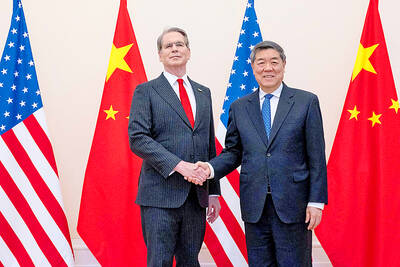
MINIMAL EXPECTATIONS: Analysts think that the two sides are likely to aim for ‘status quo’-level agreements, maintaining civility, without major trade breakthroughs US Secretary of the Treasury Scott Bessent and Chinese Vice Premier He Lifeng (何立峰) were set to meet yesterday to try to set up potential agreements on artificial intelligence (AI), tariffs and critical minerals for a summit in Washington this week between US President Donald Trump and Chinese President Xi Jinping (習近平). The meetings at JPMorgan Chase & Co’s headquarters in Manhattan, which included US Trade Representative Jamieson Greer, were due to start at about 10:30am on Sunday morning and were expected to run all day. Key topics would be the status of a US-China trade truce that is set to expire
APPEAL: Any agreement to produce advanced memory such as HBM or DRAM could run into opposition from Seoul as those technologies are sensitive, sources said South Korea’s SK Hynix Inc is in talks with Intel Corp about a deal that would see it manufacture memory chips on US soil for the first time, three people familiar with the discussions said. Under one potential scenario, SK Hynix would lease part of Intel’s long-planned chipmaking facility in Ohio, they said. Under another scenario, it could form a venture with Intel and major cloud firms that are keen to lock in memory supplies, two of the people said. A deal would relieve pressure on Intel, which has been struggling, and mark a big win for US President Donald

MORE DATA CENTERS: Microsoft’s Taiwan-area general manager said the corporation is looking to add two more data centers in northern Taiwan over the next few years Microsoft Corp plans to double its data centers in Taiwan from two facilities to four, Microsoft Taiwan general manager Sean Pien (卞志祥) said yesterday. “Over the past two to three years, we have consistently seen demand outstrip supply, and we expect that situation to continue over the next two to three years,” Pien said on the sidelines of a news conference in Taipei. The data center sites would mainly be in northern Taiwan to meet customer demand and reduce the risk of operational disruptions caused by a single event, he said, without saying their exact locations. Microsoft enabled the first phase of

Anthropic PBC CEO Dario Amodei and Salesforce Inc CEO Marc Benioff said companies have just begun taking advantage of artificial intelligence (AI) tools and need more help to gain the greatest benefits for their businesses. The power of AI is barely diffused through the economy, with only 5 to 10 percent of the value of the technology being used, Amodei said on Tuesday during an appearance with Benioff at Salesforce’s annual Dreamforce conference in San Francisco. Implementation of AI at large businesses — like the kind Salesforce mostly serves — remains far away from the futuristic vision professed by executives such as


 RSS
RSS