


Asian currencies completed a weekly loss, led by the Singapore dollar and Malaysia’s ringgit, as the US dollar climbed amid speculation the US Federal Reserve is on track to raise interest rates this year.
Fed officials remain open to tightening this year, though a June liftoff in rates is unlikely, according to the minutes of their April meeting released on Wednesday.
A preliminary gauge of manufacturing in China, Asia’s biggest economy, missed estimates this month even after borrowing costs were cut for the third time since November.
The Bloomberg-JPMorgan Asia Dollar Index fell 0.2 percent from May 15 at 4:40pm in Hong Kong. The ringgit weakened 0.6 percent, Singapore’s dollar lost 0.7 percent, Indonesia’s rupiah dropped 0.5 percent, while South Korea’s won declined 0.4 percent.
A gauge of the US dollar jumped 1.6 percent, snapping a five-week decline.
Bucking the trend was the New Taiwan dollar, which rose 0.4 percent on Friday and 0.2 percent from the previous week.
“The [US] dollar recovered as an increase in Fed rates may be likely in September,” said Leong Sook Mei, the Singapore-based Southeast Asia head of global markets research at Bank of Tokyo- Mitsubishi UFJ Ltd.
Fed policymakers expect US growth to pick up after stalling in the first quarter, the minutes showed. The average number of Americans filing for unemployment benefits over the past four weeks dropped to a 15-year low, a sign the labor market continues to strengthen.
China’s preliminary purchasing managers’ index (PMI) from HSBC Holdings PLC and Markit Economics was at 49.1 for this month, missing the median estimate of 49.3 in a Bloomberg survey. Numbers below 50 indicate contraction. Manufacturing output slipped to a 13-month low, the PMI report showed on Thursday, while employment continued to shrink.
“Chinese data was very disappointing,” said Andy Ji, a strategist at Commonwealth Bank of Australia in Singapore. “The market was expecting some kind of stabilization because of the interest-rate and reserve-ratio cuts.”
The ringgit fell as Brent crude prices retreated 0.8 percent this week, weighing on the outlook for Malaysia, the only major Asian oil-exporting nation.
Elsewhere in Asia, the Philippine peso declined 0.1 percent this week, while India’s rupee was little changed. Thailand’s baht climbed 0.4 percent and the Chinese yuan rose 0.1 percent.


Taiwan’s foreign exchange reserves fell below the US$600 billion mark at the end of last month, with the central bank reporting a total of US$596.89 billion — a decline of US$8.6 billion from February — ending a three-month streak of increases. The central bank attributed the drop to a combination of factors such as outflows by foreign institutional investors, currency fluctuations and its own market interventions. “The large-scale outflows disrupted the balance of supply and demand in the foreign exchange market, prompting the central bank to intervene repeatedly by selling US dollars to stabilize the local currency,” Department of Foreign

Intel Corp is joining Elon Musk’s long-shot effort to develop semiconductors for Tesla Inc, Space Exploration Technologies Corp and xAI, marking a surprising twist in the chipmaker’s comeback bid. Intel would help the Terafab project “refactor” the technology in a chip factory, the company said on Tuesday in a post on X, Musk’s social media platform. That is a stage in the development process that typically helps make chips more powerful or reliable. The chipmaker’s shares jumped 4.2 percent to US$52.91 in New York trading on Tuesday. The Terafab project is a grand plan by Musk to eventually manufacture his own chips for
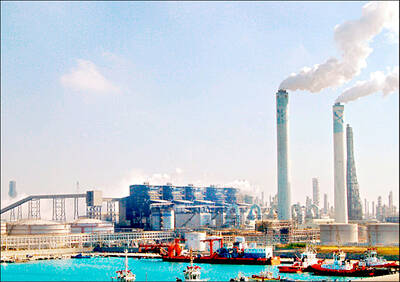
Taiwan Power Co (Taipower, 台電) yesterday said it plans to resume operations at two coal-fired power generators for three months to boost security of electricity supply as liquefied natural gas (LNG) supply risks are running high due to the Middle East conflict. The two coal-fired power generators are at Mailiao Power Plant in Yunlin County’s Mailiao Township (麥寮). The plant, operated by Formosa Plastics Group (台塑集團), supplied electricity to Taipower’s power grid until the end of last year. Taipower’s decision came about one month after Minister of Economic Affairs Kung Ming-hsin (龔明鑫) on March 10 said that the nation had no imminent

Some robotaxi passengers were left stranded in the middle of fast-moving traffic in a major Chinese city after their driverless vehicles stopped running, according to police and media reports on Wednesday. A preliminary investigation indicates more than 100 robotaxis came to a halt because of a “system malfunction,” police in the city of Wuhan said in a statement, without elaborating. No injuries were reported. One passenger told Chinese media that their robotaxi stopped after turning a corner. An instruction on a screen read: “Driving system malfunction. Staff are expected to arrive in 5 minutes.” After no one showed up, the passenger pushed


 RSS
RSS