

Hiwin Technologies Corp (上銀科技), one of the nation’s major machine tool makers, yesterday posted a 3.55 percent annual decline in net profits for the last quarter due to foreign exchange loss, but the company expects growing demand for industrial automation to drive the next quarter’s business.
Hiwin has received more orders this quarter due to surging labor costs in China, company chairman Eric Chuo (卓永財) said.
To meet rising demand, Hiwin plans to expand production capacity, Chuo said.
“This quarter was good, but the next quarter will be even better as our new capacity for ballscrews and linear guideways will be in production,” Chuo said.
Chuo said he is optimistic about the business potential for industrial automation and the company plans to invest between NT$3 billion and NT$4 billion (US$980 million and US$130 million) this year into building new plants.
Chuo did not provide further details about the company’s capacity expansion and business outlook.
JPMorgan Securities Ltd expected Hiwin to grow its revenue by 14 percent this quarter to NT$4.1 billion from last quarter’s NT$3.63 billion, driven by the stronger-than-peers momentum and the contribution of the firm’s new industrial robots.
Hiwin’s industrial robots accounted for 5 percent of the firm’s total revenues last quarter, while its ballscrews and linear guideways contributed 91 percent.
Hiwin has been developing medical robots and is in talks with the China Medical University Taiwan (中國醫藥大學) to open a research and development center for further medical robot development.
Chuo said the company expects to ship medical robots to China in the second half of this year after gaining the Chinese government’s certifications for the products this month.
“We expect sales contribution from the medical robot segment to become meaningful soon,” Chuo said.
Hiwin’s net profit dropped 3.55 percent annually to NT$515 million last quarter, mainly dragged down by the depreciation of the euro against the US dollar.
As a result, Hiwin booked exchange rate loss of NT$133 million last quarter.
Hiwin said that the weak euro also eroded its revenues from Europe, but that demand from the region is still growing.
Earnings per share was NT$1.97 last quarter, compared with NT$2.04 per share a year ago and NT$2.99 per share last quarter.
Chuo said it is still to early to tell if the euro’s fluctuation will continue to affect Hiwin’s profitability this quarter, but the firm will continue increasing its competitiveness and enhancing its product quality to offset any negative impact from currency volatility.
Hiwin shares rose 1.3 percent to NT$234 in Taipei trading yesterday, outperforming the TAIEX, which gained 0.28 percent.
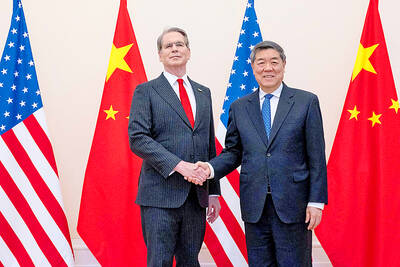
MINIMAL EXPECTATIONS: Analysts think that the two sides are likely to aim for ‘status quo’-level agreements, maintaining civility, without major trade breakthroughs US Secretary of the Treasury Scott Bessent and Chinese Vice Premier He Lifeng (何立峰) were set to meet yesterday to try to set up potential agreements on artificial intelligence (AI), tariffs and critical minerals for a summit in Washington this week between US President Donald Trump and Chinese President Xi Jinping (習近平). The meetings at JPMorgan Chase & Co’s headquarters in Manhattan, which included US Trade Representative Jamieson Greer, were due to start at about 10:30am on Sunday morning and were expected to run all day. Key topics would be the status of a US-China trade truce that is set to expire
APPEAL: Any agreement to produce advanced memory such as HBM or DRAM could run into opposition from Seoul as those technologies are sensitive, sources said South Korea’s SK Hynix Inc is in talks with Intel Corp about a deal that would see it manufacture memory chips on US soil for the first time, three people familiar with the discussions said. Under one potential scenario, SK Hynix would lease part of Intel’s long-planned chipmaking facility in Ohio, they said. Under another scenario, it could form a venture with Intel and major cloud firms that are keen to lock in memory supplies, two of the people said. A deal would relieve pressure on Intel, which has been struggling, and mark a big win for US President Donald
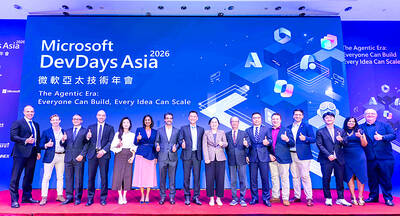
MORE DATA CENTERS: Microsoft’s Taiwan-area general manager said the corporation is looking to add two more data centers in northern Taiwan over the next few years Microsoft Corp plans to double its data centers in Taiwan from two facilities to four, Microsoft Taiwan general manager Sean Pien (卞志祥) said yesterday. “Over the past two to three years, we have consistently seen demand outstrip supply, and we expect that situation to continue over the next two to three years,” Pien said on the sidelines of a news conference in Taipei. The data center sites would mainly be in northern Taiwan to meet customer demand and reduce the risk of operational disruptions caused by a single event, he said, without saying their exact locations. Microsoft enabled the first phase of

Anthropic PBC CEO Dario Amodei and Salesforce Inc CEO Marc Benioff said companies have just begun taking advantage of artificial intelligence (AI) tools and need more help to gain the greatest benefits for their businesses. The power of AI is barely diffused through the economy, with only 5 to 10 percent of the value of the technology being used, Amodei said on Tuesday during an appearance with Benioff at Salesforce’s annual Dreamforce conference in San Francisco. Implementation of AI at large businesses — like the kind Salesforce mostly serves — remains far away from the futuristic vision professed by executives such as


 RSS
RSS