


The economy grew 3.46 percent year-on-year last quarter on the back of exports, but missed the government’s forecast of 3.5 percent due to weak private investment and fiscal spending, the Directorate-General of Budget, Accounting and Statistics (DGBAS) said yesterday.
The expansion, while better than the 3.35 percent increase three months earlier, translated into a parlous 0.27 percent gain on a seasonally adjusted basis, slowing from 1.17 percent in the preceding quarter, the DGBAS said in a report.
The statistics agency attributed the lackluster GDP reading to poor private investment and government spending, which contracted 1.2 percent and 2.5 percent respectively during the January-to-March period.
Domestic demand, which is widely expected to drive the economy this year, contributed a mere 0.77 percentage points last quarter, the report said, while external demand generated 2.69 percentage points.
“Capital equipment purchases faltered last quarter, especially among major semiconductor manufacturers, even though domestic airlines expanded their fleets,” DGBAS official Jasmine Mei (梅家瑗) said.
Private consumption lifted GDP by 1.38 percentage points last quarter, as wage increases and energy cost savings energized tourism and car sales, the report found.
Outbound tourism jumped 12.13 percent last quarter, while domestic highway tolls gained 11.37 percent and new car licenses picked up 9.09 percent, the report said.
The Japanese yen’s sharp depreciation helped attract Taiwanese tourists and boost passenger loads for Taiwanese airline companies, the report said.
By industry breakdown, manufacturers continued to play the backbone, raising GDP growth last quarter by 1.9 percentage points, the report said.
Retailers, financial service providers, hoteliers, restaurants, real-estate builders and other sectors all made contributions of less than 1 percentage point, the report said. That affirms the nation’s heavy reliance on exports and therefore makes it susceptible to headwinds abroad, the report added.
Foreign institutes remained positive about the nation’s growth outlook, but with growing caution.
Barclays PLC cut its forecast for the nation’s GDP growth by 50 basis points to 4 percent for this year, on concerns over a deeper slowdown in China and a more gradual recovery in the US.
“We expect public spending to stay subdued ahead of the presidential and legislative elections next year, in light of little progress on many infrastructure projects, such as the Taoyuan Aerotropolis Project, amid rising political uncertainty,” Barclays economist Leong Wai Ho (梁偉豪) said in a note.
Australia and New Zealand Banking Group (ANZ) stood by its growth forecast of 4.2 percent for Taiwan, but turned more vigilant on downside risks.
Local manufacturers may substitute local production with overseas output after expanding facilities in offshore sites last year, ANZ economist Raymond Yeung (楊宇霆) said.
The ongoing drought and unstable water supplies would also interrupt domestic activities, Yeung said.

UNPRECEDENTED PACE: Micron Technology has announced plans to expand manufacturing capabilities with the acquisition of a new chip plant in Miaoli Micron Technology Inc unveiled a newly acquired chip plant in Miaoli County yesterday, as the company expands capacity to meet growing demand for advanced DRAM chips, including high-bandwidth memory chips amid the artificial intelligence boom. The plant in Miaoli County’s Tongluo Township (銅鑼), which Micron acquired from Powerchip Semiconductor Manufacturing Corp (力積電) for US$1.8 billion, is expected to make a sizeable capacity contribution to the company from fiscal 2028, the company said in a statement. It would be an extended production site of Micron’s large-scale manufacturing hub in Taichung, the company said. As the global semiconductor industry is racing to reach US$1 trillion
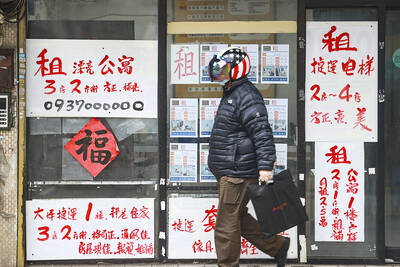
A man walks past real-estate advertisements outside a house in Taipei yesterday. The central bank yesterday said it plans to establish an “Inflation-at-Risk” gauge as a supplementary tool for observing inflation, as policymakers express wish to communicate more effectively with the public when making inflation forecasts.
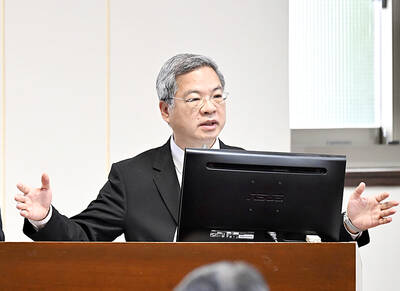
ABOVE LEGAL REQUIREMENT: The Ministry of Economic Affairs is prepared if LNG supply is disrupted, with more than the legal requirement of 11 days of inventory Taiwan has largely secured liquefied natural gas (LNG) supplies through May and arranged about half of June’s supply, Minister of Economic Affairs Kung Ming-hsin (龔明鑫) said yesterday. Since the Middle East conflict began on Feb. 28, Taiwan’s LNG inventories have remained more than 12 days, exceeding the legal requirement of 11 days, indicating no major supply concerns for domestic gas and electricity, Kung said at a meeting of the legislature’s Economics Committee in Taipei. The ministry aims to increase the figure to 14 days by the end of next year, he said. While one or two LNG or crude oil shipments for May

Memory chip stocks extended their losses yesterday after Alphabet Inc’s Google publicized research that could allow more efficient use of the storage needed for artificial intelligence (AI) development. SK Hynix Inc and Samsung Electronics Co, South Korean leaders in the market, fell more than 6 percent and about 5 percent respectively in Seoul. In the US, Micron Technology Inc, Western Digital Corp and Sandisk Corp slid more than 2 percent in pre-market trading, after they all closed lower on Wednesday. Memory companies have been on a tear in recent months as the rapid development of AI infrastructure triggered a spike in chip


 RSS
RSS