


Consumer confidence rose for the fifth consecutive month this month with all component indices gaining points, led by the bullish sentiment on stock investments, a survey by National Central University showed yesterday.
The consumer confidence index advanced 1.8 points from last month to reach a record 92.93 this month, as a liquidity-driven stock rally lifted investor confidence and the wealth effect, the survey said.
10,000 MARK
“With the TAIEX hovering around the 10,000-point mark, investors have grown more upbeat about stock investments,” said Day Jaw-yang (戴肇洋), a researcher at Taiwan Research Institute (台灣綜合研究院), which helps conduct the monthly survey with National Central University and Fu Jen Catholic University.
Of the six sub-indices, the reading on stock investment outlook logged the fastest pickup of 4.9 points to 109.7 this month, in line with the TAIEX’s showing, the survey said.
The local bourse finished up 0.6 percent yesterday at 9,973.12 — 22.88 points shy of the 10,000 mark — on heavy turnover of NT$130.16 billion (US$4.22 billion), according to Taiwan Stock Exchange statistics.
The rally had more to do with loose monetary measures worldwide than economic fundamentals, Day said, adding that plans to hike taxes also drove a considerable amount of property funds to the stock market.
Stock performance plays an important role in swaying consumer confidence in Taiwan because individuals account for a majority of investors.
The local bourse is expected to gain further momentum this month, as institutional players return from holidays and build new positions for this year, he said.
The bullish sentiment appears to have obscured concerns over a water shortage and potential electricity rationing, Day said.
ECONOMIC OUTLOOK
The sub-index on the nation’s economic outlook and job market rose marginally to 88.45 and 114.9 this month, from 87.65 and 114.25 last month respectively, the survey showed.
The gauge on consumption plans for durable goods advanced to 106.05 this month, from 105.05 last month, on the back of robust car sales although property transactions remained weak, the survey said.
Reports of property price falls may facilitate transactions going forward, Day said.
The sub-index on inflation stood at 52.85 this month, from 51.1 last month, suggesting continued concern over consumer price hikes although cheaper crude prices pushed the government’s inflationary gauge into the negative zone for the past few months, the survey said.
A confidence score of 100 suggests optimism and values below the threshold indicate pessimism. The survey polled 2,448 Taiwanese aged 20 and older by telephone between April 19 and 23, and has a confidence level of 95 percent.

UNPRECEDENTED PACE: Micron Technology has announced plans to expand manufacturing capabilities with the acquisition of a new chip plant in Miaoli Micron Technology Inc unveiled a newly acquired chip plant in Miaoli County yesterday, as the company expands capacity to meet growing demand for advanced DRAM chips, including high-bandwidth memory chips amid the artificial intelligence boom. The plant in Miaoli County’s Tongluo Township (銅鑼), which Micron acquired from Powerchip Semiconductor Manufacturing Corp (力積電) for US$1.8 billion, is expected to make a sizeable capacity contribution to the company from fiscal 2028, the company said in a statement. It would be an extended production site of Micron’s large-scale manufacturing hub in Taichung, the company said. As the global semiconductor industry is racing to reach US$1 trillion
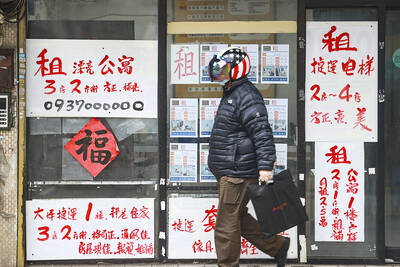
A man walks past real-estate advertisements outside a house in Taipei yesterday. The central bank yesterday said it plans to establish an “Inflation-at-Risk” gauge as a supplementary tool for observing inflation, as policymakers express wish to communicate more effectively with the public when making inflation forecasts.
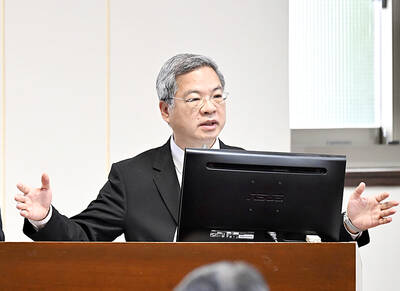
ABOVE LEGAL REQUIREMENT: The Ministry of Economic Affairs is prepared if LNG supply is disrupted, with more than the legal requirement of 11 days of inventory Taiwan has largely secured liquefied natural gas (LNG) supplies through May and arranged about half of June’s supply, Minister of Economic Affairs Kung Ming-hsin (龔明鑫) said yesterday. Since the Middle East conflict began on Feb. 28, Taiwan’s LNG inventories have remained more than 12 days, exceeding the legal requirement of 11 days, indicating no major supply concerns for domestic gas and electricity, Kung said at a meeting of the legislature’s Economics Committee in Taipei. The ministry aims to increase the figure to 14 days by the end of next year, he said. While one or two LNG or crude oil shipments for May

Memory chip stocks extended their losses yesterday after Alphabet Inc’s Google publicized research that could allow more efficient use of the storage needed for artificial intelligence (AI) development. SK Hynix Inc and Samsung Electronics Co, South Korean leaders in the market, fell more than 6 percent and about 5 percent respectively in Seoul. In the US, Micron Technology Inc, Western Digital Corp and Sandisk Corp slid more than 2 percent in pre-market trading, after they all closed lower on Wednesday. Memory companies have been on a tear in recent months as the rapid development of AI infrastructure triggered a spike in chip


 RSS
RSS