


This year’s Taipei Spring Computer Show, which opens today at the Taipei World Trade Center, is set to present more creative consumer electronics products rather than traditional computer products amid the development of Internet of Things applications.
“Over the past year, we have noticed that there are many new Taiwanese startups making smart devices to make life simpler and more fun, and they are not necessarily notebooks or smartphones,” said Enoch Du (杜全昌), secretary-general of the Taipei Computer Association (台北市電腦公會), which organizes the annual tech fair.
The number of exhibitors this year is 10 percent higher at 220 companies from last year, with about 70 percent of them being local small and medium-sized companies, Du said.
These small firms will exhibit more than 2,000 products for this year’s fair, and the association has set up a special pavilion to boost their visibility in the market, Du said.
“Some interesting products should definitely draw visitors’ attention,” he said.
The special pavilion features a wide range of technological gadgets, such as a stylus allowing users to capture colors from any object, wide-angle camera lenses for smartphones, fish-eye camera lenses, smart bracelets, Bluetooth speakers, Wi-Fi connectivity devices, mobile power packs and heads-up displays for cars, the association said.
The color-capturing stylus Mozbii is manufactured by Taiwanese startup Ufro Inc (優富樂), which was founded in 2013 by former Asustek Computer Inc (華碩) and Acer Inc (宏碁) employee Jeremy Shu (丘彪盛).
Mozbii can capture colors by pressing the stylus against the surface of an object, allowing users to use the stylus to draw on a tablet via an app.
The stylus, which has been on the market since November last year, comes in five colors and is priced at NT$2,990.
One smartphone accessory that is on display is a tube-shaped speaker with Bluetooth functionality made by Taiwanese connector and cable maker Chant Sincere Co (銓欣).
The Qooker-brand Bluetooth speaker is an LED flashlight that can be clipped onto a bicycle. Not only can riders use it as a flashlight, they can use it to play music from a smartphone or to answer calls via Bluetooth connectivity, Du said.
This year is the first time the Spring Computer Show will display unmanned aerial vehicles, as demand has increased significantly since the launch of the documentary Beyond Beauty: Taiwan from Above in October 2013.
Du said four Taiwanese distributors are to showcase up to 10 drones at the show, including one that can be controlled by a smartphone.
The exhibition hall is divided into different areas for various themes and the association has also arranged a PC area for companies such as Asustek, Acer and Lenovo Group Ltd (聯想) to showcase their notebooks and smart devices, he said.
The five-day show is expected to attract about 400,000 visitors this year, he added.
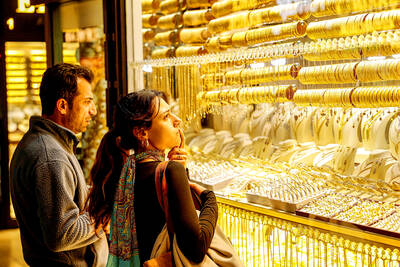
In Italy’s storied gold-making hubs, jewelers are reworking their designs to trim gold content as they race to blunt the effect of record prices and appeal to shoppers watching their budgets. Gold prices hit a record high on Thursday, surging near US$5,600 an ounce, more than double a year ago as geopolitical concerns and jitters over trade pushed investors toward the safe-haven asset. The rally is putting undue pressure on small artisans as they face mounting demands from customers, including international brands, to produce cheaper items, from signature pieces to wedding rings, according to interviews with four independent jewelers in Italy’s main
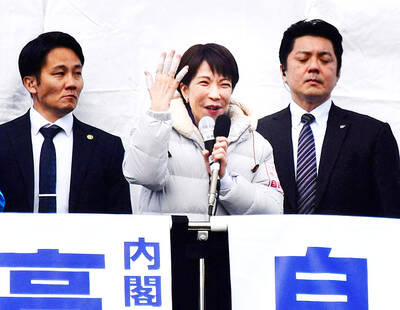
Japanese Prime Minister Sanae Takaichi has talked up the benefits of a weaker yen in a campaign speech, adopting a tone at odds with her finance ministry, which has refused to rule out any options to counter excessive foreign exchange volatility. Takaichi later softened her stance, saying she did not have a preference for the yen’s direction. “People say the weak yen is bad right now, but for export industries, it’s a major opportunity,” Takaichi said on Saturday at a rally for Liberal Democratic Party candidate Daishiro Yamagiwa in Kanagawa Prefecture ahead of a snap election on Sunday. “Whether it’s selling food or
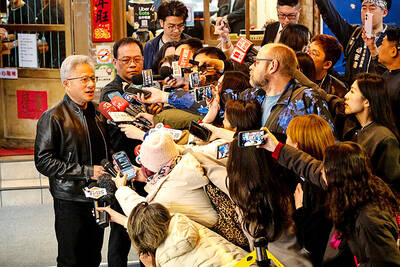
CONCERNS: Tech companies investing in AI businesses that purchase their products have raised questions among investors that they are artificially propping up demand Nvidia Corp chief executive officer Jensen Huang (黃仁勳) on Saturday said that the company would be participating in OpenAI’s latest funding round, describing it as potentially “the largest investment we’ve ever made.” “We will invest a great deal of money,” Huang told reporters while visiting Taipei. “I believe in OpenAI. The work that they do is incredible. They’re one of the most consequential companies of our time.” Huang did not say exactly how much Nvidia might contribute, but described the investment as “huge.” “Let Sam announce how much he’s going to raise — it’s for him to decide,” Huang said, referring to OpenAI
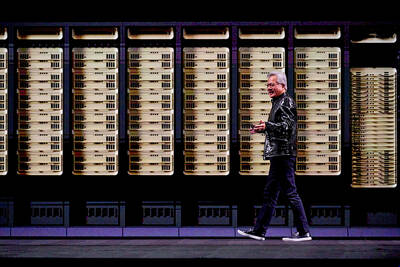
The global server market is expected to grow 12.8 percent annually this year, with artificial intelligence (AI) servers projected to account for 16.5 percent, driven by continued investment in AI infrastructure by major cloud service providers (CSPs), market researcher TrendForce Corp (集邦科技) said yesterday. Global AI server shipments this year are expected to increase 28 percent year-on-year to more than 2.7 million units, driven by sustained demand from CSPs and government sovereign cloud projects, TrendForce analyst Frank Kung (龔明德) told the Taipei Times. Demand for GPU-based AI servers, including Nvidia Corp’s GB and Vera Rubin rack systems, is expected to remain high,


 RSS
RSS