


Compal Electronics Inc (仁寶) is in talks to buy companies in Silicon Valley and Taiwan as the contract manufacturer embarks on “aggressive” acquisitions to reduce its reliance on notebook computers.
US targets include a provider of network download software and a developer of 3D printing technology, Compal chief executive officer Ray Chen (陳瑞聰) said in an interview.
Compal is also set to buy a stake in a Taiwan-based industrial PC maker by the end of this year, he said, declining to name targets.
Compal is withstanding a slump in the global PC market by shifting more contract production to tablet computers and smartphones. Chen purchased a minority stake in Avalue Technology Inc (安勤) last year as part of a strategy to boost sales of industrial computing hardware and software in healthcare, sports and fitness.
“Our intention is to invest and take more aggressive M&A [mergers and acquisitions] into the new category,” Chen said at the company’s Taipei headquarters on Monday.
Compal is likely to become the second-largest shareholder after the founders in the US targets, before possibly increasing its stake, he said.
One target makes software to speed downloads for applications that analyze large amounts of data. Another provides technology that allows products to be prototyped using 3D printing, Chen said. The deals would be worth “several million” US dollars each, he said without being more specific.
Compal had NT$75 billion (US$2.4 billion) in cash and equivalents at the end of last year and has no plans to conduct share buybacks, Chen said.
Compal shares were unchanged at NT$27.05 at the close of Taipei trading on Monday, after dropping by as much as 1.7 percent earlier, while the benchmark TAIEX fell 0.25 percent.
The stock has climbed by 21.85 percent this year, outperforming a 3.6 percent gain in the TAIEX.
Compal is the largest contract manufacturer of notebooks after local rival Quanta Computer Inc (廣達). The company’s customers include Lenovo Group Ltd (聯想), Hewlett-Packard Co and Dell Inc.
Non-PC products accounted for 23 percent of sales last year, with Compal expecting that to pass 30 percent this year.
Global PC industry shipments fell by 6.7 percent to 68.5 million units in the quarter ending last month, market researcher International Data Corp said in a statement on Monday.
Compal’s move beyond PCs has shown mixed success, with the company landing some orders to make Apple Inc’s iPad mini and tablets for Amazon.com Inc. Its smartphone client list is limited to smaller players such as HTC Corp (宏達電), Microsoft Corp’s Nokia business and Sony Corp.
Winning orders from Micromax Informatics Ltd, the biggest India-based smartphone maker, and China’s Coolpad Group Ltd (酷派) could help double phone shipments to 35 million this year, while notebook sales volume might only increase slightly to about 44 million, he said. Compal’s smartphone sales should outpace notebooks next year, Chen said.
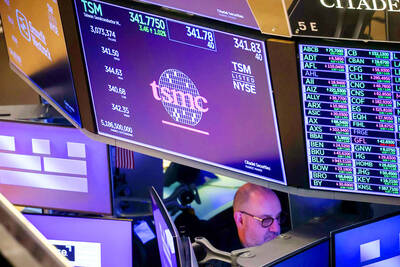
STRONG INTEREST: Analysts have pointed to optimism in TSMC’s growth prospects in the artificial intelligence era as the cause of the rising number of shareholders The number of people holding shares of chipmaker Taiwan Semiconductor Manufacturing Co (TSMC, 台積電) hit a new high last week despite a decline in its stock price, the Taiwan Depository and Clearing Corp (TDCC, 台灣集保) said. The number of TSMC shareholders rose to 2.46 million as of Friday, up 75,536 from a week earlier, TDCC data showed. The stock price fell 1.34 percent during the same week to close at NT$1,840 (US$57.55). The decline in TSMC’s share price resulted from volatility in global tech stocks, driven by rising international crude oil prices as the war against Iran continues. Dealers said
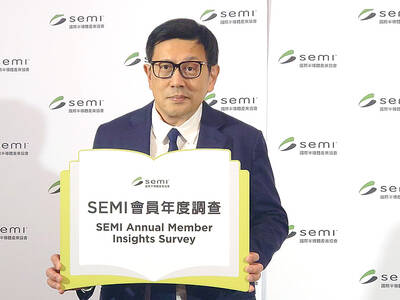
PRICE HIKES: The war in the Middle East would not significantly disrupt supply in the short term, but semiconductor companies are facing price surges for materials Taiwan’s semiconductor companies are not facing imminent supply disruptions of essential chemicals or raw materials due to the war in the Middle East, but surges in material costs loom large, industry association SEMI Taiwan said yesterday. The association’s comments came amid growing concerns that supplies of helium and other key raw materials used in semiconductor production could become a choke point after Qatar shut down its liquefied natural gas (LNG) production and helium output earlier this month due to the conflict. Qatar is the second-largest LNG supplier in the world and accounts for about 33 percent of global helium output. Helium is
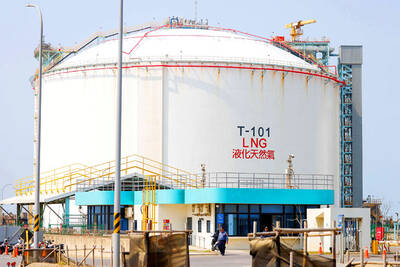
Taiwan’s natural gas supply remains stable through the end of May, despite rising concerns about potential disruptions to Qatari liquefied natural gas (LNG) supplies due to escalating conflicts in the Middle East, the Ministry of Economic Affairs said yesterday. The ministry in a statement said that Taiwan has completed preparations for natural gas supply and shipping schedules through the end of May. It has also made plans to increase natural gas imports from regions outside the Middle East in June to ensure a stable supply, it added. Taiwan sources natural gas from 14 countries and is not solely dependent on the Middle East,
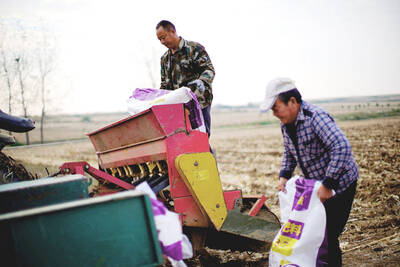
China is clamping down on fertilizer exports to protect its domestic market, industry sources said, putting an additional strain on global markets that were already grappling with shortages caused by the US-Israeli war on Iran. China is among the largest fertilizer exporters — shipping more than US$13 billion of it last year — and it has a history of controlling exports to keep prices low for farmers. Shipments through the war-blocked Strait of Hormuz account for about one-third of the sea-borne supply. This month, Beijing banned exports of nitrogen-potassium fertilizer blends and certain phosphate varieties, sources said. The ban, which has not


 RSS
RSS