


Taiwanese handset maker HTC Corp (宏達電) is optimistic about new smart devices it unveiled in Barcelona on Sunday, but analysts were downbeat on sales of those products this year, citing a lack of significant upgrades in the company’s new flagship model.
The company introduced its latest One M9 flagship smartphone and two non-smartphone products — the Grip professional fitness tracker wristband and the Vive virtual reality headset — at the Mobile World Congress in Spain.
The latest Qualcomm Snapdragon 810 processor powers the One M9, HTC said in a statement. The handset has a 20-megapixel rear camera with a sapphire cover lens and can capture ultra-high-definition (4K ) video, it added.
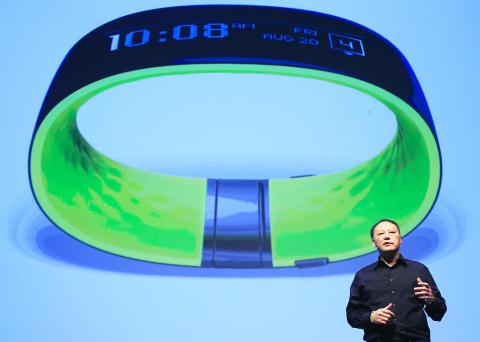
Photo: Bloomberg
The GPS-enabled Grip is its first wearable device to be developed with strategic partner Under Armour Inc — a US sports clothing and accessories supplier, HTC said. The water-resistant wristband has a 100mAh battery that can least for two and a half days.
The virtual reality HTC Vive headset enables 360? views and has a tracking system that will allow users to walk around in virtual worlds, the company said.
HTC chairwoman Cher Wang (王雪紅) expressed high hopes for the HTC Vive headset — developed with strategic partner US-based video game developer Valve.
At an investors’ conference last month, HTC chief financial officer Chang Chia-lin (張嘉臨) said the company expects revenue from its non-smartphone segment to grow significantly this year and make material contributions beginning next year and beyond.
However, the One M9 is “the world’s most beautiful disappointment,” Yuanta Securities Investment and Consulting Co (元大投顧) — quoting US technology Web site the Verge — said.
The M9 is hard to distinguish from the M8, as the new model has the same 5-inch full-HD 1080p display and BoomSound speaker the M8 did, a Yuanta analyst who declined to be named told the Taipei Times.
“I believe the market’s reactions to the M9 are reflected in HTC’s share price, which fell 2.61 percent to NT$149 in Taipei trading on Friday last week,” the analyst said.
HTC usually unveils new flagship models in March and the product is expected to boost sales in the second quarter of the year, but given its similarities to the M8, the analyst expects HTC’s revenue growth next quarter to be weaker than the market consensus.
“I expect HTC’s revenue to grow less than 47 percent next quarter from this quarter’s estimated NT$44 billion (US$1.4 billion),” the analyst said.
The consensus estimate is 50 percent, according to Yuanta.
The new flagship device is to be available beginning in the middle of this month, and the Grip is to go on sale later in the spring, the firm said.
The HTC Vive Developer Edition is being launched before the summer as well, HTC said, adding that the consumer edition is to be available by the end of this year.
Separately, the firm yesterday reported sales of NT$9.22 billion for last month, down 24.85 percent from January’s NT$12.27 billion.
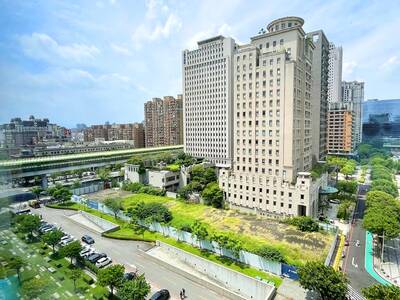
Taichung reported the steepest fall in completed home prices among the six special municipalities in the first quarter of this year, data compiled by Taiwan Realty Co (台灣房屋) showed yesterday. From January through last month, the average transaction price for completed homes in Taichung fell 8 percent from a year earlier to NT$299,000 (US$9,483) per ping (3.3m²), said Taiwan Realty, which compiled the data based on the government’s price registration platform. The decline could be attributed to many home buyers choosing relatively affordable used homes to live in themselves, instead of newly built homes in the city’s prime property market, Taiwan Realty
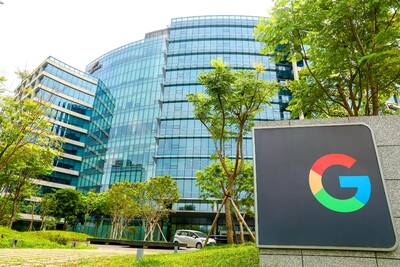
The government yesterday approved applications by Alphabet Inc’s Google to invest NT$27.08 billion (US$859.98 million) in Taiwan, the Ministry of Economic Affairs said in a statement. The Department of Investment Review approved two investments proposed by Google, with much of the funds to be used for data processing and electronic information supply services, as well as inventory procurement businesses in the semiconductor field, the ministry said. It marks the second consecutive year that Google has applied to increase its investment in Taiwan. Google plans to infuse NT$25.34 billion into Charter Investments Ltd (特許投資顧問) through its Singapore-based subsidiary Fructan Holdings Singapore Pte Ltd, and

JET JUICE: The war on Iran’s secondary effects have seen fuel prices skyrocket, knocking flight schedules down to earth in return as airlines struggle with costs Airline passengers should brace for more irritation in the next few months as carriers worldwide cancel flights and ground planes to cope with stratospheric increases in jet-fuel prices. Dutch flag carrier KLM is the latest company to cut its schedule, saying on Thursday that it would scrap 80 return flights at Amsterdam’s Schiphol Airport in the coming month. That puts it in the same league as United Airlines Holdings Inc, Deutsche Lufthansa AG and Cathay Pacific Airways Ltd, which have all pruned itineraries to mitigate costs. Global capacity for next month has been reduced by about 3 percentage points, with all

The US said it plans to help build a first-of-its-kind industrial hub in the Philippines to boost production of inputs crucial to US supply chains. The 4,000-acre hub is intended to be “a purpose-built platform for allied manufacturing” and “an investment acceleration hub where the specific industrial activities are shaped by market demand,” the US Department of State said on Thursday. The project — touted as an “economic security zone” — would be within the Luzon Economic Corridor, a flagship economic project backed by the US and Japan on the main Philippine island. The project was also described as “the first artificial intelligence


 RSS
RSS