


Audi is to spend 24 billion euros (US$29.24 billion) to develop technology and expand production, boosting its five-year investment plan by 2 billion euros as it chases BMW for the top spot in luxury-car sales.
About 16.8 billion euros, or 70 percent of the total, is earmarked for new models like the Q1 subcompact sport-utility vehicle, the Ingolstadt, Germany-based unit of Volkswagen AG said on Friday in a statement.
Audi expects to sell a record of more than 1.7 million autos this year.
“We are making large investments in the innovative areas of electric mobility, connectivity and lightweight construction,” Audi chief executive officer Rupert Stadler said in the statement. The brand intends to increase its lineup to 60 models by 2020, from 50.
Audi, No. 2 in global luxury-car sales, aims to surpass BMW AG’s namesake brand in deliveries by the end of the decade.
The race tightened this year. BMW outsold Audi by just 42,600 cars in the first 11 months of the year, compared with 54,600 a year earlier. Audi’s budget is part of Volkswagen’s 85.6 billion-euro investment program to beat Toyota Motor Corp in global auto-industry sales.
Audi plans to spend the equivalent of 4.8 billion euros a year, an increase from the previous rolling five-year plan that called for investing 4.4 billion euros annually, on new vehicles and expanding production capacity.
“Despite the growth in total investment, we will keep a watchful eye on the upcoming challenges and exercise the required cost discipline,” chief financial officer Axel Strotbek said.
Audi, which already outsells BMW in China and Europe, is aiming to catch up in the US. Last month, it unveiled the Prologue concept car in Los Angeles to showcase a more aggressive design. The company also plans an electric crossover for the US in 2017 to challenge Tesla Motors Inc and is building a factory in Mexico that will start building the Q5 SUV in 2016 for America.
Meanwhile, Tesla is offering a suite of upgrades to the sporty two-seater it no longer sells that will give owners as much as a 644km range, enough to drive from San Francisco to Los Angeles.
Improved battery technology can provide 31 percent more energy than the original Roadster cells, the Palo Alto, California-based company said in a blog on its Web site. Combined with an aerodynamics kit, new tires and improvements to wheel bearings and brakes, range can be increased as much as 50 percent compared with the original Roadster, Tesla said.
The company did not say what it will charge for the upgrades, which it collectively calls Roadster 3.0.
“There is a set of speeds and driving conditions where we can confidently drive the Roadster 3.0 over 400 miles [644km],” Tesla said in the blog post. “We will be demonstrating this in the real world during a non-stop drive from San Francisco to Los Angeles in the early weeks of 2015.”
Tesla sold about 2,500 of the US$109,000 Roadsters, which were built on a Lotus chassis.
The Model S, the only car Tesla currently has in production, will get a battery-pack upgrade eventually, though not soon, chief executive officer Elon Musk said in a tweet over the weekend.
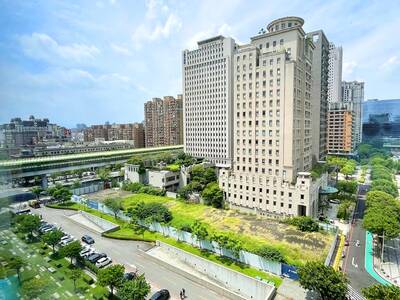
Taichung reported the steepest fall in completed home prices among the six special municipalities in the first quarter of this year, data compiled by Taiwan Realty Co (台灣房屋) showed yesterday. From January through last month, the average transaction price for completed homes in Taichung fell 8 percent from a year earlier to NT$299,000 (US$9,483) per ping (3.3m²), said Taiwan Realty, which compiled the data based on the government’s price registration platform. The decline could be attributed to many home buyers choosing relatively affordable used homes to live in themselves, instead of newly built homes in the city’s prime property market, Taiwan Realty
The government yesterday approved applications by Alphabet Inc’s Google to invest NT$27.08 billion (US$859.98 million) in Taiwan, the Ministry of Economic Affairs said in a statement. The Department of Investment Review approved two investments proposed by Google, with much of the funds to be used for data processing and electronic information supply services, as well as inventory procurement businesses in the semiconductor field, the ministry said. It marks the second consecutive year that Google has applied to increase its investment in Taiwan. Google plans to infuse NT$25.34 billion into Charter Investments Ltd (特許投資顧問) through its Singapore-based subsidiary Fructan Holdings Singapore Pte Ltd, and
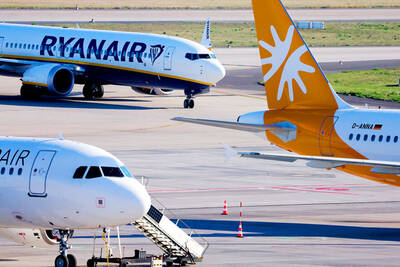
JET JUICE: The war on Iran’s secondary effects have seen fuel prices skyrocket, knocking flight schedules down to earth in return as airlines struggle with costs Airline passengers should brace for more irritation in the next few months as carriers worldwide cancel flights and ground planes to cope with stratospheric increases in jet-fuel prices. Dutch flag carrier KLM is the latest company to cut its schedule, saying on Thursday that it would scrap 80 return flights at Amsterdam’s Schiphol Airport in the coming month. That puts it in the same league as United Airlines Holdings Inc, Deutsche Lufthansa AG and Cathay Pacific Airways Ltd, which have all pruned itineraries to mitigate costs. Global capacity for next month has been reduced by about 3 percentage points, with all
The US said it plans to help build a first-of-its-kind industrial hub in the Philippines to boost production of inputs crucial to US supply chains. The 4,000-acre hub is intended to be “a purpose-built platform for allied manufacturing” and “an investment acceleration hub where the specific industrial activities are shaped by market demand,” the US Department of State said on Thursday. The project — touted as an “economic security zone” — would be within the Luzon Economic Corridor, a flagship economic project backed by the US and Japan on the main Philippine island. The project was also described as “the first artificial intelligence


 RSS
RSS