


Motech Industries Inc (茂迪) yesterday said its board has approved a plan to acquire a smaller local rival for NT$2.05 billion (US$65 million) via a share swap, creating the world’s largest solar cell maker.
The merger with Topcell Solar International Co (聯景光電) should boost Motech’s annual capacity to about 3 gigawatts from the current 2 gigawatts, allowing it to surpass Neo Solar Power Corp’s (新日光), 2.1 gigawatts.
“The merger will help improve operational efficiency by integrating the resources of the two companies. The new firm will also have stronger pricing power as the company scale expands,” Motech spokesman Jack Hsieh (謝祖葳) said in a statement submitted to the Taiwan Stock Exchange.
Under the agreement, each Motech share is to be exchanged for six Topcell shares. Motech plans to issue 45.672 million new shares for the merger, which are worth NT$2.05 billion based on Motech’s closing price of NT$45 yesterday.
“We are positive about this merger for the industry and for the companies,” TrendForce Corp (集邦科技) solar industry analyst Jason Huang (黃公暉) said.
“Motech will get the much-needed capacity to safeguard its market share, which is crucial to staying competitive in a highly competitive and expanding industry like the solar sector,” Huang said.
Global solar market demand is expected to increase 16.5 percent annually to 51.4 gigawatts next year from an estimated 44 gigawatts this year, TrendForce said early this month.
The researcher attributed the growth to robust demand from China, the US and Japan.
In addition, it “is a bargain for Motech to buy one gigawatt of capacity for just NT$2 billion,” Huang said.
It will take NT$5 billion to build 1 gigawatt of new capacity, he said.
On top of that, Topcell can help expand Motech’s customer base, he said.
Topcell mostly supplies solar cells to Chinese solar cell module makers, while Motech has a diverse customer portfolio, he said.
After the deal is completed in July next year, Topcell’s parent company, United Microelectronics Corp (UMC, 聯電), will hold a 9 percent share of Motech, making UMC the second-largest shareholder after Taiwan Semiconductor Manufacturing Co (TSMC, 台積電).
UMC is the nation’s second-largest contract chipmaker after TSMC.
“The sale will be a relief for UMC,” Huang said.
UMC has booked losses each quarter for its new businesses, mainly its solar business, for a long time.
This quarter, UMC expects to book NT$400 million in losses from its new business.
Huang forecast that most solcar cell companies would be running at 90 percent capacity next quarter as demand has rebounded after the US Department of Commerce early this month made its final ruling on an anti-dumping and anti-subsidy probe.
Taiwanese solar cell makers will be required to pay an average duty of 19.5 percent, lower than the 24.23 percent indicated in July’s ruling.
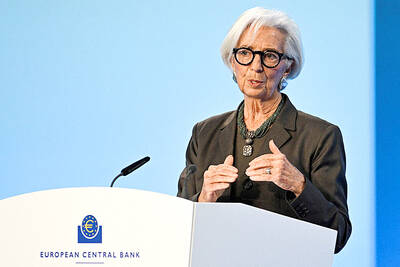
European Central Bank (ECB) President Christine Lagarde is expected to step down from her role before her eight-year term ends in October next year, the Financial Times reported. Lagarde wants to leave before the French presidential election in April next year, which would allow French President Emmanuel Macron and German Chancellor Friedrich Merz to find her replacement together, the report said, citing an unidentified person familiar with her thoughts on the matter. It is not clear yet when she might exit, the report said. “President Lagarde is totally focused on her mission and has not taken any decision regarding the end of
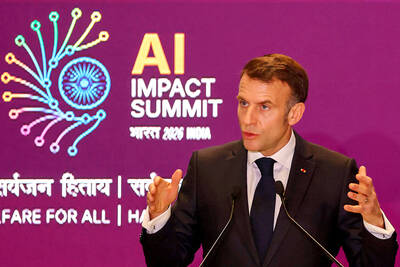
French President Emmanuel Macron told a global artificial intelligence (AI) summit in India yesterday he was determined to ensure safe oversight of the fast-evolving technology. The EU has led the way for global regulation with its Artificial Intelligence Act, which was adopted in 2024 and is coming into force in phases. “We are determined to continue to shape the rules of the game... with our allies such as India,” Macron said in New Delhi. “Europe is not blindly focused on regulation — Europe is a space for innovation and investment, but it is a safe space.” The AI Impact Summit is the fourth
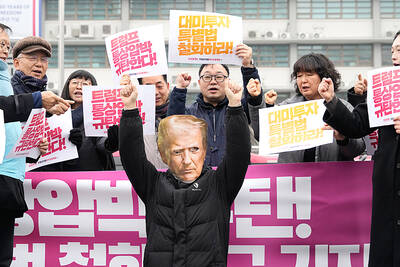
CONFUSION: Taiwan, Japan and other big exporters are cautiously monitoring the situation, while analysts said more Trump responses ate likely after his loss in court US trading partners in Asia started weighing fresh uncertainties yesterday after President Donald Trump vowed to impose a new tariff on imports, hours after the Supreme Court struck down many of the sweeping levies he used to launch a global trade war. The court’s ruling invalidated a number of tariffs that the Trump administration had imposed on Asian export powerhouses from China and South Korea to Japan and Taiwan, the world’s largest chip maker and a key player in tech supply chains. Within hours, Trump said he would impose a new 10 percent duty on US imports from all countries starting on
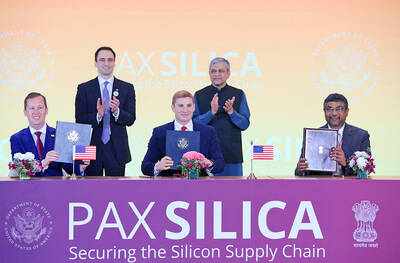
STRATEGIC ALLIANCE: The initiative is aimed at protecting semiconductor supply chain resilience to reduce dependence on China-dominated manufacturing hubs India yesterday joined a US-led initiative to strengthen technology cooperation among strategic allies in a move that underscores the nations’ warming ties after a brief strain over New Delhi’s unabated purchase of discounted Russian oil. The decision aligns India closely with Washington’s efforts to build secure supply chains for semiconductors, advanced manufacturing and critical technologies at a time when geopolitical competition with China is intensifying. It also signals a reset in relations following friction over energy trade and tariffs. Nations that have joined the Pax Silica framework include Japan, South Korea, the UK and Israel. “Pax Silica will be a group of nations


 RSS
RSS