


Goldman Sachs Group Inc cut its forecasts for Brent and West Texas Intermediate (WTI) crude prices next year on rising global supplies, predicting OPEC is set to lose influence over the oil market amid the US shale boom.
The bank is becoming more confident in the scale and sustainability of US shale oil production and said US benchmark prices need to decline to US$75 a barrel for a slowdown in output growth.
Brent is set to average US$85 a barrel in the first quarter, down from a previous forecast of US$100, and WTI is scheduled to sell for US$75 a barrel in the period, from an earlier estimate of US$90, analysts including Jeffrey Currie wrote in a report.
The biggest members of OPEC are discounting supplies to defend market share rather than cutting production to boost prices that have collapsed into a bear market.
The highest US output in almost 30 years is helping increase stockpiles as exporters including Saudi Arabia reduce prices to stimulate demand.
“We believe that OPEC will no longer act as the first-mover swing producer and that US shale oil output will be called upon to fill this role,” Goldman said in the report. “Our forecast also reflects the realization of a loss of pricing power by core OPEC [members].”
Any near-term OPEC production cut is set to be modest until there is sufficient evidence of a slowdown in US shale oil production growth, according to the report.
Global producers might need to cut almost 800,000 barrels a day of output next year to limit a build in inventories and ultimately balance the global oil market in 2016, Goldman said.
Accelerating non-OPEC production growth outside North America, including from Brazil, Mexico and Azerbaijan, would outpace demand growth, leaving the oil market oversupplied, according to the report.
The increased output is forcing producers to reduce prices to lure buyers.
State-owned Saudi Arabian Oil Co on Oct. 1 cut prices for all grades and to all regions for next month.
The Asian price of Arab Light was cut by US$1 a barrel to a discount of US$1.05 to the average of Oman and Dubai crudes, the benchmark published by Platts, the energy-information division of McGraw-Hill Cos — the lowest since December 2008.
“Core-OPEC [members] will not cut production significantly in coming months,” Goldman said in its report.
The drop in Saudi Arabian oil supply to markets last month reflects an increase in domestic stockpiles, and not a production cut, the bank said.
Nations from South Korea to India are benefiting from weak prices by seeking to diversify their crude suppliers.
India plans to seek US crude if the government eases a ban on domestic crude exports, Indian Oil Minister Dharmendra Pradhan said last week.
ConocoPhillips Co last month shipped its first cargo of Alaska North Slope crude to South Korea in eight years, making rare use of a Bill Clinton-era exemption to US oil export restrictions.

STRONG INTEREST: Analysts have pointed to optimism in TSMC’s growth prospects in the artificial intelligence era as the cause of the rising number of shareholders The number of people holding shares of chipmaker Taiwan Semiconductor Manufacturing Co (TSMC, 台積電) hit a new high last week despite a decline in its stock price, the Taiwan Depository and Clearing Corp (TDCC, 台灣集保) said. The number of TSMC shareholders rose to 2.46 million as of Friday, up 75,536 from a week earlier, TDCC data showed. The stock price fell 1.34 percent during the same week to close at NT$1,840 (US$57.55). The decline in TSMC’s share price resulted from volatility in global tech stocks, driven by rising international crude oil prices as the war against Iran continues. Dealers said
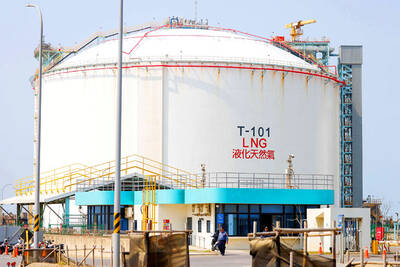
Taiwan’s natural gas supply remains stable through the end of May, despite rising concerns about potential disruptions to Qatari liquefied natural gas (LNG) supplies due to escalating conflicts in the Middle East, the Ministry of Economic Affairs said yesterday. The ministry in a statement said that Taiwan has completed preparations for natural gas supply and shipping schedules through the end of May. It has also made plans to increase natural gas imports from regions outside the Middle East in June to ensure a stable supply, it added. Taiwan sources natural gas from 14 countries and is not solely dependent on the Middle East,

China is clamping down on fertilizer exports to protect its domestic market, industry sources said, putting an additional strain on global markets that were already grappling with shortages caused by the US-Israeli war on Iran. China is among the largest fertilizer exporters — shipping more than US$13 billion of it last year — and it has a history of controlling exports to keep prices low for farmers. Shipments through the war-blocked Strait of Hormuz account for about one-third of the sea-borne supply. This month, Beijing banned exports of nitrogen-potassium fertilizer blends and certain phosphate varieties, sources said. The ban, which has not

Grab Holdings Ltd agreed to buy Delivery Hero SE’s Foodpanda operations in Taiwan for US$600 million, a deal that marks its first foray outside of its Southeast Asian base. The cash acquisition will allow Grab to expand into 21 cities across Taiwan, the Singapore-based ride-hailing and delivery company said in a statement yesterday. Grab expects the transaction to be completed in the second half, subject to regulatory approvals. The purchase will give Grab a presence on the island of about 23 million people, helping it to expand beyond its intensely competitive home market. Grab has seen growth slow dramatically as it takes


 RSS
RSS