

Ten years after the Asian tsunami devastated Sarath Kumara’s cinnamon plantation in Sri Lanka, forcing him to start over with nothing, the farmer faces a new threat from further afield.
Sri Lanka is the world’s leading cinnamon supplier thanks to its centuries-old industry, whose lush, green plantations are strung along the island’s southern coast where European colonists and Arab traders once flocked.
However, the industry says its product — known the world over as “Ceylon cinnamon” — is being undermined by a cheaper rival called “cassia cinnamon” grown mostly in China, Southeast Asia and neighboring India.
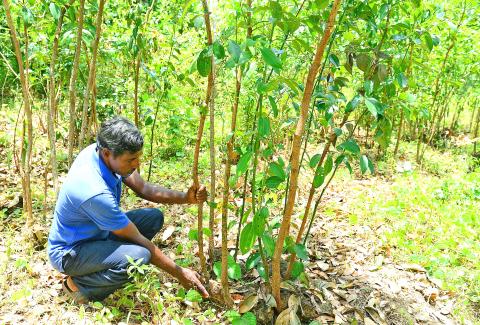
Photo: AFP
“It took about four years before I could get any crops from new trees and it is only now they are giving a full yield,” Kumara, 54, said at his ancestral farm in Hikkaduwa, 100km south of Colombo. “I have not seen cassia, but we know that some people [abroad] adulterate our cinnamon with cassia or sell cassia as Ceylon cinnamon.”
Kumara lost a brother and a sister-in-law, while half of his 9,000 trees were uprooted, when walls of water destroyed plantations in the 2004 tsunami and left 31,000 people dead and a million homeless across the country.
The industry eventually recovered to become stronger than ever thanks to international donors and a herculean effort by its farmers who replanted half a million cinnamon trees in Hikkaduwa and adjoining Balapitiya area.
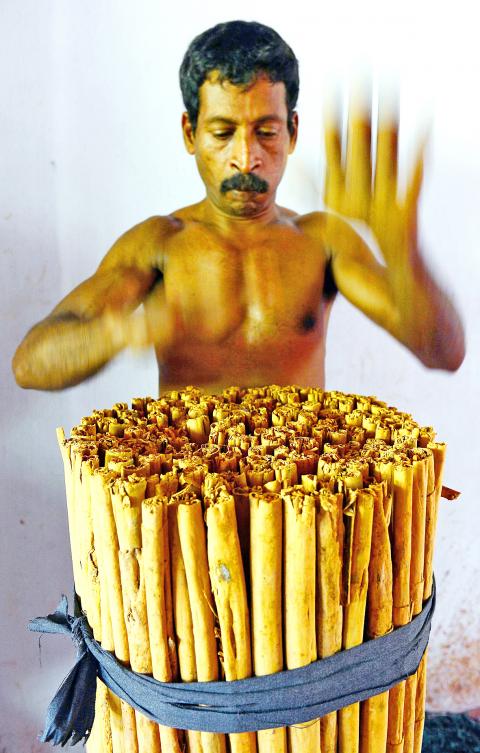
Photo: AFP
With cinnamon prices now soaring, the Sri Lankan industry fears wholesalers will increasingly turn to the cheaper product, which is darker in color and according to purists leaves a bitter aftertaste — but still label it “Ceylon cinnamon” or simply cinnamon.
The Spice Council of Sri Lanka wants to protect the brand “Ceylon cinnamon,” and has approached the WTO and the EU about gaining copyright or a patent.
“In many Western countries, cassia is passed off as Ceylon cinnamon [in supermarkets and other shops],” council head Sarada de Silva said. “The true cinnamon is Ceylon cinnamon.”
The council wants the WTO to declare “Celyon cinnamon” a specific product based on a “geographical indication” along the same lines as Champagne, which comes from the region with the same name in northern France.
Under Portuguese, Dutch and finally British colonial rule from the 1500s, the Indian Ocean island was called Celyon and switched to Sri Lanka upon becoming a republic in 1972.
The aromatic spice — used in savory dishes and desserts — grew naturally in Sri Lanka for centuries before Dutch invaders started commercial crops in the 17th century. Sri Lanka’s industry, which supplies 80 percent of the world market, is enjoying record export earnings for the island. High-grade cinnamon oil, extracted from the bark, has been fetching up to 65,000 rupees (US$510) a kilogram.
Cinnamon earned Sri Lanka a record US$135 million from 13,866 tonnes exported last year compared with US$47 million from 12,000 tonnes in 2005, with Mexico, Colombia, Peru and the US the major buyers.
“Prices have never been so good,” De Silva said. “The challenge is to get our geographical indication recognized [by the WTO and others]. That is the best way to deal with cassia.”
The tsunami tragedy pushed devastated cinnamon farmers to invest in better technology upon rebuilding their farms and oil mills and are now reaping the rewards.
“After replanting, it took me four years to make money again,” said farmer Upul Asanka, who lost his farm in the tsunami.
“Initially there was salinity in the soil, but it is better now,” the 38-year-old said.
Kumara said he harvests his 9,000 trees every eight months, compared with every 18 months before the tragedy.
“Since the tsunami our agricultural practice has improved,” Kumara said.
“I notice that the replanted trees give a better crop,” he added.
Improved productivity has also allowed farmers to produce more of the lower-grade oil extracted from cinnamon tree leaves for use in balms, disinfectants, detergents and soap. The more expensive bark oil, meanwhile, is being sold for addition to high-end perfumes and even fizzy drinks.
The council has commissioned a study into the perceived health effects of cinnamon, which some have long claimed lowers blood sugar levels and cholesterol.
Chef Dell’Ascenza Riccardo of Sri Lanka’s biggest luxury hotel chain, also known as “Cinnamon,” said he has started using the famed local product in his Italian dishes.
“I use it for my red wine sauce and many other dishes,” Riccardo said. “The diners feel something different and it makes a good impression.”

HAND-IN-HAND: Nvidia’s inability to hold the line on prices reflects how much leverage memorychip makers have amid the surge in demand for AI infrastructure Some of Nvidia Corp’s biggest customers have been told that the prices of servers containing its artificial intelligence (AI) chips are going up more than 15 percent in many cases with memory costs soaring. The price hikes would go into effect on systems shipped early next year and impact systems including those with the flagship Vera Rubin and Grace Blackwell chips, people familiar with the process said on condition of anonymity. The increases would depend on the generation of Nvidia chips and the memory configurations, they said. Companies who build the servers under contract for large data center operators such as Microsoft

YouTube is offering millions of dollars to popular channels if they upload their videos to the site exclusively for a certain period of time, in an effort to halt Netflix Inc’s pursuit of its biggest stars, people familiar with the conversations said. The payment would come in a couple of different forms. YouTube has discussed directly financing some programs, and it has also offered to allot a portion of major brand deals to creators. Although YouTube has not finalized deals with any creators, it is close an agreement with several partners, said the people, who declined to be identified because

AM Intelligence, an Indian artificial intelligence (AI) infrastructure company, has ordered 9,000 Nvidia Corp Vera Rubin systems, seeking to become one of the first adopters of the advanced computing platform in Asia. Servers equipped with the rack-scale systems are slated to come online next year in southern India, the Hyderabad-based company said in a statement yesterday. Customers include major cloud service providers, AI labs and organizations aiming to develop homegrown Indian AI models, it said. Supplies of high-end Nvidia compute clusters remain tight. Demand from data centers and companies such as Microsoft Corp, Alphabet Inc’s Google and Amazon.com Inc to train AI models
The market debut of artificial intelligence (AI) start-up Anthropic PBC, a chief rival to OpenAI, could break the record set by Space Exploration Technologies Corp (SpaceX), US media have reported. Businessman Elon Musk’s SpaceX went public in June at a value of US$1.77 trillion and raised US$85.7 billion in its blockbuster initial public offering (IPO), the largest in history. Anthropic, maker of the Claude AI models, “expects to match or beat the size” of SpaceX’s deal, Bloomberg reported. The company’s bankers have told potential investors it could seek to raise “more than US$100 billion” in its IPO, which could put the company’s


 RSS
RSS