


Cheng Shin Rubber Industry Co (正新橡膠), the world’s ninth-largest tire maker, said it expects that spending more on research and development (R&D) at its operation in Kunshan, Jiangsu Province, China, this year will help it secure more orders from international brands.
The Changhua County-based company — known for its brands CST, Maxxis, Sakura and Presa — also aims to dethrone Japan’s Yokohama Rubber Co to become the eighth-largest tire maker in the world by tapping the fast growth the Chinese car market has exhibited over recent years, it said.
Although the US currently has the largest amount of cars in the world, China is likely to supersede the US as the world’s largest car market in the future, Cheng Shin chairman Robert Lo (羅才仁) said on Tuesday in Kunshan.
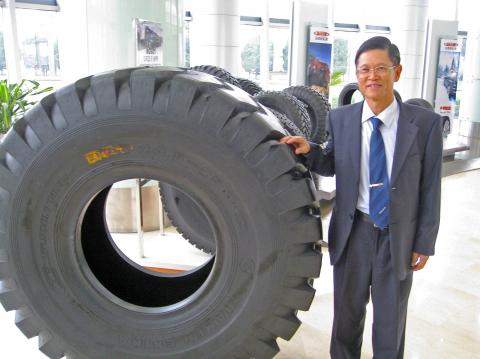
Photo: CNA
Last year, Cheng Shin supplied 13 million tires for about 3 million new cars in China, accounting for 13 percent of the country’s total new car sales of 23 million. That is higher than the 10 percent registered in 2012, Lo said.
From January through last month, Cheng Shin reported revenue of NT$87.18 billion (US$2.9 billion), registering a 4.83 percent decline from NT$89.35 billion a year ago due to fierce competition from global tier-one tire makers in China.
Analysts say the sales drop also emphatically reflects the slowing growth in China’s commercial vehicle market.
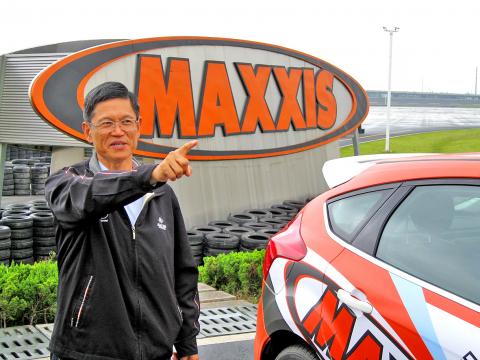
Photo: CNA
“It is as if all major tire makers around the world are playing the [soccer] World Cup in China,” said Lo, who in June took the helm of the company from his father, Luo Jye (羅結), who founded Cheng Shin.
The younger Lo said his role is to try to support the different teams within the company and help them cooperate with each other.
“It is impossible for a chairman to control every part of the company; we have to also rely on our professional management personnel,” Robert Lo said.
He said he is confident that Cheng Shin can obtain more orders from global car vendors, given that the company has Asia’s largest proven tire testing ground in Kunshan.
The NT$5 billion testing facility — the building of which began in 2003 and was completed in November 2012 — spans 86 hectares, nearly 60 percent of the total area of Cheng Shin’s Kunshan operation.
To build the field, the company spent one year investigating road conditions around the world and another two years designing the ground, Robert Lo said.
The tire-testing facility employs 300 R&D personnel, while the Kunshan operation has a total of 6,000 employees, he said.
“The testing facility allows us to submit every car to the most extreme conditions and see if the design of our tires goes well with the vehicle,” he said.
According to Lo, although the world’s top 10 tire makers all have testing facilities like the Kunshan ground, Cheng Shin is the only one with such a facility in Asia.
“Car makers tend to have more confidence in a tire company with a field like that,” Robert Lo said.
He said the test facility can cut the development time for a tire by about 30 percent because the company does not need to ship the tires to Europe or other places for testing.
The Kunshan test facility’s largest client is BMW AG, Robert Lo said, adding that Ford Motor Co is also a major client.
Cheng Shin supplies the tires used for the best-selling Ford Focus sedans in China, with 400,000 of the cars distributed in the country each year by Ford’s local subsidiary.
This year, the Kunshan operation will spend about 3 percent of its revenue on R&D, Robert Lo said.
In total, Cheng Shin spent NT$1.57 billion on R&D in the first half of the year, accounting for 2.45 percent of its NT$64.29 billion revenue, according to the company’s filing with the Taiwan Stock Exchange.
The Kunshan operation accounted for 18 percent of Cheng Shin’s total revenue of NT$133.09 billion last year, assistant vice president Richard Lo (羅永勵) told reporters yesterday.
In the first half of the year, about 64.3 percent of the division’s revenue came from sales in the original equipment market, the highest rate among all the company’s factories, according to Cheng Shin.
About 26.9 percent of the company’s revenue from January through June came from the original equipment market, it said.
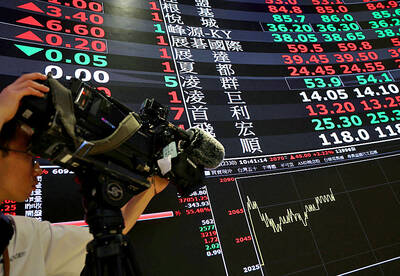
After several years flying high as Asia’s best Nvidia Corp proxy, Taiwan Semiconductor Manufacturing Co (TSMC, 台積電) is increasingly vying with other artificial intelligence (AI) stocks for investor attention. Stock traders are chasing a wider array of beneficiaries as mainstream usage of AI creates demand for hardware beyond the most-advanced chips TSMC makes for Nvidia. Subthemes from the deepening memory crunch to advances in robotics are also luring bids. At the same time, investment caps on single stocks are pushing funds to diversify, while retail investors long familiar with TSMC through its US depositary receipts are being offered a broader set of
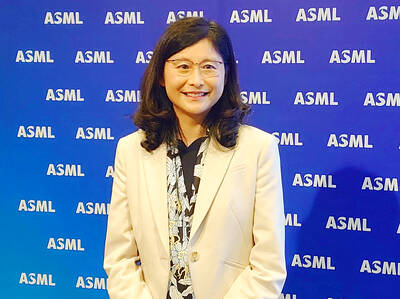
Netherlands-based semiconductor equipment supplier ASML Holding NV yesterday said that it is planning to hire an additional 1,000 people in Taiwan this year in response to growing demand from clients. ASML had previously planned to recruit 600 people this year, but that the plan has been adjusted upward, ASML vice president and ASML Taiwan general manager Grace Wang (汪佳慧) told reporters. ASML has a workforce of more than 4,500 in Taiwan, accounting for about 10 percent of its global total, Wang said. This year’s recruitment campaign would focus on adding people in the customer support, manufacturing and supply chain domains to assist ASML
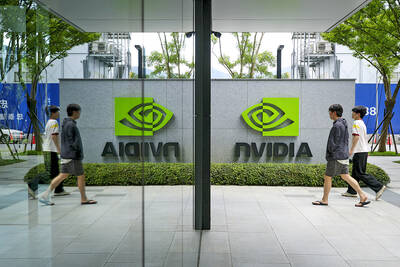
UNDER MICROSCOPE: Taiwan detained three people who allegedly conspired to buy servers in Taiwan and export them using fraudulent documentation, prosecutors said Nvidia Corp chief executive officer Jensen Huang (黃仁勳) on Saturday urged Super Micro Computer Inc to tighten up on compliance after Taiwan detained three people this week for allegedly making fraudulent declarations about artificial intelligence (AI) servers made by its US partner. The development marked the nation’s first crackdown on semiconductor smuggling, which grew after the US slapped restrictions on exports of high-end chips such as Nvidia AI accelerators to China. Nvidia is “rigorous” in explaining regulations to all of its partners, Huang told reporters after arriving in Taipei. “Ultimately Super Micro has to run their own company,” he said in response to
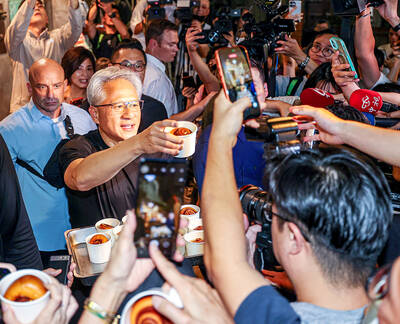
Nvidia Corp yesterday announced that CEO Jensen Huang (黃仁勳) would attend an employee meeting in Taipei tomorrow to celebrate the launch of the company’s Taiwan headquarters project. Huang would attend a gathering at the site of Nvidia’s planned headquarters in Beitou Shilin Technology Park (北投士林科技園區), the company said in a statement. After arriving in Taiwan on Saturday last week, Huang told reporters that he plans to meet with Quanta Computer Inc (廣達) chairman Barry Lam (林百里) and Taiwan Semiconductor Manufacturing Co (TSMC, 台積電) chairman C.C. Wei (魏哲家), and would attend the groundbreaking ceremony for Nvidia’s Taiwan headquarters tomorrow. Nvidia has not yet applied


 RSS
RSS