

The Indian Cabinet has approved plans to open its defense and railways industries to foreign investment as Indian Prime Minister Narendra Modi’s right-wing administration moves to reform and revive the ailing economy.
Cabinet agreed on Wednesday to increase the limit on foreign direct investment (FDI) in defense to 49 percent from 26 percent, and to allow unlimited investment in railway infrastructure, the Press Trust of India news agency reported.
The government, which unveiled both plans in the budget last month, is attempting to push ahead with reforms after sweeping to power at elections in May with the largest mandate in 30 years.
However, its efforts hit a major hurdle this week, when the opposition blocked its efforts to introduce legislation aimed at lifting investment in the insurance sector.
The Indian Cabinet approval comes as US Secretary of Defense Chuck Hagel was due to arrive in India yesterday with the goals of strengthening ties between the two militaries and drumming up defense deals.
Hagel is expected to meet with top government ministers during the three-day visit.
“The US recognizes the immense potential for its companies in the Indian arms market [with the lifting of the investment cap],” analyst Sameer Patil from Mumbai-based thinktank Gateway House said this week.
Modi’s government wants to speed up the modernization of its Soviet-era military after years of slow procurement and the collapse of deals over allegations of corruption.
India, the world’s biggest arms importer, traditionally relied on Russia but has turned to the US in recent years for equipment and other technology.
Investment in India’s vast and crumbling state-run railway network, which carries 23 million passengers a day, is desperately needed after years of neglect. India struggles to fund upgrades of the network, partly developed under British colonial rule, because most of its revenues are spent on operating costs.
Railway company shares were up yesterday on the approval, with Texmaco Rail & Engineering Ltd gaining 9.41 percent on the Bombay Stock Exchange. Kalindee Rail Nirman Engineers Ltd was up 5 percent, while Titagarh Wagons Ltd and Kernex Microsystems India Ltd were also trading almost 5 percent higher.
“The increase in FDI for railways ... will have a positive impact on the economy and growth,” Deloitte India director Vishwas Udgirkar said.
However, investment was not expected to increase overnight, with foreign companies first needing to form joint ventures with Indian firms before taking cautious steps, he said.

Taiwan Semiconductor Manufacturing Co (TSMC, 台積電) is accelerating capacity expansion fivefold this year, but it is still unable to keep up with the booming demand for artificial intelligence (AI), TSMC deputy cochief operating officer Cliff Hou (侯永清) said yesterday. This year alone, the company is building 25 chip manufacturing fabs and advanced packaging facilities worldwide, including 13 plants in Taiwan, which is unprecedented, Hou said at a CEO Summit fireside chat at Semicon Taiwan in Taipei. In the past, the company was able to build five or six factories a year, said Hou, who is also chairman of the Taiwan Semiconductor Industry
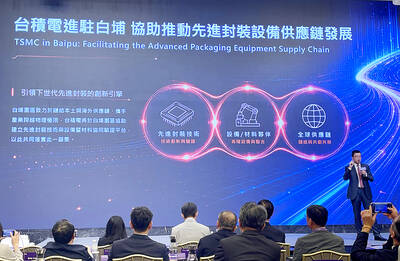
EXPANSION: The 3-hectare site would include small clean rooms and laboratories as well as a world-class training base for advanced packaging talent, the company said Taiwan Semiconductor Manufacturing Co (TSMC, 台積電) is to establish a presence in the Baipu Industrial Park (白埔產業園區) in Kaohsiung to accelerate the testing and validation of semiconductor materials and equipment, a company executive said on Tuesday. The company is working with the Ministry of Economic Affairs and the Kaohsiung City Government on the plan, which is expected to improve validation efficiency by 25 to 50 percent, TSMC vice president of advanced packaging technology and service Jun He (何軍) said at a 3D IC global summit held ahead of the Semicon Taiwan trade show, which opened in Taipei yesterday. TSMC would also conduct
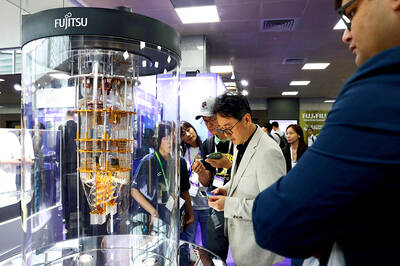
Visitors look at a 64-qubit superconducting quantum computer on display at the Fujitsu booth at the Semicon Taiwan trade show in Taipei yesterday.

Silicon photonics would play a dominant role next year and make chip-level co-packaged optics (CPO) packaging possible, Taiwan Semiconductor Manufacturing Co (TSMC, 台積電) said yesterday. “For years, critics questioned the reliability of CPO. The doubts are being thoroughly dismantled by real-world data and market validation,” TSMC vice president of advanced packaging technology development K.C. Hsu (徐國晉) said at a SEMI forum in Taipei. The company is on track to enter production of CPO later this year, Hsu said in another forum arranged by Imec in Taipei yesterday, about four months after TSMC announced its progress in CPO development in May.


 RSS
RSS