


Enterex International Ltd (英瑞國際), a Cayman Islands incorporated auto parts supplier, has filed an application for a primary listing on the main board, the Taiwan Stock Exchange (TWSE) said on Wednesday.
The TWSE said Enterex, which specializes in the production of auto components such as radiators, condensers and evaporators, is the second foreign registered company to seek a listing on the exchange this year.
According to a prospectus filed with the stock exchange, Enterex is planning to issue 11.2 million new shares for the listing and will reserve 10 percent of the new shares for its employees.
It has set the issue price tentatively at NT$40 per share, aiming to raise about NT$448 million (US$14.9 million), which will be used as working capital for future business expansion, the company said.
The fundraising is scheduled to be completed in the fourth quarter of this year, the prospectus showed.
The auto parts supplier currently has a production base in Yangzhou in China’s Jiangsu Province.
Last year, Enterex posted NT$4.31 billion in sales, up from NT$3.76 billion in 2012, with North American buyers accounting for 87.68 percent of its total revenue.
In light of its huge North American market, the auto parts maker set up a research and development center — Enterex America International LLC — in the US in 2009.
In 2011, Enterex established another subsidiary, Automotive Parts Distribution International LLC, in the US to distribute its products in North America.
Enterex is gearing up to penetrate China, which has a fast growing auto segment.
In addition, Enterex has been working with a group of engineers from Taiwan, the US, China and Japan to develop radiators for electric cars, amid growing environmental awareness.
Last year, Enterex’s net profit totaled NT$397.59 million, down from NT$485.31 million in 2012, while its earnings per share stood at NT$4.76, compared with NT$4.92 the previous year.
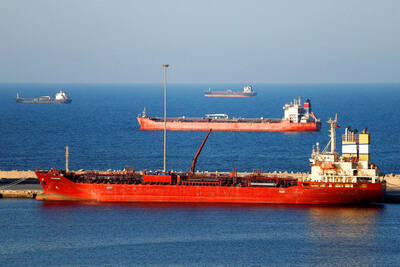
HORMUZ ISSUE: The US president said he expected crude prices to drop at the end of the war, which he called a ‘minor excursion’ that could continue ‘for a little while’ The United Arab Emirates (UAE) and Kuwait started reducing oil production, as the near-closure of the crucial Strait of Hormuz ripples through energy markets and affects global supply. Abu Dhabi National Oil Co (ADNOC) is “managing offshore production levels to address storage requirements,” the company said in a statement, without giving details. Kuwait Petroleum Corp said it was lowering production at its oil fields and refineries after “Iranian threats against safe passage of ships through the Strait of Hormuz.” The war in the Middle East has all but closed Hormuz, the narrow waterway linking the Persian Gulf to the open seas,

Taiwan has enough crude oil reserves for more than 100 days and sufficient natural gas reserves for more than 11 days, both above the regulatory safety requirement, Minister of Economic Affairs Kung Ming-hsin (龔明鑫) said yesterday, adding that the government would prioritize domestic price stability as conflicts in the Middle East continue. Overall, energy supply for this month is secure, and the government is continuing efforts to ensure sufficient supply for next month, Kung told reporters after meeting with representatives from business groups at the ministry in Taipei. The ministry has been holding daily cross-ministry meetings at the Executive Yuan to ensure

RATIONING: The proposal would give the Trump administration ample leverage to negotiate investments in the US as it decides how many chips to give each country US officials are debating a new regulatory framework for exporting artificial intelligence (AI) chips and are considering requiring foreign nations to invest in US AI data centers or security guarantees as a condition for granting exports of 200,000 chips or more, according to a document seen by Reuters. The rules are not yet final and could change. They would be the first attempt to regulate the flow of AI chips to US allies and partners since US President Donald Trump’s administration said it rescinded its predecessor’s so-called AI diffusion rules. Those rules sought to keep a significant amount of AI

Apple Inc increased iPhone production in India by about 53 percent last year and now makes a quarter of its marquee devices there, reflecting the US company’s efforts to avoid tariffs on China. The company assembled about 55 million iPhones in India last year, up from 36 million a year earlier, people familiar with the matter said, asking not to be named because the numbers aren’t public. Apple makes about 220 million to 230 million iPhones a year globally, with India’s share of the total increasing rapidly. Apple has accelerated its expansion in the world’s most populous country in recent years, bolstered


 RSS
RSS