


Singapore state investment giant Temasek Holdings Pte and Chinese oil group Sinopec Corp (中國石化) aim to snap up a multibillion-euro stake in Spain’s Gas Natural SDG SA, the Financial Times said yesterday.
The two groups had contacted Spanish oil firm Repsol YPF SA separately to say they were interested in buying its 4.7 billion euro (US$6.4 billion) stake in Gas Natural, the paper said, citing people close to the process.
Spanish company Repsol has a 30 percent stake in Gas Natural and wants to sell most of the investment so as to leave itself with a 5 percent share in the gas firm.
Repsol has been selling assets to replace income lost after the nationalization of its Argentinian subsidiary YPF by Argentinian President Cristina Kirchner’s government in April last year.
POTENTIAL INVESTORS
Spanish lender CaixaBank, which is the largest single investor in Repsol with a 12 percent stake and in Gas Natural with a 34 percent stake, approves of Temasek and Sinopec as potential investors, the paper said.
Spanish business daily Expansion said Repsol also was considering an alternative approach of taking over the whole of Gas Natural after selling some of its assets, but this scheme was opposed by CaixaBank.
In February, Repsol announced it was selling a part of its liquefied natural gas business to Dutch-anglo group Royal Dutch Shell for US$6.65 billion.
STRATEGIC PLAN
The group’s 2012-to-2016 strategic plan proposes 19 billion euros in international investments, of which 80 percent is destined for exploration and production.
The strategy includes investing 2 billion euros in Brazil, 2.3 billion euros in the US, 1.2 billion euros in Venezuela, 400 million euros in Russia and 20 million euros in Spain.
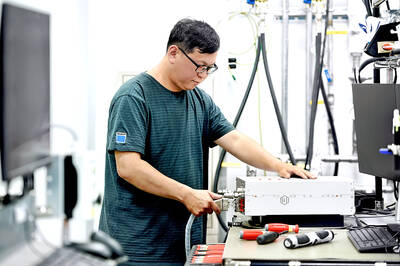
SEMICONDUCTORS: The German laser and plasma generator company will expand its local services as its specialized offerings support Taiwan’s semiconductor industries Trumpf SE + Co KG, a global leader in supplying laser technology and plasma generators used in chip production, is expanding its investments in Taiwan in an effort to deeply integrate into the global semiconductor supply chain in the pursuit of growth. The company, headquartered in Ditzingen, Germany, has invested significantly in a newly inaugurated regional technical center for plasma generators in Taoyuan, its latest expansion in Taiwan after being engaged in various industries for more than 25 years. The center, the first of its kind Trumpf built outside Germany, aims to serve customers from Taiwan, Japan, Southeast Asia and South Korea,
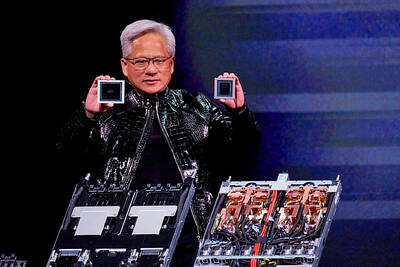
Nvidia Corp chief executive officer Jensen Huang (黃仁勳) on Monday introduced the company’s latest supercomputer platform, featuring six new chips made by Taiwan Semiconductor Manufacturing Co (TSMC, 台積電), saying that it is now “in full production.” “If Vera Rubin is going to be in time for this year, it must be in production by now, and so, today I can tell you that Vera Rubin is in full production,” Huang said during his keynote speech at CES in Las Vegas. The rollout of six concurrent chips for Vera Rubin — the company’s next-generation artificial intelligence (AI) computing platform — marks a strategic

Gasoline and diesel prices at domestic fuel stations are to fall NT$0.2 per liter this week, down for a second consecutive week, CPC Corp, Taiwan (台灣中油) and Formosa Petrochemical Corp (台塑石化) announced yesterday. Effective today, gasoline prices at CPC and Formosa stations are to drop to NT$26.4, NT$27.9 and NT$29.9 per liter for 92, 95 and 98-octane unleaded gasoline respectively, the companies said in separate statements. The price of premium diesel is to fall to NT$24.8 per liter at CPC stations and NT$24.6 at Formosa pumps, they said. The price adjustments came even as international crude oil prices rose last week, as traders
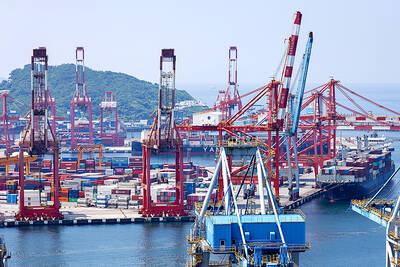
PRECEDENTED TIMES: In news that surely does not shock, AI and tech exports drove a banner for exports last year as Taiwan’s economic growth experienced a flood tide Taiwan’s exports delivered a blockbuster finish to last year with last month’s shipments rising at the second-highest pace on record as demand for artificial intelligence (AI) hardware and advanced computing remained strong, the Ministry of Finance said yesterday. Exports surged 43.4 percent from a year earlier to US$62.48 billion last month, extending growth to 26 consecutive months. Imports climbed 14.9 percent to US$43.04 billion, the second-highest monthly level historically, resulting in a trade surplus of US$19.43 billion — more than double that of the year before. Department of Statistics Director-General Beatrice Tsai (蔡美娜) described the performance as “surprisingly outstanding,” forecasting export growth


 RSS
RSS