


Global container shippers may find it challenging to raise freight rates this month because of oversupply problems caused by slow seasonal demand this quarter, according to reports issued by brokerage houses.
Major container shipping companies in Taiwan, including Evergreen Marine Corp (長榮海運) and Wan Hai Lines Ltd (萬海航運), have announced their rate hike programs, or rate restoration plans, which took effect yesterday.
Evergreen Marine, the owner of the nation’s largest container shipper fleet, is set to hike rates for its Far East and Indian subcontinent to Europe and the Mediterranean region by US$450 per twenty-foot equivalent unit (TEU), or by US$900 per forty-foot equivalent unit (FEU).
Wan Hai, meanwhile, unveiled a price increase plan on all dry cargoes originated from Asia, by US$300 per TEU, or US$600 per FEU, for routes to Middle East and Pakistan, as well as by US$200 per TEU, or US$400 per FEU, for routes to India and Sri Lanka.
It marked the sixth consecutive price increases this year by major global container shippers.
Evergreen Marine president Anchor Chang (張正鏞) said the price hike reflected an uptrend in demand in the container shipping industry this quarter. Chang expected strong sentiment will last to next quarter.
OVERSUPPLY
“With expected oversupply in the shipping sector near term, it will be challenging to fully pass on the higher fuel costs unless the industry cuts more capacity,” JPMorgan analyst Corrine Png (方華婷) said in the report.
Capital Securities Corp (群益證券) shared JPMorgan’s views, saying freight rates in the container shipping industry may be less pressured next quarter, as the number of idling vessels remained relatively low, with the amount of new capacity added in the second half of this year also higher than the first half.
That may make major container shippers in Taiwan see profitability in October-to-December period decline from three months ago — the traditional high season for the industry, Capital Securities said in its report.
However, SinoPac Securities Investment Service Co (永豐投顧) kept a more optimistic outlook for the container shipping industry.
CONTROLLING CAPACITY
Despite a low level of idling vessels, SinoPac Securities said major global container shippers have been indirectly controlling capacity by lowering speed and not operating extra services during the peak period.
In addition, the economic recovery in the US and Europe may help support the rate restoration program, SinoPac said in its report.
SinoPac Securities expects the three major container shipper in Taiwan — Evergreen Marine, Wan Hai and Yang Ming Marine Transport Corp (陽明海運) — to return to the black in the third quarter.
However, for the whole of this year, Yang Ming may still suffer a net loss of NT$2.66 billion (US$88.72 million) because of heavy losses made in the first half, SinoPac Securities forecast.
However, Evergreen Marine and Wan Hai would have a better chance to make profits for the entire year, the brokerage said.
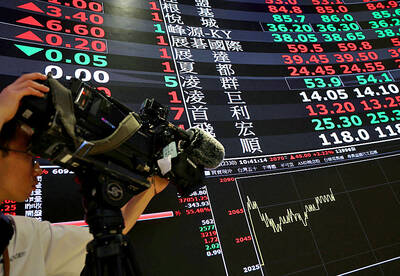
After several years flying high as Asia’s best Nvidia Corp proxy, Taiwan Semiconductor Manufacturing Co (TSMC, 台積電) is increasingly vying with other artificial intelligence (AI) stocks for investor attention. Stock traders are chasing a wider array of beneficiaries as mainstream usage of AI creates demand for hardware beyond the most-advanced chips TSMC makes for Nvidia. Subthemes from the deepening memory crunch to advances in robotics are also luring bids. At the same time, investment caps on single stocks are pushing funds to diversify, while retail investors long familiar with TSMC through its US depositary receipts are being offered a broader set of

Netherlands-based semiconductor equipment supplier ASML Holding NV yesterday said that it is planning to hire an additional 1,000 people in Taiwan this year in response to growing demand from clients. ASML had previously planned to recruit 600 people this year, but that the plan has been adjusted upward, ASML vice president and ASML Taiwan general manager Grace Wang (汪佳慧) told reporters. ASML has a workforce of more than 4,500 in Taiwan, accounting for about 10 percent of its global total, Wang said. This year’s recruitment campaign would focus on adding people in the customer support, manufacturing and supply chain domains to assist ASML
UNDER MICROSCOPE: Taiwan detained three people who allegedly conspired to buy servers in Taiwan and export them using fraudulent documentation, prosecutors said Nvidia Corp chief executive officer Jensen Huang (黃仁勳) on Saturday urged Super Micro Computer Inc to tighten up on compliance after Taiwan detained three people this week for allegedly making fraudulent declarations about artificial intelligence (AI) servers made by its US partner. The development marked the nation’s first crackdown on semiconductor smuggling, which grew after the US slapped restrictions on exports of high-end chips such as Nvidia AI accelerators to China. Nvidia is “rigorous” in explaining regulations to all of its partners, Huang told reporters after arriving in Taipei. “Ultimately Super Micro has to run their own company,” he said in response to

Nvidia Corp yesterday announced that CEO Jensen Huang (黃仁勳) would attend an employee meeting in Taipei tomorrow to celebrate the launch of the company’s Taiwan headquarters project. Huang would attend a gathering at the site of Nvidia’s planned headquarters in Beitou Shilin Technology Park (北投士林科技園區), the company said in a statement. After arriving in Taiwan on Saturday last week, Huang told reporters that he plans to meet with Quanta Computer Inc (廣達) chairman Barry Lam (林百里) and Taiwan Semiconductor Manufacturing Co (TSMC, 台積電) chairman C.C. Wei (魏哲家), and would attend the groundbreaking ceremony for Nvidia’s Taiwan headquarters tomorrow. Nvidia has not yet applied


 RSS
RSS