


W ith two cars, foreign holidays and a cook for their apartment, one Beijing family epitomizes the new middle class created by China’s decades of rapid economic growth — and its resulting worries.
Li Na, 42, is a caterer at the Beijing Zoo, and her husband, Chi Shubo, 48, works for a state-owned investment company. The couple have seen their fortunes transformed since Li arrived in Beijing 20 years ago from Shandong Province.
Then, she cycled for hours from a shared dormitory to visit her husband’s workplace. Now she commutes in a US-made car and the couple holiday with their 11-year-old daughter in Japan, South Korea and the US.
Photo: Reuters
Tens of millions of other Chinese have made a similar transition. About 10 percent of China’s 1.35 billion people now count as middle class, according to the Organisation for Economic Co-operation and Development, a figure that is set to rise to 40 percent by 2020.
However, their concerns about air pollution, food safety and China’s education system show the challenges facing the country’s newly appointed leaders, who have promised a shift away from the model of growth at all costs.
Every year, Li and her husband set a goal to improve their lives.
“We always have a plan,” Li said. “For example, this year I might want a new camera and my husband will help make that come true.”
The family’s four-bedroom apartment in a Beijing suburb was the most important purchase of their lives.
“We struggled half our lives to buy it,” Li said over a breakfast of fried eggs and bacon.
In a picture of comfortable suburban living, their daughter, who goes by the name Nancy, sprawls on a vast sofa opposite a huge flat-screen Sony television, nuzzling the family’s fluffy brown dog.
Li says her top priority is Nancy’s education. It is not a school day, but Li’s iPhone alarm rings to signal that it is time for her daughter’s first lesson.
She steers her Chevrolet Epica sedan past forests of near-identical apartment blocks to the Haidian Youth Palace, a relic of Maoist-era China which now holds classes aimed at boosting children’s creativity.
At weekends, Nancy has lessons in traditional Chinese calligraphy and a badminton class “with a private coach,” Li said.
In the past year, the young girl swapped learning the piano for a new instrument, the ocarina, a pocket-sized flute.
Nancy has only three or four hours of free time a day on weekends, Li said, as she seeks to hold her position in China’s highly competitive education system.
A glut of graduates created by the expansion of China’s university system means that the graduate unemployment rate is higher than that of the general population, making winning a place at the very best colleges ever more crucial.
Getting into a top school is also not always about ability, Li said, with cash donations sometimes involved.
“Sometimes parents need to do extra work, give out red envelopes and even then, success can depend on your contacts,” she said.
This year has bought some more worrying lessons. When thick smog blanketed northern China, sending pollution levels soaring in the capital, Nancy learned about PM2.5, the name given to invisible pollutants which can damage children’s lungs.
She reached into the pocket of her mother’s car seat and pulled out a face mask.
“My mum made me wear this every day in January and February because the PM2.5 was very bad,” she said.
At lunchtime, the family gathers in a chain restaurant over plates of braised pork, spicy tofu and buns filled with red bean paste. However, eating out is becoming a rarer treat.
Years of scandals involving poisoned food — from tainted milk, to reprocessed “gutter oil” taken from drains and sold as new, to rat meat passed off as lamb — make the family nervous about Beijing’s restaurants.
“I try to make sure my daughter eats outside as little as possible,” Li said.
At dinner time, Nancy runs to the door to greet her father, while a domestic helper cooks dozens of seafood-filled dumplings. Li pulls a bottle of imported Australian wine from a cabinet, before deciding on a New Zealand red.
Worries about safety mean they source their food carefully, ideally from farms near Li’s home town, she said, adding: “There is corruption in the industry, which makes the problem worse.”
The family has benefited hugely from decades of rapid economic growth, but Li hopes for more from China’s new leadership, formally installed in March.
“Ordinary people are losing faith in the government because of problems accumulating over a long period,” she said. “I don’t think their main duty is to improve the economy ... it’s to improve the quality of life, so that we don’t have to eat oil from the gutter, or worry about milk.”
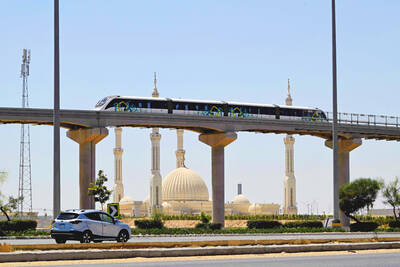
Cairo’s new monorail slices across the city skyline, running above the familiar chaos of blaring horns and aging buses’ exhaust fumes that mark rush hour below. The US$4.5 billion monorail, opened this month, is among Egypt’s most prominent new transport projects, part of a debt-funded infrastructure drive criticized for sapping state finances while bringing limited benefits to most of the country’s 109 million people. “It feels like you’re in a different country,” said Ramy Sayed, a restaurant manager, aboard a driverless Innovia 300 train. “No noise, no traffic, we’re not used to this.” The eastern line runs 56km from the bustling middle-class
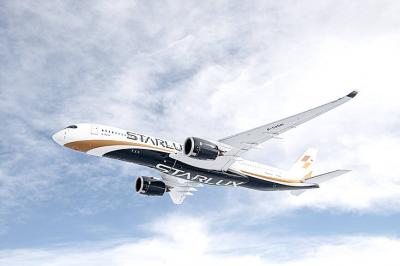
Starlux Airlines Co (星宇航空) today unveiled a long-haul network expansion plan at a shareholders’ meeting in Taipei, including direct flights to Barcelona, Spain, and Zurich, Switzerland, as well as a service connecting Taipei, Sydney and New Zealand. Starlux is to become the first Taiwanese carrier to offer non-stop services to the two European cities, while the inaugural oceanic route is expected to expand transit opportunities within the Australia-New Zealand market, Starlux said. Flight services to Chicago, Dallas, Washington and New York are under evaluation, the airline added. Prior to the shareholders’ meeting, the airline earlier this year announced that it would be

Taiwanese firms have increased investment in the Philippines in recent years as Manila’s ties with Washington deepen and global supply chains continue to shift away from China, an expert at the Chung-Hua Institution for Economic Research (CIER, 中華經濟研究院) said yesterday. The Philippines had not been among Taiwanese investors’ top choices in Southeast Asia, CIER Taiwan ASEAN Studies Center director Kristy Hsu (徐遵慈) said at a seminar in Taipei. However, Taiwan’s investment in the country has grown significantly since the COVID-19 pandemic, reaching US $257 million last year, a high in recent years, she said. Although Taiwan’s total investment in the Philippines still lags

Taiwanese prosecutors suspect that three people successfully smuggled at least one shipment of Nvidia Corp artificial intelligence (AI) chips to China after first exporting them to Japan, people familiar with the matter said. The trio was detained last week by the Keelung District Prosecutors’ Office for allegedly falsifying documents related to exports of Super Micro Computer Inc servers containing advanced Nvidia chips, which the US has barred from sale to China without a license from Washington. The move marked Taiwan’s first public crackdown on AI chip diversion after years of pressure from the US to take a more active role in curtailing


 RSS
RSS