


Aspeed Technology Inc (信驊), which designs chips for servers supporting cloud computing technology, is issuing a total of 2.04 million shares for its debut on the GRETAI Securities Market today.
With an initial public offering price (IPO) of NT$110, the company expects to raise NT$223.96 million (US$7.59 million) from its debut, the company said yesterday.
A remote-end server chip provider, the company’s net profit last year grew 50.62 percent to NT$136 million, or earnings per share of NT$6.5.
Although the first quarter is usually a slow season for technology companies, Aspeed’s net profit in the first three months of the year expanded 105.93 percent to NT$40.15 million from NT$19.5 million a year ago, due to foreign-exchange gains and better operating expense control, the company told reporters.
“We are very optimistic about sales this month and forecast the figure will hit a record high after reaching NT$54.81 million in March,” Aspeed chairman Chris Lin (林鴻明) said at a pre-IPO press conference.
“Our sales from this quarter are expected to achieve sequential quarter-on-quarter growth, supported by strong demand from Microsoft Corp,” Lin added.
Aspeed’s sales of chips used in cloud computing technology-enabled servers has grown 30 percent annually since 2010, Lin said.
As Microsoft Corp and Intel Corp, the company’s two largest clients, shift focus to “cloud concepts” to meet the rapid increase in data consumption by smartphone and tablet users, Aspeed said it expected revenue from chips used in Windows 8-powered products to drive its annual sales.
Last year, chips used in servers accounted for 92.8 percent of Aspeed’s sales, while video, desktop and notebook camera chips accounted for 7.2 percent, Lin said.
Citing reports by market researchers, Lin said that enterprise servers are expected to see a compounded annual growth rate of 5 to 6 percent, but Aspeed’s cloud servers are forecast to outpace the industry and grow by up to 30 percent.
Currently, Japan’s Renesas Electronics Corp is the world’s largest supplier of remote-end server chips, accounting for 50 percent of the market, followed by Aspeed with 25 percent and the US’ Emulex Corp with 25 percent.
Aspeed last year rolled out a new chip that can convert Microsoft’s Windows 8 operating system virtually across different devices, beating Texas Instruments Inc of the US in launching the product.
“We were far ahead of Texas Instruments; together we are the only two chip providers to Microsoft,” Lin said.
“Through collaboration with Microsoft, the tech industry giant, we forecast our chip products will achieve explosive growth this year,” Lin said.

DAMAGE REPORT: Global central banks are assessing war-driven inflation risks as the law of unintended consequences careens around the world, spiking oil prices Central banks from Washington to London and from Jakarta to Taipei are about to make their first assessments of economic damage after more than two weeks of conflict between the US and Iran. Decisions this week encompassing every member of the G7 and eight of the world’s 10 most-traded currency jurisdictions are likely to confirm to investors that the specter of a new inflation shock is already worrying enough to prompt heightened caution. The US Federal Reserve is widely expected to do exactly what everyone anticipated weeks ahead of its March 17-18 policy gathering: hold rates steady. The narrative surrounding that
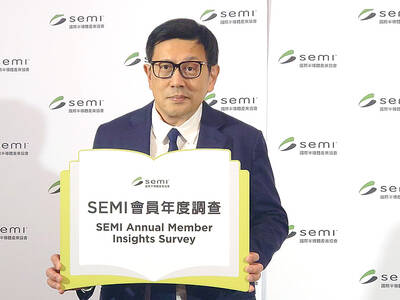
PRICE HIKES: The war in the Middle East would not significantly disrupt supply in the short term, but semiconductor companies are facing price surges for materials Taiwan’s semiconductor companies are not facing imminent supply disruptions of essential chemicals or raw materials due to the war in the Middle East, but surges in material costs loom large, industry association SEMI Taiwan said yesterday. The association’s comments came amid growing concerns that supplies of helium and other key raw materials used in semiconductor production could become a choke point after Qatar shut down its liquefied natural gas (LNG) production and helium output earlier this month due to the conflict. Qatar is the second-largest LNG supplier in the world and accounts for about 33 percent of global helium output. Helium is
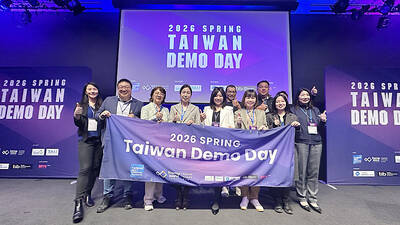
About 1,000 participants, including more than 200 venture capitalists, joined the Taiwan Demo Day in Silicon Valley on Saturday, the largest iteration to date of the event held ahead of Nvidia Corp’s annual GPU Technology Conference which runs from today to Thursday. Taiwan Demo Day, co-organized by the Taiwan Next Foundation and the Startup Island Taiwan Silicon Valley Hub, took place at the Computer History Museum in California, showcasing 12 teams focused on physical artificial intelligence (AI) and agentic AI technologies. Katie Hsieh (謝凱婷), founder of the Taiwan Next Foundation, said the event highlighted the strength of the Taiwan-US start-up ecosystem, with
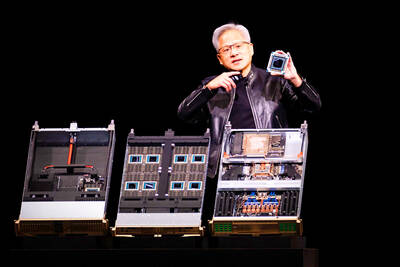
DOMESTIC COMPONENT: Huang identified several Taiwanese partners to be a key part of Nvidia’s Vera Rubin supply chain, including Asustek, Hon Hai and Wistron Nvidia Corp chief executive officer Jensen Huang (黃仁勳), addressing crowds at the company’s biggest annual event, unveiled a variety of new products while predicting that its flagship artificial intelligence (AI) processors would help generate US$1 trillion in sales through next year. During a two-and-a-half-hour keynote address, Huang announced plans to push deeper into central processing units (CPUs) — Intel Corp’s home turf — and introduced semiconductors made with technology acquired from start-up Groq Inc. The company even said it was developing chips for data centers in outer space. At the heart of Huang’s speech was the message that demand for computing power


 RSS
RSS