


Gold’s price cycle has probably turned as the recovery in the US economy gathers momentum and investment holdings collapse, according to Goldman Sachs Group Inc, which reduced forecasts for the metal.
The bank cut its three-month target to US$1,615 an ounce from US$1,825 and lowered the six and 12-month forecasts to US$1,600 and US$1,550 from US$1,805 and US$1,800.
Goldman reversed an assumption exchange-traded products holdings will expand this year, analysts Damien Courvalin and Jeffrey Currie wrote in a report on Monday.
Gold has dropped 5 percent this year as economic data improved, equities advanced and some US central bankers sought more flexibility in their stimulus program. An inevitable unwinding of gold’s 12-year bull market has begun, Credit Suisse Group AG said on Thursday in a report. ETP holdings are poised for the biggest monthly decline since January 2011.
“The turn in the gold cycle has likely already started,” the Goldman analysts wrote in the report, after predicting an end of gold’s bull run in a note on Dec. 5 last year.
“The latest collapse in gold ETF holdings stands in sharp contrast to our assumption that ETF positions were likely driven by longer-term allocation rather than short-term trading,” the analysts said.
Gold for April delivery traded at US$1,592.80 an ounce on the Comex at 1:49pm in Singapore, poised for a fifth monthly drop in what would be the worst run since 1997. Holdings in ETPs, also known as exchange-traded funds, fell to a five-month low of 2,536.289 metric tonnes yesterday and have shrunk 2.9 percent this month, data compiled by Bloomberg show.
Billionaire investors George Soros and Louis Moore Bacon cut their stakes in gold ETPs last quarter, while John Paulson maintained his share, government filings showed this month.
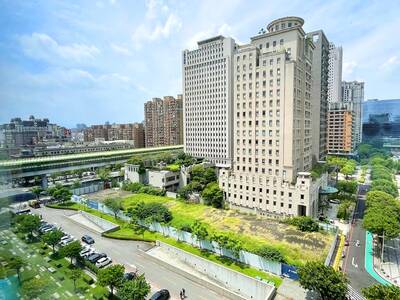
Taichung reported the steepest fall in completed home prices among the six special municipalities in the first quarter of this year, data compiled by Taiwan Realty Co (台灣房屋) showed yesterday. From January through last month, the average transaction price for completed homes in Taichung fell 8 percent from a year earlier to NT$299,000 (US$9,483) per ping (3.3m²), said Taiwan Realty, which compiled the data based on the government’s price registration platform. The decline could be attributed to many home buyers choosing relatively affordable used homes to live in themselves, instead of newly built homes in the city’s prime property market, Taiwan Realty
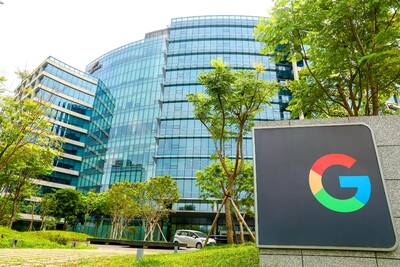
The government yesterday approved applications by Alphabet Inc’s Google to invest NT$27.08 billion (US$859.98 million) in Taiwan, the Ministry of Economic Affairs said in a statement. The Department of Investment Review approved two investments proposed by Google, with much of the funds to be used for data processing and electronic information supply services, as well as inventory procurement businesses in the semiconductor field, the ministry said. It marks the second consecutive year that Google has applied to increase its investment in Taiwan. Google plans to infuse NT$25.34 billion into Charter Investments Ltd (特許投資顧問) through its Singapore-based subsidiary Fructan Holdings Singapore Pte Ltd, and

JET JUICE: The war on Iran’s secondary effects have seen fuel prices skyrocket, knocking flight schedules down to earth in return as airlines struggle with costs Airline passengers should brace for more irritation in the next few months as carriers worldwide cancel flights and ground planes to cope with stratospheric increases in jet-fuel prices. Dutch flag carrier KLM is the latest company to cut its schedule, saying on Thursday that it would scrap 80 return flights at Amsterdam’s Schiphol Airport in the coming month. That puts it in the same league as United Airlines Holdings Inc, Deutsche Lufthansa AG and Cathay Pacific Airways Ltd, which have all pruned itineraries to mitigate costs. Global capacity for next month has been reduced by about 3 percentage points, with all

The US said it plans to help build a first-of-its-kind industrial hub in the Philippines to boost production of inputs crucial to US supply chains. The 4,000-acre hub is intended to be “a purpose-built platform for allied manufacturing” and “an investment acceleration hub where the specific industrial activities are shaped by market demand,” the US Department of State said on Thursday. The project — touted as an “economic security zone” — would be within the Luzon Economic Corridor, a flagship economic project backed by the US and Japan on the main Philippine island. The project was also described as “the first artificial intelligence


 RSS
RSS