


In a small Arctic town in Sweden, a construction crew bundled up in heavy parkas is bustling around a building site unlike any other: A massive ice hotel is taking shape.
Armed with thick gloves and safety helmets over fur-lined hats, the builders in the northern town of Jukkasjarvi assemble 2 tonne blocks of ice as if they were a large set of Lego blocks, with the end result a giant igloo with several domes, vaulted ceilings and archways.
In one hallway, a worker uses a large pick to carve a door out of blue-tinged packed snow, working up a sweat despite the sub-zero temperatures as he exhales feathery puffs of breath.
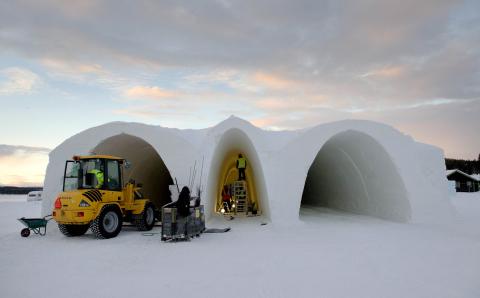
Photo: AFP
The builders had just a few weeks to sculpt 65 hotel rooms, a lobby and reception area, a main hall and an ice bar in a race against the clock ahead of the opening earlier this month.
An ice chapel will be added to host weddings and christenings, complete with an ice-sculpted altar, font and pews.
Yet all this effort is ephemeral: In a few months, the entire structure will melt away with the spring thaw.
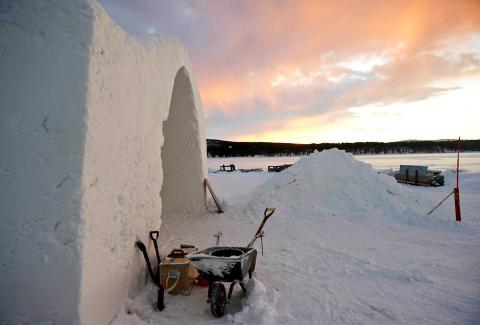
Photo: AFP
“We’re completely dependent on the weather, we have a schedule to adhere to, but it varies from year to year,” Icehotel representative Beatrice Karlsson said.
The construction method is unique to the Icehotel, to Nordic architecture expert Rasmus Waern said.
“It’s totally original. There’s no tradition in Scandinavia of building with ice,” he said.
However, it is rapidly becoming a tradition: the Icehotel is being staged for the 23rd time this year on the shores of the Torne River from where the ice is taken.
“In March, 5,000 tonnes of ice are pulled from the river and then conserved in 2 tonne blocks in two warehouses where the temperature is maintained at between minus-8oC and minus-5oC,” said Jens Thoms Ivarsson, who is in charge of the hotel’s interior design.
Construction typically begins in the autumn, when the first polar chills descend on Sweden’s far north.
However, once spring arrives five months later, bringing with it the long-awaited sun, the entire site melts down.
“We return to the Torne what we borrowed,” said Thoms Ivarsson, grateful for the river’s loan without which the Icehotel could not exist.
Once the building process is completed, the interior still needs to be decorated. Ornate chandeliers will embellish the main hall, while avant-garde sculptures, bas reliefs, chairs and beds all cut out of ice will adorn the rooms.
Each of the 16 suites is considered a unique piece of art, designed by artists selected from more than 100 applicants from all corners of the globe.
While management refuses to disclose how much the entire endeavor costs each year, the hotel’s interior design alone has a budget of 5 million kronor (US$752,000).
Ambitious sculptures in the past have included a pinball machine with colored lights inside the ice, a man sitting on a toilet in a bathroom, a female Buddha, a rocket ship and the inside of a refrigerator.
The hotel also has 49 standard rooms with less elaborate decor, some of which will feature scenes of northern lights, a spectacular phenomenon also known as the aurora borealis in which streams of colored lights streak across the night sky, a show some visitors will be lucky enough to see during their stay.
As in the suites, all of the regular room beds are made of ice blocks covered with reindeer skins. Visitors spending the night are given thermal sleeping bags when they check in — and a diploma when they check out to prove they survived a night at minus-7oC.
The hotel — copies of which are now erected in several other countries — has no stars the way other hotels do.
Yet that does not mean it is for budget travelers: The cost of a room ranges from 2,200 kronor to 7,000 kronor per night.
Alternately, tourists can pay 325 kronor a head to tour the hotel, which also makes money off the weddings and christenings it hosts, as well as the popular ice bar where drinks are served in glasses made of ice.
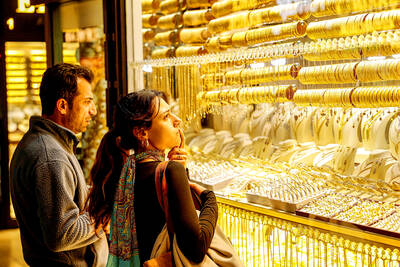
In Italy’s storied gold-making hubs, jewelers are reworking their designs to trim gold content as they race to blunt the effect of record prices and appeal to shoppers watching their budgets. Gold prices hit a record high on Thursday, surging near US$5,600 an ounce, more than double a year ago as geopolitical concerns and jitters over trade pushed investors toward the safe-haven asset. The rally is putting undue pressure on small artisans as they face mounting demands from customers, including international brands, to produce cheaper items, from signature pieces to wedding rings, according to interviews with four independent jewelers in Italy’s main

Japanese Prime Minister Sanae Takaichi has talked up the benefits of a weaker yen in a campaign speech, adopting a tone at odds with her finance ministry, which has refused to rule out any options to counter excessive foreign exchange volatility. Takaichi later softened her stance, saying she did not have a preference for the yen’s direction. “People say the weak yen is bad right now, but for export industries, it’s a major opportunity,” Takaichi said on Saturday at a rally for Liberal Democratic Party candidate Daishiro Yamagiwa in Kanagawa Prefecture ahead of a snap election on Sunday. “Whether it’s selling food or

CONCERNS: Tech companies investing in AI businesses that purchase their products have raised questions among investors that they are artificially propping up demand Nvidia Corp chief executive officer Jensen Huang (黃仁勳) on Saturday said that the company would be participating in OpenAI’s latest funding round, describing it as potentially “the largest investment we’ve ever made.” “We will invest a great deal of money,” Huang told reporters while visiting Taipei. “I believe in OpenAI. The work that they do is incredible. They’re one of the most consequential companies of our time.” Huang did not say exactly how much Nvidia might contribute, but described the investment as “huge.” “Let Sam announce how much he’s going to raise — it’s for him to decide,” Huang said, referring to OpenAI
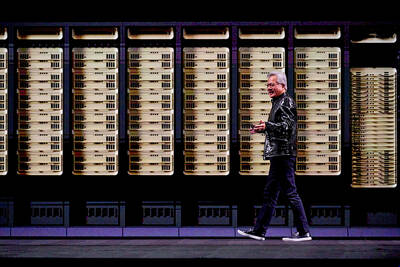
The global server market is expected to grow 12.8 percent annually this year, with artificial intelligence (AI) servers projected to account for 16.5 percent, driven by continued investment in AI infrastructure by major cloud service providers (CSPs), market researcher TrendForce Corp (集邦科技) said yesterday. Global AI server shipments this year are expected to increase 28 percent year-on-year to more than 2.7 million units, driven by sustained demand from CSPs and government sovereign cloud projects, TrendForce analyst Frank Kung (龔明德) told the Taipei Times. Demand for GPU-based AI servers, including Nvidia Corp’s GB and Vera Rubin rack systems, is expected to remain high,


 RSS
RSS