


Facebook shares plunged on Monday after Barron’s, the influential markets-focused newspaper and Web site, said the stock was still sharply overvalued and was possibly only worth US$15.
The shares slumped 9.06 percent to end the day at US$20.79, after dipping as low as US$20.36.
The fall came after Barron’s published a story saying the world’s largest online social networking company was still overpriced despite a drop of nearly half since its initial public offering (IPO) four months ago.
“Facebook’s 40 percent plunge from its initial public offering price of US$38 in May has millions of investors asking a single question: Is the stock a buy?” Barron’s said. “The short answer is ‘No.’”
“What are the shares worth? Perhaps only US$15,” Barron’s said, adding that even at that level they are “no bargain.”
The shares are still above their post-IPO low of US$17.55, but analysts have warned that on Oct. 29 a huge new supply of shares from company employees, up to now prohibited from selling their holdings, could flood the market, putting more downward pressure on the price.
Addressing the IPO flop for the first time on Sept. 11, Facebook founder Mark Zuckerberg said: “The performance of the stock has obviously been disappointing and we care about our shareholders.”
However, he assured that over time, “we’re going to be making more money on mobile than we make on desktop.”
However, Barron’s argued that the firm was behind on addressing the challenge of getting advertising revenue from people using Facebook on their smartphones.
Separately, Facebook on Monday denied reports that it displayed some users’ old private messages in public “timelines” at the social network.
Facebook said it investigated the complaints, initially from members in France, and was satisfied there had been no breach of privacy.
“A small number of users raised concerns after what they mistakenly believed to be private messages appeared on their Timeline,” it said in an e-mail response to a reporter’s inquiry.
“Our engineers investigated these reports and found that the messages were older wall posts that had always been visible on the users’ profile pages,” it said.
Concerns that private Facebook messages from 2007, 2008, or 2009 were being posted for public viewing spread wildly on one-to-many text message service Twitter after a story first appeared in free French daily Metro.
Facebook remained adamant that messages at issue were “wall” posts that have always been open to viewing by others and not made with private side-conversation tools subsequently added to the service.

NEW MARKET: The partnership opens up India to the Dutch company, which already has a strong hold in the semiconductor market of South Korea, Taiwan and China ASML Holding NV entered into a partnership agreement with Tata Electronics Pvt Ltd aimed at ramping up India’s goal to develop domestic chip-manufacturing capabilities. The Dutch company’s technology would help power Tata Electronics’ planned 300 millimeter (mm) semiconductor foundry in Gujarat, according to a joint statement from the two companies on Saturday. The signing of a memorandum of understanding coincides with a visit by Indian Prime Minister Narendra Modi to the Netherlands, which is looking to deepen bilateral relations with New Delhi. ASML, whose top customers include Taiwan Semiconductor Manufacturing Co (台積電) and Samsung Electronics Co, makes lithography machines that can print
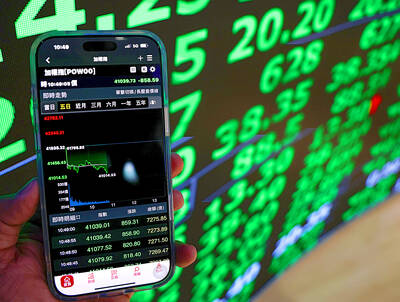
PORTFOLIO REBALANCING: The adjustments in three global equity indices reflect rising investor appetite for semiconductor and artificial intelligence-related stocks Taiwan’s weighting in major global equity indices compiled by MSCI Inc is to rise modestly following the latest quarterly review, underscoring the market’s expanding role in emerging-market portfolios, as global investors continue to favor the nation’s technology sector. Taiwan’s weighting in the MSCI Emerging Markets Index is to increase by 0.30 percentage points to 23.76 percent, after the changes take effect at the close of the May 29 session. Its weighting in the MSCI All-Country Asia ex-Japan Index is to rise 0.37 percentage points to 27.16 percent, while that in the MSCI All Country World Index is to edge up slightly to
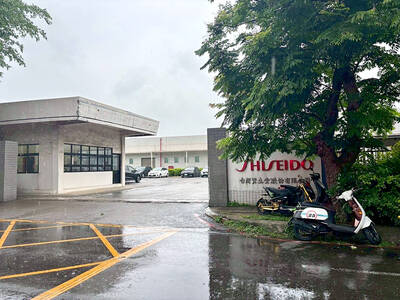
The Hsinchu County Government’s Labor Affairs Department yesterday said that it has received a plan from cosmetics brand Taiwan Shiseido Co (台灣資生堂) detailing mass layoffs at its plant in Hukou Township (湖口). While the labor authorities did not disclose the number of employees to be laid off, Japanese news media earlier in the day reported that the closure of the company’s factory in Hukou would result in 170 employees losing their jobs. Shiseido followed the law by reporting its layoff plan, the department said, adding that authorities would closely monitor negotiations between the management and affected employees and step in if any
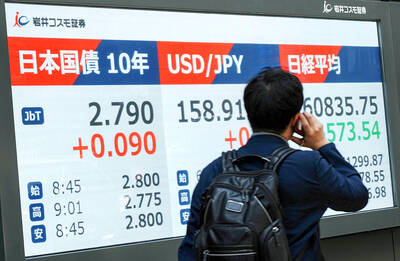
ROUGH RECORDS: Bonds in Japan, as well is in New Zealand, Australia and the US, are seeing the effects of a nervy market as stock exchanges across Asia edge down A deepening slump in Japanese government bonds added fuel to the selloff in global debt markets as rising oil prices stoked inflation fears and pushed yields to multi-decade highs. Japan’s 30-year yield yesterday surged as much as 20 basis points to the highest level since the tenor’s debut in 1999, before paring some of the move. Shorter-maturity Japanese debt was also under pressure, underscored by weak demand at a sale of five-year notes that offered a record-high coupon of 2 percent. Concerns over inflation and government spending rippling through markets including the US, Australia and New Zealand are being amplified in Japan,


 RSS
RSS