

HTC Corp (宏達電) remained the fifth-largest supplier of mobile phones in the US, but the struggling manufacturer has narrowed the gap between it and the leading players, research firm comScore said on Wednesday.
According to comScore, 234 million Americans aged 13 and older used smartphones and feature phones from April to June this year.
Samsung Electronics Co ranked as the top handset maker with 25.6 percent of US mobile subscribers, followed by LG Electronics Inc (18.8 percent), Apple Inc (15.4 percent), Motorola Mobility Holdings Inc (11.7 percent) and HTC (6.4 percent), it said.
Among the top five vendors, Apple recorded the biggest gain of 1.4 percentage points from the previous three-month period, while HTC’s market share rose 0.4 percentage points.
Google Inc’s unit, Motorola, dipped 1.1 percentage points, while LG and Samsung declined 0.5 and 0.4 percentages points respectively, it said.
In April, HTC said it would rely more on the smartphone markets in Europe and Asia in the face of the stiff competition in the US.
AT&T Inc, the second-largest US mobile operator, last month cut the price of HTC’s One X flagship smartphone from US$199 to US$99 for a two-year contract, less than three months after its launch.
Some analysts viewed the move as a bad signal because HTC had been able to sell its phones for six to 12 months prior to the price cuts.
HTC has also been doing well in China, with its cheaper “New Desire” series, which lifted its market share in the below-2,500 yuan (US$392) segment from 3 percent in the first quarter to 6 percent in June, they said.
The company is scheduled to report its latest quarterly results today, with two foreign brokerages forecasting a weak outlook for the struggling smartphone vendor, citing a worsening product mix and tougher competition.
“We maintain our view initiated since October 2011 that HTC is squeezed in the middle, with smartphone commoditization being accelerated by chip designer MediaTek Inc (聯發科),” said Aaron Jeng (鄭明宗), a Taipei-based Nomura Holdings Inc analyst.
“What’s worse, HTC seems to be losing share in the high-end smartphone space despite launching its One X flagship model both in China and the US,” he wrote in a research note on Monday.
“We expect competition will become tougher over the next 6-9 months, with iPhone 5 hitting the One X, and China-branded low-price dual-core and quad-core phones hitting the ‘New Desire,’” Jeng wrote.
In a separate note, Bank of America Merrill Lynch said it expected a 4 percent quarter-on-quarter drop in HTC’s third-quarter sales, with an operating margin of 8.6 percent.
Merrill Lynch said it expected HTC to launch a 5-inch Android smartphone, and models running on the touch-friendly Windows 8 system later this year.
However, the Windows-based smartphone has only a 4 percent market share currently and will likely remain a niche market player this year, while big-screen models will also face strong competition from Samsung, it said.
Bank of America Merrill Lynch Merrill Lynch analyst Robert Cheng (鄭勝榮) said HTC’s most important model launch was likely to be in the first quarter of next year, and its momentum in the second half of this year would be muted due to a lack of strong models.
“We have witnessed HTC conducting a series of cost-downs and restructuring in its R&D team recently to lift the bottom line,” he said. “However, amazing new models and market position are the key growth factors for the company.”
READJUSTMENT? Despite the rumors, a senior Google official said that the company plans to expand its AI research center in Taipei’s Shilin District Google Taiwan is reducing its workforce as the company continues to adjust operations to improve efficiency and focus resources on core goals, the Chinese-language Liberty Times (sister paper of the Taipei Times) reported yesterday. The Alphabet Inc unit said the organizational adjustments have begun and would continue, even though it did not put a figure on the number of potential job cuts or specify the affected departments in its Taiwan operations. The company’s response came after rumors circulated on social media about major job cuts at Google Taiwan. Some posts said the downsizing would target the company’s consumer electronics-related departments
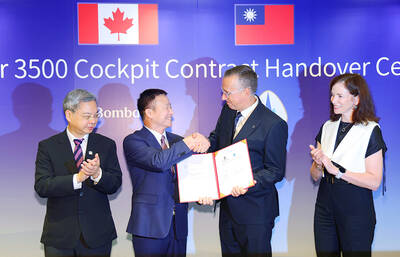
Taiwanese aircraft maker Aerospace Industrial Development Corp (AIDC, 漢翔航空) yesterday announced that it has secured a 20-year partnership agreement with Canada-based Bombardier Inc. The two companies held a ceremony in Taipei yesterday to exchange signed copies of the agreement, launching the 20-year partnership under which AIDC would supply cockpit and forward fuselage structural components for Bombardier’s super-midsize Challenger 3500 business jets, the Taiwanese company said. The agreement represents a new milestone in cooperation between the two companies, which dates back to 1999, with the Taiwanese supplier having provided rear fuselage structural components for more than 1,000 Challenger 3500 aircraft, it
FOUNDRY DATA: Demand pushed production on some TSMC lines to full utilization, while Samsung’s market share of 5.9 percent dropped, TrendForce said Taiwan Semiconductor Manufacturing Co’s (TSMC, 台積電) foundry market share edged up to 72.5 percent in the second quarter from 72.3 percent in the previous quarter, propelled by robust artificial intelligence (AI) and smartphone chip revenue, data compiled by market researcher TrendForce Corp (集邦科技) showed yesterday. TSMC’s revenue last quarter grew 12 percent sequentially to US$40.2 billion, outpacing the 11.5 percent average growth among the world’s top 10 foundry companies, the researcher said. Combined revenue of the top 10 is expected to grow further this quarter from US$53.49 billion last quarter, supported by strong demand and price hikes, it said. The increased demand has

Global notebook computer shipments are expected to fall 8 percent year-on-year to 167.9 million units this year, dragged by weak demand, high component prices and supply constraints, the Market Intelligence and Consulting Institute (MIC) said on Tuesday. Next year, shipments are expected to decline by a further 4.7 percent to 160 million units as higher retail prices weigh on consumption, MIC deputy director-general Edward Lin (林柏齊) told a news conference in Taipei. The downtrend is expected to extend into 2028, with replacement demand unlikely to recover before supplies of key components rebound and costs decline, Lin said. Surging demand for artificial intelligence (AI)


 RSS
RSS