

The majority of Germans think their country would be better off without the euro, a poll suggested yesterday, as the German economy minister reiterated doubts over whether Greece can stay in the single currency.
The Emnid poll for the Bild am Sonntag mass circulation weekly showed 51 percent of Germans believed Europe’s top economy would be better outside the 17-country eurozone. Twenty-nine percent said it would be worse off.
The survey also showed that 71 percent of Germans wanted Greece to leave the euro if it did not live up to its austerity promises.
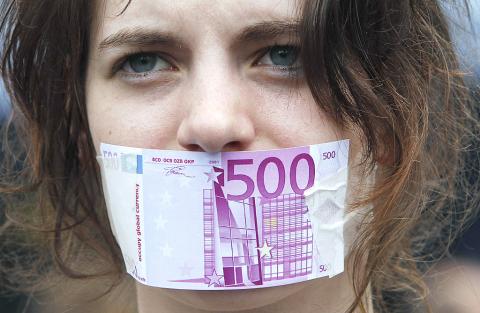
Photo: Reuters
German Minister of Economics and Vice Chancellor Philipp Roesler told the Bild am Sonntag there were “considerable doubts whether Greece is living up to its reform promises.”
“The implementation [of the reforms] is faltering. There is still no functioning tax office. Also, almost nothing has happened in terms of the promised privatization of public assets,” Roesler told the paper. “If Greece does not fulfill its obligations, there can be no more money. Then Greece would be insolvent.”
Roesler and his party — junior partners in Germany’s ruling coalition — have frequently expressed doubts about whether Greece is prepared to follow through with the painful reforms necessary to stay in the single currency club.
Debt-wracked Greece is under immense pressure to carry out a structural reform program, part of a package worth billions of euros that have been keeping its economy alive since 2010.
International auditors are currently in Greece, assessing the Greek government’s progress toward reforms seen as essential to get the country back on its feet.
The audit report will determine whether Greece will receive the next tranche of 31.5 billion euros (US$38.8 billion) from its aid program that it needs to keep the economy afloat.
Meanwhile, German Finance Minister Wolfgang Schaeuble on Saturday threw cold water on speculation that the eurozone’s bailout fund will buy Spanish public debt.
Spanish and French media have suggested that the European Financial Stability Facility would start buying bonds issued by Italy and Spain in a coordinated action with the European Central Bank (ECB).
“No, these speculations are unfounded,” Schaeuble said in an interview with the German weekly Die Welt am Sonntag that was to appear on yesterday.
The ECB could resume its own purchases of sovereign bonds on secondary markets to ease pressure on borrowing costs for Rome and Madrid that have climbed to what many consider to be unsustainable levels.
Many economists have also begun to expect some kind of combined effort on the part of eurozone governments and the central bank, especially after ECB President Mario Draghi said on Thursday that the bank would “do whatever it takes to preserve the euro.”
Yet Madrid has rejected the notion of a financial rescue and ruled it out again on Friday.
“A bailout is not an option,” Spanish Deputy Prime Minister Soraya Saenz de Santamaria said.
The Spanish economic daily El Economista spoke on Wednesday of an overall plan worth 300 billion euros that would allow Spain to finance its public deficit for at least a year-and-a-half.
The eurozone has already approved up to 100 billion euros in aid for the Spanish banking sector.
Schaeuble told Die Welt am Sonntag that Spain “has taken all necessary decisions and is putting them into effect.”
The German finance minister said financial markets had not yet taken account of efforts made to resolve Spain’s banking sector crisis, but added: “That will come.”

INFRINGEMENT: The investigation comes after a complaint from Vicor Corp, with the company seeking a limited exclusion order as well as cease-and-desist orders, the ITA said The US International Trade Commission (USITC) has launched a Section 337 investigation naming Taiwanese technology companies, including Hon Hai Precision Industry Co (鴻海), Delta Electronics Inc (台達電) and Quanta Computer Inc (廣達), as respondents. The Ministry of Economic Affairs (MOEA) pledged assistance if needed. The USITC said on Friday in a statement that it had voted to institute an investigation under Section 337 of the US Tariff Act of 1930 into certain vertical power delivery systems, related components and computing devices incorporating such systems. The investigation covers 20 companies from Taiwan, China, Germany and the US, the commission said, adding that it

IN GOOD FAITH: Lai said he appreciates Micron’s commitment to Taiwan and that it would continue expanding its investment in the country, while also working with labor President William Lai (賴清德) yesterday called for US memory maker Micron Technology Inc and its workers to negotiate “sincerely” ahead of a possible strike by the company’s union in Taiwan. Last week, a Taiwanese union representing workers at Micron said it had secured authorization from its members to strike over a dispute concerning the company’s bonus scheme, escalating a labor conflict at the chipmaker’s largest manufacturing hub. Micron employs about 15,000 people in Taiwan and has said it invested more than NT$1.6 trillion (US$49.6 billion) in the country. Speaking in Taichung at the opening of a new Micron advanced assembly and testing facility,

A man charged along with Super Micro Computer Inc co-founder Yih-Shyan “Wally” Liaw (廖益賢) of conspiring to send cutting-edge chips to China in violation of US export controls pleaded guilty, court documents said. Ting-Wei “Willy” Sun (孫廷瑋), a former outside contractor described by US authorities as a “fixer” who allegedly aided in the sales, pleaded guilty on Thursday at a hearing in federal court in New York as part of an agreement with prosecutors, court filings showed. Prosecutors claimed the men were part of a scheme to send Nvidia Corp-powered servers to an unnamed Southeast Asian company and then divert them to
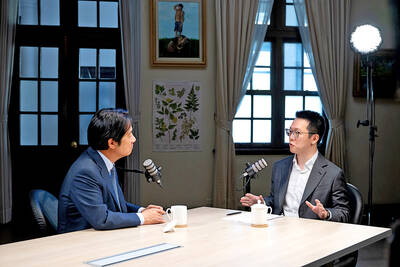
Taiwan should not rule out any energy source or abandon environmental sustainability in favor of ideology and short-term benefits, President William Lai (賴清德) said in an interview, calling for a “professional assessment” of whether nuclear power should be reintroduced into Taiwan’s energy mix. In an online interview with influencer Yu Ting-hao (游庭皓) that aired yesterday, Lai reiterated his position on nuclear power. SHIFT Lai’s remarks marked a shift from the Democratic Progressive Party’s (DPP’s) longstanding opposition to nuclear power. As premier from 2017 to 2019, Lai pushed for more gas-fired power capacity while sticking to the DPP’s nuclear free homeland ideology and rejected the


 RSS
RSS