


China’s exports and imports shot up last month, but analysts cautioned the better-than-expected data released yesterday was no cause for joy amid global economic woes and a slowdown in the Asian powerhouse.
According to the customs agency, exports rose 15.3 percent year-on-year to US$181.1 billion and imports increased 12.7 percent to US$162.4 billion last month, slightly widening the trade surplus for the third consecutive month to US$18.7 billion.
This compares with a lackluster 4.9 percent increase in exports and 0.3 percent rise in imports in April.
The figures widely defied analyst’s expectations — a hopeful sign for the world’s second--largest economy, which recorded poor data last month such as slower-than--expected growth in industrial output.
A survey released by banking giant HSBC also indicated a contraction in Chinese manufacturing activity last month for the seventh consecutive month.
“It is encouraging to see that imports and exports have not collapsed and have actually -performed a lot better than expectations,” said Alistair Thornton, a Beijing-based China economist for IHS Global Insight.
“But we had some pretty dismal data out yesterday and it came off the back of an interest rate cut which really signals that policy-makers are extremely concerned about the state of the economy,” he said.
“The fundamentals [of the economy] haven’t really changed and in fact over the past few months the fundamentals have deteriorated,” he added.
Authorities have been easing monetary policy for some time in an effort to stimulate growth, -cutting the amount of money banks are required to keep in reserve three times since December last year. Economic growth slowed to 8.1 percent in the first quarter of this year — its slowest year-on-year pace in nearly three years.
On Friday, the people’s Bank of China also cut interest rates for the first time in more than three years and allowed banks more flexibility to set rates, introducing greater competition in the market.
Ken Peng (彭墾), a Beijing-based economist at BNP Paribas, said the stronger-than-expected trade figures last month could be due to temporary factors such as extra working days or inventory that needed to be cleared.
“May had one extra work day and April had one less than last year, so the comparisons are not very even, and secondly, there are inventory issues — perhaps some of the traders thought they had too much inventory,” he said.
“We are in a period where external demand is not improving, the RMB [yuan] has increased sharply versus most of its competitors and especially versus the euro,” he added, “So there is no reason [the rise in] exports should be seen as a sustainable improvement at this point.”
Chinese policymakers are trying to place a greater emphasis on domestic demand to stimulate growth rather than maintaining a reliance on exports as the crisis in Europe — the country’s largest export market — rages on.
As such, the sharp rise in imports last month indicates this policy could be starting to bear fruit.
However, Thornton cautioned against reading too much into last month’s trade data.
“Next month, I would imagine that things will pull back again and revert to trend levels, which is rather subdued positive export growth for the year, and likewise with imports,” he said.
“The domestic economy is slowing quite substantially and that will feed through into imports over the next few months, so this is likely to be a bit of an aberration rather than a new normal,” he added.

Taichung reported the steepest fall in completed home prices among the six special municipalities in the first quarter of this year, data compiled by Taiwan Realty Co (台灣房屋) showed yesterday. From January through last month, the average transaction price for completed homes in Taichung fell 8 percent from a year earlier to NT$299,000 (US$9,483) per ping (3.3m²), said Taiwan Realty, which compiled the data based on the government’s price registration platform. The decline could be attributed to many home buyers choosing relatively affordable used homes to live in themselves, instead of newly built homes in the city’s prime property market, Taiwan Realty
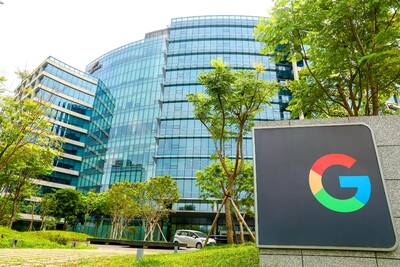
The government yesterday approved applications by Alphabet Inc’s Google to invest NT$27.08 billion (US$859.98 million) in Taiwan, the Ministry of Economic Affairs said in a statement. The Department of Investment Review approved two investments proposed by Google, with much of the funds to be used for data processing and electronic information supply services, as well as inventory procurement businesses in the semiconductor field, the ministry said. It marks the second consecutive year that Google has applied to increase its investment in Taiwan. Google plans to infuse NT$25.34 billion into Charter Investments Ltd (特許投資顧問) through its Singapore-based subsidiary Fructan Holdings Singapore Pte Ltd, and

JET JUICE: The war on Iran’s secondary effects have seen fuel prices skyrocket, knocking flight schedules down to earth in return as airlines struggle with costs Airline passengers should brace for more irritation in the next few months as carriers worldwide cancel flights and ground planes to cope with stratospheric increases in jet-fuel prices. Dutch flag carrier KLM is the latest company to cut its schedule, saying on Thursday that it would scrap 80 return flights at Amsterdam’s Schiphol Airport in the coming month. That puts it in the same league as United Airlines Holdings Inc, Deutsche Lufthansa AG and Cathay Pacific Airways Ltd, which have all pruned itineraries to mitigate costs. Global capacity for next month has been reduced by about 3 percentage points, with all

Micron Technology Inc is a driving force pushing the US Congress to pass legislation that would put new export restrictions on equipment its Chinese competitors use to make their chips, according to people familiar with the matter. A US House of Representatives panel yesterday was to vote on the “MATCH Act,” a bill designed to close gaps in restrictions on chipmaking equipment. It would also pressure foreign companies that sell equipment to Chinese chipmaking facilities to align with export curbs on US companies like Lam Research Corp and Applied Materials Inc. The bill targets facilities operated by China’s ChangXin Memory Technologies Inc


 RSS
RSS