


Foxconn Technology Group’s (富士康) decision to start making solar power modules may speed the rate at which margins are narrowing for Chinese manufacturers, another blow for an industry already coping with a plunge in prices.
The Taiwanese company that’s the world’s biggest contract maker of electronics, including Apple Inc’s iPhone, started work on a solar-module plant in China’s Jiangsu Province near the headquarters of Suntech Power Holdings Co (尚德), the largest silicon-based module manufacturer.
HUGE SUPPLY
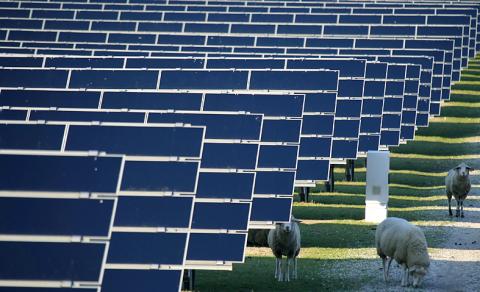
Photo: Reuters
“Foxconn plans to build new factories with undreamed-of scale and lower cost,” Jenny Chase, who leads a team of six solar analysts at Bloomberg New Energy Finance, said on Friday. “It will push capacity higher and prices lower.”
Prices for solar cells have skidded 62 percent this year as Chinese companies led by Suntech boosted production and won market share from European and Japanese rivals. Foxconn’s gross margin of 5.6 was less than half Suntech’s in the third quarter, according to data compiled by Bloomberg.
Chase said Foxconn’s EBITDA margin ranges from 2 percent to 5 percent compared with as much as 30 percent enjoyed by the companies purely manufacturing solar products.
“Foxconn is good at operating with low margins in electronics and can replicate the success it has there to the solar industry,” Lian Rui (廉銳), a senior analyst for the research company Solarbuzz, said by telephone from Shanghai.
It “will make the competition fiercer and drive margins down further,” Lian said.
TRIAL PRODUCTION
Foxconn will begin trial production in May, the Funing County Government, where the plant is located, said in a statement on its Web site on Thursday.
The company’s Hon Hai Precision Industry Co (鴻海精密) unit will invest US$30 million as registered capital to set up Fuyu Energy Technology (Funing) Co (富昱能源科技[阜寧]公司) in the county, according to a filing on Tuesday to the Taiwan Stock Exchange. The unit will make solar cells. No details about the plant’s capacity were given.
Suntech’s gross margin declined to 13.3 percent in the third quarter from 17.9 percent a year earlier. Shanghai-based JA Solar Holdings Co (晶澳太陽能) had a negative 4.3 percent gross margin in the third quarter compared with 22.5 percent last year.
Asian solar companies enjoyed high margins in the industry as shipments surged last year. The average gross margin for the 10 Asia-based solar companies in Bloomberg Industries’ Large Solar Index was 24.6 percent last year. Trina Solar Ltd (天合光能) had a gross margin of 33.2 percent and Yingli Green Energy Holding Co (英利新能源) 31.5 percent, the Bloomberg data shows.
Foxconn’s gross margin was 5.6 percent in the six months through June 30, down from 6.8 percent in the second half of last year, Bloomberg data also shows.
PRICE DROP
The average price for solar modules has declined 47 percent this year to US$0.94 a watt, according to Bloomberg New Energy Finance. Three US companies led by Solyndra LLC filed for bankruptcy this year. In Germany, Q-Cells SE, once the world’s biggest solar maker, is looking for a partner after its earnings and margins plunged.
“Foxconn’s entry into the solar industry has been rumored for a long time,” Chase said. “The company’s formal entry at a time when ingot, wafer and cell makers are not making their cash costs must be bad news for the incumbent companies.”

Taichung reported the steepest fall in completed home prices among the six special municipalities in the first quarter of this year, data compiled by Taiwan Realty Co (台灣房屋) showed yesterday. From January through last month, the average transaction price for completed homes in Taichung fell 8 percent from a year earlier to NT$299,000 (US$9,483) per ping (3.3m²), said Taiwan Realty, which compiled the data based on the government’s price registration platform. The decline could be attributed to many home buyers choosing relatively affordable used homes to live in themselves, instead of newly built homes in the city’s prime property market, Taiwan Realty
The government yesterday approved applications by Alphabet Inc’s Google to invest NT$27.08 billion (US$859.98 million) in Taiwan, the Ministry of Economic Affairs said in a statement. The Department of Investment Review approved two investments proposed by Google, with much of the funds to be used for data processing and electronic information supply services, as well as inventory procurement businesses in the semiconductor field, the ministry said. It marks the second consecutive year that Google has applied to increase its investment in Taiwan. Google plans to infuse NT$25.34 billion into Charter Investments Ltd (特許投資顧問) through its Singapore-based subsidiary Fructan Holdings Singapore Pte Ltd, and

JET JUICE: The war on Iran’s secondary effects have seen fuel prices skyrocket, knocking flight schedules down to earth in return as airlines struggle with costs Airline passengers should brace for more irritation in the next few months as carriers worldwide cancel flights and ground planes to cope with stratospheric increases in jet-fuel prices. Dutch flag carrier KLM is the latest company to cut its schedule, saying on Thursday that it would scrap 80 return flights at Amsterdam’s Schiphol Airport in the coming month. That puts it in the same league as United Airlines Holdings Inc, Deutsche Lufthansa AG and Cathay Pacific Airways Ltd, which have all pruned itineraries to mitigate costs. Global capacity for next month has been reduced by about 3 percentage points, with all

The US said it plans to help build a first-of-its-kind industrial hub in the Philippines to boost production of inputs crucial to US supply chains. The 4,000-acre hub is intended to be “a purpose-built platform for allied manufacturing” and “an investment acceleration hub where the specific industrial activities are shaped by market demand,” the US Department of State said on Thursday. The project — touted as an “economic security zone” — would be within the Luzon Economic Corridor, a flagship economic project backed by the US and Japan on the main Philippine island. The project was also described as “the first artificial intelligence


 RSS
RSS