


Smartphones detecting bad breath and radiation, twistable remote controls and a super-thin tablet computer were just some of the gadgets showcased at Asia’s biggest tech fair in Japan yesterday.
Around 600 firms unveiled their innovations at the Combined Exhibition of Advanced Technologies (CAETEC) technology exhibition in Chiba, near Tokyo, which is expected to draw 200,000 visitors during its five-day run, organizers said.
Japan’s Toshiba showcased what it calls “the world’s thinnest and lightest” tablet computer, equipped with a 10.1-inch display that is just 7.7mm thick and weighs 558g.
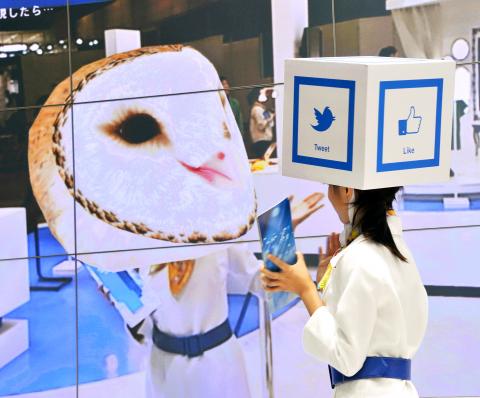
Photo: AFP
Electronics parts maker Murata Manufacturing unveiled devices using a newly developed transparent organic film that can deliver instructions via twisting motions or pressure.
One of the devices, a conceptual light-powered plate named Leaf Grip Remote Controller, has no buttons and instead operates by the user bending and twisting it.
Another application of the film is as a touch panel. The “touch pressure pad” responds to finger swipes in the left-right and up-down directions and can also sense how strongly it is pressed, unlike the conventional touch screen glass used on smartphones.
“Currently we give commands two-dimensionally on touch panels in smartphones and tablet computers, but this invention would give us another dimension — how hard they are pressed,” Murata spokesman Kazuhisa Mashita said.
“This could enable users to scroll screens slowly by touching the screen lightly and move images faster by pressing it harder,” he said ahead of the exhibition.
Japanese telecoms giant NTT DoCoMo will showcase a smartphone with changeable “jackets” that measure bad breath, body fat and even radiation levels, while Japanese microchip maker Rohm showcased what it called the world’s tiniest resistors, which are so small that 500,000 of them can be used in an hourglass instead of sand.
Among other high-profile Japanese companies, Hitachi will show off technology that enables the projection of holographic 3D images, instead of relying on special displays. The lifelike images can be viewed from all angles without the need to wear special glasses.
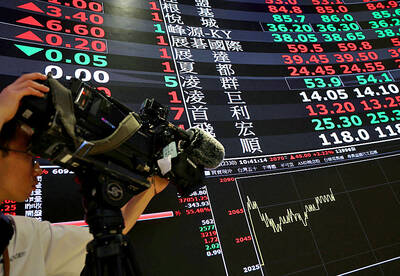
After several years flying high as Asia’s best Nvidia Corp proxy, Taiwan Semiconductor Manufacturing Co (TSMC, 台積電) is increasingly vying with other artificial intelligence (AI) stocks for investor attention. Stock traders are chasing a wider array of beneficiaries as mainstream usage of AI creates demand for hardware beyond the most-advanced chips TSMC makes for Nvidia. Subthemes from the deepening memory crunch to advances in robotics are also luring bids. At the same time, investment caps on single stocks are pushing funds to diversify, while retail investors long familiar with TSMC through its US depositary receipts are being offered a broader set of
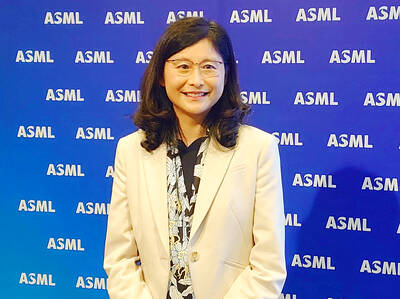
Netherlands-based semiconductor equipment supplier ASML Holding NV yesterday said that it is planning to hire an additional 1,000 people in Taiwan this year in response to growing demand from clients. ASML had previously planned to recruit 600 people this year, but that the plan has been adjusted upward, ASML vice president and ASML Taiwan general manager Grace Wang (汪佳慧) told reporters. ASML has a workforce of more than 4,500 in Taiwan, accounting for about 10 percent of its global total, Wang said. This year’s recruitment campaign would focus on adding people in the customer support, manufacturing and supply chain domains to assist ASML

UNDER MICROSCOPE: Taiwan detained three people who allegedly conspired to buy servers in Taiwan and export them using fraudulent documentation, prosecutors said Nvidia Corp chief executive officer Jensen Huang (黃仁勳) on Saturday urged Super Micro Computer Inc to tighten up on compliance after Taiwan detained three people this week for allegedly making fraudulent declarations about artificial intelligence (AI) servers made by its US partner. The development marked the nation’s first crackdown on semiconductor smuggling, which grew after the US slapped restrictions on exports of high-end chips such as Nvidia AI accelerators to China. Nvidia is “rigorous” in explaining regulations to all of its partners, Huang told reporters after arriving in Taipei. “Ultimately Super Micro has to run their own company,” he said in response to
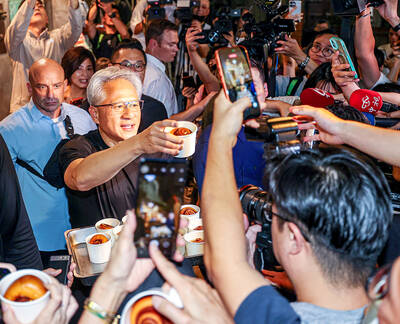
Nvidia Corp yesterday announced that CEO Jensen Huang (黃仁勳) would attend an employee meeting in Taipei tomorrow to celebrate the launch of the company’s Taiwan headquarters project. Huang would attend a gathering at the site of Nvidia’s planned headquarters in Beitou Shilin Technology Park (北投士林科技園區), the company said in a statement. After arriving in Taiwan on Saturday last week, Huang told reporters that he plans to meet with Quanta Computer Inc (廣達) chairman Barry Lam (林百里) and Taiwan Semiconductor Manufacturing Co (TSMC, 台積電) chairman C.C. Wei (魏哲家), and would attend the groundbreaking ceremony for Nvidia’s Taiwan headquarters tomorrow. Nvidia has not yet applied


 RSS
RSS