


GlobalFoundries Inc, the world’s No. 3 contract chipmaker, yesterday said it has as many as 35 customers designing chips using its cutting-edge 28-nanometer (nm) process technology, paving the way for an early shipment in the first quarter of next year.
GlobalFoundries, created out of the chip manufacturing operations of Advanced Micro Devices Inc and Singapore-based Chartered Semiconductor Manufacturing Ltd (特許), said most of its customers are expected to ship their products made on 28nm technology next year.
This means Taiwan Semiconductor Manufacturing Co (TSMC, 台積電) will maintain its leadership in the intensifying race to offer advanced technologies to make small and low-power-consumption chips suitable for mobile devices, such as smartphones and tablet devices, as the Hsinchu-based company said 89 of its customers were in the final stage of the current chip design cycle before they begin manufacturing using 28nm technology.
TSMC is expected to start small volume production on 28nm technology in the final quarter of this year, during which the advanced technology would account for 1 percent of its total revenues. The massive production was rescheduled for the first quarter of next year, slightly behind the originally scheduled second half of this year, as customer demand dropped amid global economic weakness.
“Demand for leading-edge [technologies] is still high. We don’t see change there. We saw some softness in mainstream [technologies] like our competitors have said,” GlobalFoundries chief executive Ajit Manocha said.
Manocha said the company has shipped tens of thousand chips using gate-first 32nm technology from its factory in Dresden, Germany, since last year, which made up a significant portion of its revenues.
The Silicon Valley-based GlobalFoundries, which is owned by an investment arm of the Abu Dhabi government, said it would keep its capital spending unchanged at US$5.4 billion, mostly to expand its capacities in the Dresden factory and for a new plant in New York.
The utilization rate on mainstream, or less advanced technologies such as 65nm technology, are expected to drop by 10 to 15 percent in the second half of this year from the first half, the chipmaker said.
GlobalFoundries is a new player, targeting the world’s two biggest contract chipmakers TSMC and United Microelectronics Corp (UMC, 聯電) to expand market share.
Last year, GlobalFoundries won 12.4 percent of the market share, just behind UMC, which had a 13.5 percent, while TSMC had 47.1 percent, according to market researcher Gartner Inc’s statistics.
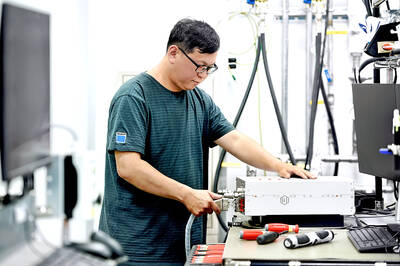
SEMICONDUCTORS: The German laser and plasma generator company will expand its local services as its specialized offerings support Taiwan’s semiconductor industries Trumpf SE + Co KG, a global leader in supplying laser technology and plasma generators used in chip production, is expanding its investments in Taiwan in an effort to deeply integrate into the global semiconductor supply chain in the pursuit of growth. The company, headquartered in Ditzingen, Germany, has invested significantly in a newly inaugurated regional technical center for plasma generators in Taoyuan, its latest expansion in Taiwan after being engaged in various industries for more than 25 years. The center, the first of its kind Trumpf built outside Germany, aims to serve customers from Taiwan, Japan, Southeast Asia and South Korea,

Gasoline and diesel prices at domestic fuel stations are to fall NT$0.2 per liter this week, down for a second consecutive week, CPC Corp, Taiwan (台灣中油) and Formosa Petrochemical Corp (台塑石化) announced yesterday. Effective today, gasoline prices at CPC and Formosa stations are to drop to NT$26.4, NT$27.9 and NT$29.9 per liter for 92, 95 and 98-octane unleaded gasoline respectively, the companies said in separate statements. The price of premium diesel is to fall to NT$24.8 per liter at CPC stations and NT$24.6 at Formosa pumps, they said. The price adjustments came even as international crude oil prices rose last week, as traders

SIZE MATTERS: TSMC started phasing out 8-inch wafer production last year, while Samsung is more aggressively retiring 8-inch capacity, TrendForce said Chipmakers are expected to raise prices of 8-inch wafers by up to 20 percent this year on concern over supply constraints as major contract chipmakers Taiwan Semiconductor Manufacturing Co (TSMC, 台積電) and Samsung Electronics Co gradually retire less advanced wafer capacity, TrendForce Corp (集邦科技) said yesterday. It is the first significant across-the-board price hike since a global semiconductor correction in 2023, the Taipei-based market researcher said in a report. Global 8-inch wafer capacity slid 0.3 percent year-on-year last year, although 8-inch wafer prices still hovered at relatively stable levels throughout the year, TrendForce said. The downward trend is expected to continue this year,
Taiwan Semiconductor Manufacturing Co (TSMC, 台積電), which supplies advanced chips to Nvidia Corp and Apple Inc, yesterday reported NT$1.046 trillion (US$33.1 billion) in revenue for last quarter, driven by constantly strong demand for artificial intelligence (AI) chips, falling in the upper end of its forecast. Based on TSMC’s financial guidance, revenue would expand about 22 percent sequentially to the range from US$32.2 billion to US$33.4 billion during the final quarter of 2024, it told investors in October last year. Last year in total, revenue jumped 31.61 percent to NT$3.81 trillion, compared with NT$2.89 trillion generated in the year before, according to


 RSS
RSS