


Brazil vowed on Tuesday to defend its domestic industry against unfair competition and slapped import tariffs on select Chinese steel products.
It is the latest in a series of measures to defend struggling domestic manufacturers and help shield Latin America’s largest economy from the fallout of global financial turmoil.
The Latin American economic powerhouse will impose an anti-dumping tariff of US$743 per tonne on steel pipes, the government’s foreign trade chamber said. The levy will be valid for five years.
The pipes are used in Brazil’s oil and gas industry, which is booming following big hydrocarbon discoveries in recent years.
The move is part of a broader effort by Brazilian President Dilma Rousseff, who took office on Jan. 1, to get tough on imports and protect domestic jobs.
“[We] will never allow foreign goods using unfair competition against our products,” Rousseff said on a nationally televised address on the eve of Brazil’s Independence Day.
“In the current crisis, our main weapon is expanding and defending our internal market,” she said.
Economic growth is expected to slow to just less than 4 percent from 7.5 percent last year. However, Rousseff said domestic consumer demand was still strong, in part due to record employment and wages.
Still, many Brazilian manufacturers have been losing market share at home and abroad to foreign competitors.
Industry grew only 0.2 percent in the second quarter, compared with overall economic growth of 0.8 percent from the previous quarter.
Industry leaders say Brazil’s expensive currency and Chinese export subsidies are at fault.
Brazilian Minister of Finance Guido Mantega said last week that Brazil would fight back against any new round of quantitative easing in the US by taking fresh measures to protect its currency.
The currency war could get worse, said Mantega, who coined the term to describe how countries are weakening their currencies to try to gain an upper hand in global trade and stimulate their economies.
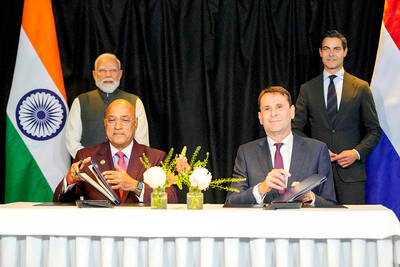
NEW MARKET: The partnership opens up India to the Dutch company, which already has a strong hold in the semiconductor market of South Korea, Taiwan and China ASML Holding NV entered into a partnership agreement with Tata Electronics Pvt Ltd aimed at ramping up India’s goal to develop domestic chip-manufacturing capabilities. The Dutch company’s technology would help power Tata Electronics’ planned 300 millimeter (mm) semiconductor foundry in Gujarat, according to a joint statement from the two companies on Saturday. The signing of a memorandum of understanding coincides with a visit by Indian Prime Minister Narendra Modi to the Netherlands, which is looking to deepen bilateral relations with New Delhi. ASML, whose top customers include Taiwan Semiconductor Manufacturing Co (台積電) and Samsung Electronics Co, makes lithography machines that can print
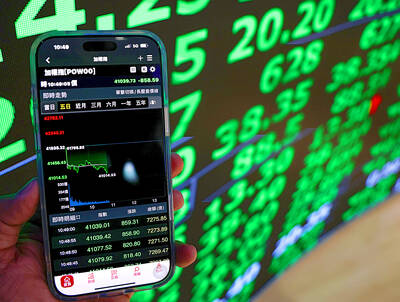
PORTFOLIO REBALANCING: The adjustments in three global equity indices reflect rising investor appetite for semiconductor and artificial intelligence-related stocks Taiwan’s weighting in major global equity indices compiled by MSCI Inc is to rise modestly following the latest quarterly review, underscoring the market’s expanding role in emerging-market portfolios, as global investors continue to favor the nation’s technology sector. Taiwan’s weighting in the MSCI Emerging Markets Index is to increase by 0.30 percentage points to 23.76 percent, after the changes take effect at the close of the May 29 session. Its weighting in the MSCI All-Country Asia ex-Japan Index is to rise 0.37 percentage points to 27.16 percent, while that in the MSCI All Country World Index is to edge up slightly to
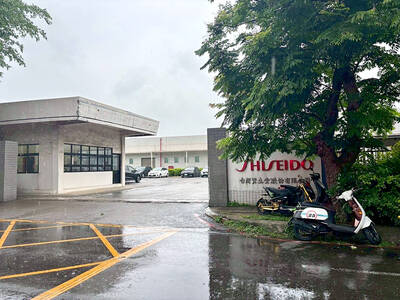
The Hsinchu County Government’s Labor Affairs Department yesterday said that it has received a plan from cosmetics brand Taiwan Shiseido Co (台灣資生堂) detailing mass layoffs at its plant in Hukou Township (湖口). While the labor authorities did not disclose the number of employees to be laid off, Japanese news media earlier in the day reported that the closure of the company’s factory in Hukou would result in 170 employees losing their jobs. Shiseido followed the law by reporting its layoff plan, the department said, adding that authorities would closely monitor negotiations between the management and affected employees and step in if any
Hon Hai Precision Industry Co (鴻海精密) on Tuesday confirmed a cyberattack targeting some of its North American facilities, but said the affected factories were gradually returning to normal. The company, known globally as Foxconn Technology Group (富士康科技集團), said that its cybersecurity team “activated the response mechanism and implemented operational measures to ensure the continuity of production and delivery.” “The affected factories are resuming normal production,” the company said in a statement. Hon Hai had previously described it as a “technical issue,” when news of the cyberattack first surfaced. The confirmation followed media reports of a large-scale information technology system incident that broke out at


 RSS
RSS