


Mazda Motor Corp has a creepy problem — a common spider species seems to have developed a hankering for making nests and weaving webs inside the engines of its sporty Mazda 6 sedan.
The Japanese automaker said on Thursday it would be recalling 65,000 vehicles in the US, Canada and Mexico to outfit them with special screens to keep the spiders out.
“There doesn’t seem to be any particular reason why he’s chosen the Mazda 6,” spokesman Jeremy Barnes said.
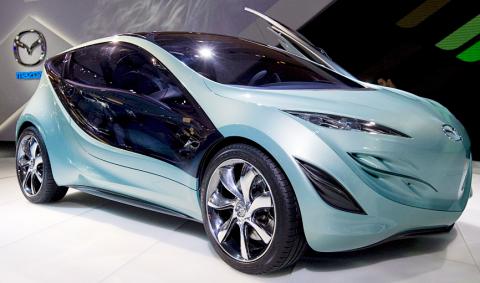
Photo: EPA
“It apparently likes to go zoom-zoom from the best we can tell,” he said with a laugh, in reference to Mazda’s advertising tag-line.
While the spider problem sounds silly, Barnes said it could be dangerous. The webs and nests can block air flow in the fuel tank’s vent and this could cause the tank to leak or even catch fire. So far there have been no accidents or fires, but Madza isn’t taking any chances.
Since the problem wasn’t restricted to a particular geographic region, Mazda thought it best to recall all its affected vehicles in areas where the yellow sac spider lives, Barnes said.
The problem was first discovered in October 2009 when a dealer found a spider web in a canister vent line when a customer brought their Mazda 6 in for repairs after it started leaking fuel.
The dealer investigated further and it was determined that the web blocked up the vent and caused “excessive vacuum” in the fuel tank, which “eventually resulted in a crack in the fuel tank through repetitive negative pressure stress,” Mazda said in filings with safety regulators.
Nineteen other spider nests have been discovered in Mazda 6 vehicles across the US, but only in the four-cylinder versions, so maybe it isn’t that sporty after all. Dealers will inspect all the vehicles for cracks, clean out the vents, install a “spring to prohibit spider intrusion” and reprogram the powertrain control module to avoid a build up of pressure in the tank.
In the latest defect recall to hit Japanese automakers, Honda Motor Co Ltd said on Thursday it was recalling almost 37,000 Civic Hybrids in the US.
Honda said a faulty converter in the hybrid control system could lead to the engine stalling and malfunction of the headlights.
No injuries or accidents have been reported in relation to the problem, which affects 2006 and 2007 models.
Chrysler Group is also recall nearly 250,000 vehicles in the US to fix an ignition key unit defect that can cause the engine to stall or shut off while driving, safety regulators reported on Thursday.
The defect affects last year’s models of the Chrysler Town & Country and Dodge Grand Caravan minivans, and Dodge Journey sport utility vehicles.
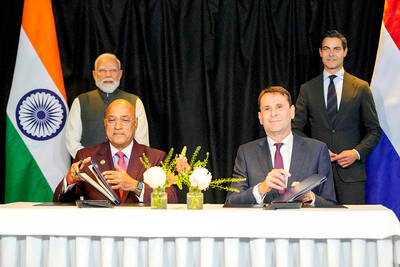
NEW MARKET: The partnership opens up India to the Dutch company, which already has a strong hold in the semiconductor market of South Korea, Taiwan and China ASML Holding NV entered into a partnership agreement with Tata Electronics Pvt Ltd aimed at ramping up India’s goal to develop domestic chip-manufacturing capabilities. The Dutch company’s technology would help power Tata Electronics’ planned 300 millimeter (mm) semiconductor foundry in Gujarat, according to a joint statement from the two companies on Saturday. The signing of a memorandum of understanding coincides with a visit by Indian Prime Minister Narendra Modi to the Netherlands, which is looking to deepen bilateral relations with New Delhi. ASML, whose top customers include Taiwan Semiconductor Manufacturing Co (台積電) and Samsung Electronics Co, makes lithography machines that can print
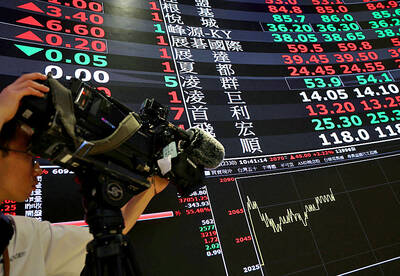
After several years flying high as Asia’s best Nvidia Corp proxy, Taiwan Semiconductor Manufacturing Co (TSMC, 台積電) is increasingly vying with other artificial intelligence (AI) stocks for investor attention. Stock traders are chasing a wider array of beneficiaries as mainstream usage of AI creates demand for hardware beyond the most-advanced chips TSMC makes for Nvidia. Subthemes from the deepening memory crunch to advances in robotics are also luring bids. At the same time, investment caps on single stocks are pushing funds to diversify, while retail investors long familiar with TSMC through its US depositary receipts are being offered a broader set of
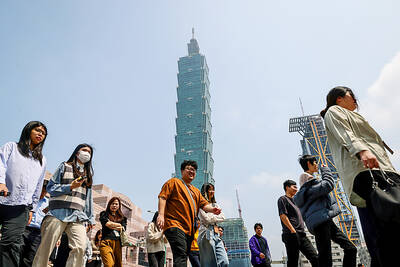
TECH RELIANCE: Growth is increasingly reflecting an unequal K-shaped distribution, where technology sectors outperform and other industries struggle, an expert said Standard Chartered Bank has significantly raised its forecast for Taiwan’s economic growth to 9.5 percent this year, up from 7.6 percent previously, citing surging artificial intelligence (AI) demand driving exports, semiconductor production and investment. The upgrade reflects a sustained AI supercycle that continues to fuel demand for advanced chips and technology infrastructure, which form the backbone of Taiwan’s exports, the bank said in a report this week. “We raise our 2026 growth forecast to reflect a much stronger-than-expected first-quarter GDP figure,” Standard Chartered senior economist for greater China and Asia Tommy Wu (胡東安) said in the report. Driven largely by a 35.3 percent
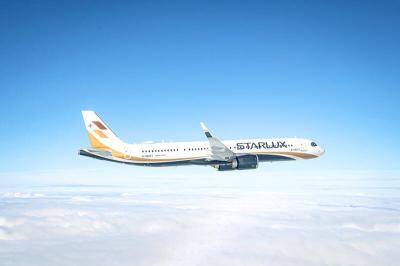
Two of Taiwan’s international carriers, Starlux Airlines Co (星宇航空) and EVA Airways Corp (長榮航空), have retained the five-star airline rating awarded by international airline review organization Skytrax. Starlux was awarded the distinction for a second consecutive year, while EVA Air received it for the 11th straight year, Skytrax said in statements released yesterday and on Thursday last week, respectively. The five-star rating is considered one of the airline industry's highest honors and is awarded following professional audits of airline product and frontline service standards, Skytrax said. The ratings are based on in-depth assessments using unified global quality standards rather than customer review scores


 RSS
RSS