


A small Taiwanese PC firm with lofty ambitions is preparing to take the next step in the own-brand PC industry with First International Computer Inc’s (FIC, 大眾電腦) release of its first tablet computer.
The 30-year-old company makes notebooks and desktops on a contract manufacturing basis and also ships PCs carrying own-brand logos in Japan, the US and China in small volumes.
It has decided to heighten its global profile by rolling out a slew of tablets that will carry the “FIC” logo beginning next year. The foray will first begin on its home turf, with its first tablet scheduled to be launched on Saturday.
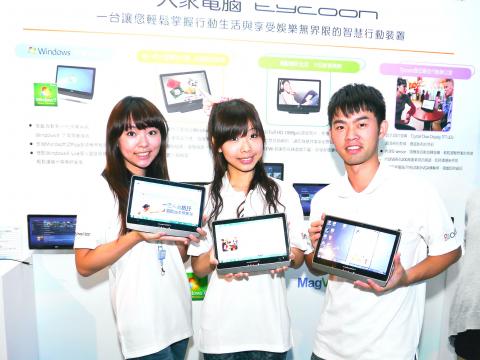
Photo: Chen Ping-hung, Taipei Times
“FIC has been laying low for quite awhile and our performance wasn’t very impressive either in the past few years,” FIC’s chief operating officer Leo Chien (簡民智) said. “Next year is the time for us to make a hike up the hill and we will make the splash with tablets.”
Chien said the company sniffed the trend of a tablet revival early this year and launched research and development activities in April.
“Users need something that is even more portable than a netbook. With tablets weighing less than 1kg, it is a good fit,” he said.
The tablet FIC showcased yesterday has been designated “Tycoon,” and is targeted at business executives that demand productivity on the go.
The 10.1-inch model runs on Windows 7, sports a 120GB hard drive, an Intel Atom N455 processor and weighs 840g. It will start selling on the U-Life TV shopping channel on Saturday, with telecom partners, including Vibo Telecom Inc (威寶電信), to sell the device later.
Tycoons will sell for NT$19,800 apiece, compared with Apple iPad’s US$499 entry-level price with Wi-Fi connectivity and 16GB of storage capacity.
Chien said the shipments in Taiwan would be a few thousand units a month. Total volume will round up to 50,000 units per month if shipments to overseas contract clients are taken into account.
Despite taking a lead over Taiwanese PC peers by launching a tablet, FIC is set to compete against giants Acer Inc (宏碁) and Asustek Computer Inc (華碩) in winning over users’ hearts.
Acer is set to announce its first tablets in New York at the end of the month, while Asustek will unveil its own version in January.
Meanwhile, Vibo is also following in the tablet chase with plans to launch its own-brand tablet called “Vpad” next week.
Vibo president Chang Feng--hsiung (張豐雄) told reporters yesterday that the 7-inch model will run on the Android 2.2 operating system.
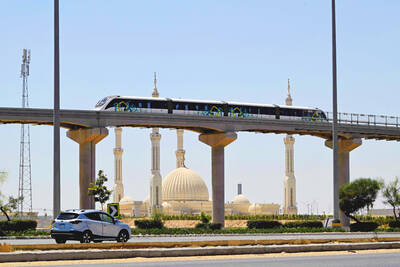
Cairo’s new monorail slices across the city skyline, running above the familiar chaos of blaring horns and aging buses’ exhaust fumes that mark rush hour below. The US$4.5 billion monorail, opened this month, is among Egypt’s most prominent new transport projects, part of a debt-funded infrastructure drive criticized for sapping state finances while bringing limited benefits to most of the country’s 109 million people. “It feels like you’re in a different country,” said Ramy Sayed, a restaurant manager, aboard a driverless Innovia 300 train. “No noise, no traffic, we’re not used to this.” The eastern line runs 56km from the bustling middle-class

Taiwanese firms have increased investment in the Philippines in recent years as Manila’s ties with Washington deepen and global supply chains continue to shift away from China, an expert at the Chung-Hua Institution for Economic Research (CIER, 中華經濟研究院) said yesterday. The Philippines had not been among Taiwanese investors’ top choices in Southeast Asia, CIER Taiwan ASEAN Studies Center director Kristy Hsu (徐遵慈) said at a seminar in Taipei. However, Taiwan’s investment in the country has grown significantly since the COVID-19 pandemic, reaching US $257 million last year, a high in recent years, she said. Although Taiwan’s total investment in the Philippines still lags

Intel Corp regards Taiwan Semiconductor Manufacturing Co (TSMC, 台積電) as a longstanding partner, as the US chipmaker would continue outsourcing production of advanced chips to TSMC, Intel chief executive officer Lip-Bu Tan (陳立武) said yesterday. “I don’t look at people as competitors. I look at the collaboration... Nvidia is also, you know, a good friend,” Tan told a news conference following his keynote speech at the Computex trade show in Taipei. “It’s a very trusted partnership for us... We are a big, top customer for them, and we’re going to continue doing that,” he said, referring to TSMC, the world’s largest foundry
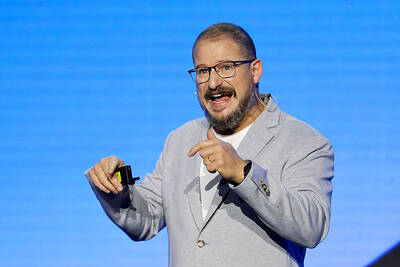
Artificial intelligence (AI) agents would supplant smartphones as the center of people’s digital lives, fundamentally reshaping personal devices and driving a major computing upgrade cycle, Qualcomm Inc CEO Cristiano Amon said yesterday. In his keynote speech for this year’s Computex trade show in Taipei, Amon said that the rise of "agentic AI" — AI systems capable of reasoning, planning and carrying out tasks autonomously — would transform how people interact with technology across phones, PCs, vehicles and wearable devices. Describing the technology as the next major evolution in computing, Amon said that "2026 is the year of agents.” For decades, smartphones have sat


 RSS
RSS