


Evergreen Group (長榮集團), Taiwan’s largest shipping company, yesterday said chairman Chang Yung-fa (張榮發) had been named “Newsmaker of the Year” by Lloyd’s List.
Lloyd’s List is a London-based international marine publication which provides information and analysis on the global shipping industry. It was scheduled to hold an awards ceremony in Singapore last night to announce this year’s 17 Lloyd’s List Asia Awards.
Evergreen said the award showed recognition for the impact that Chang had on the development of the global shipping industry and of world trade over the past 12 months.
A recent interview with Chang by CNBC’s Managing Asia showed Chang was one of the most impressive people in the shipping industry, Evergreen said.
In the interview, Chang talked about his efforts to establish Evergreen Marine Corp (長榮海運) and then expand to the airline and hotel businesses, the group said.
In the previous years when the shipping industry was booming, Chang defied the trend of other shippers to order many large container ships. He believed such expansion would only raise operating costs and impact the bottom line, the group said.
As a result, Evergreen, which had very litte debt, has encountered less financial pressure than other firms, the group said.
In 2006, Chang was the first Asian to be awarded the “Lifetime Achievement Award” by Lloyd’s List.
Evergreen Group encompasses shipping, transportation and associated service companies. It was formed in 1975 from the diversification of the original Evergreen Marine Corp.

Starlux Airlines Co (星宇航空) today unveiled a long-haul network expansion plan at a shareholders’ meeting in Taipei, including direct flights to Barcelona, Spain, and Zurich, Switzerland, as well as a service connecting Taipei, Sydney and New Zealand. Starlux is to become the first Taiwanese carrier to offer non-stop services to the two European cities, while the inaugural oceanic route is expected to expand transit opportunities within the Australia-New Zealand market, Starlux said. Flight services to Chicago, Dallas, Washington and New York are under evaluation, the airline added. Prior to the shareholders’ meeting, the airline earlier this year announced that it would be
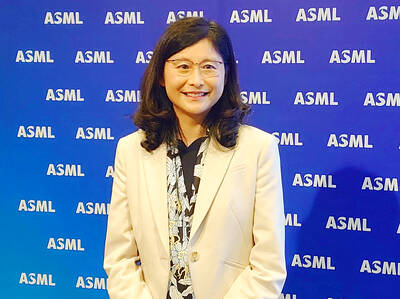
Netherlands-based semiconductor equipment supplier ASML Holding NV yesterday said that it is planning to hire an additional 1,000 people in Taiwan this year in response to growing demand from clients. ASML had previously planned to recruit 600 people this year, but that the plan has been adjusted upward, ASML vice president and ASML Taiwan general manager Grace Wang (汪佳慧) told reporters. ASML has a workforce of more than 4,500 in Taiwan, accounting for about 10 percent of its global total, Wang said. This year’s recruitment campaign would focus on adding people in the customer support, manufacturing and supply chain domains to assist ASML

Cairo’s new monorail slices across the city skyline, running above the familiar chaos of blaring horns and aging buses’ exhaust fumes that mark rush hour below. The US$4.5 billion monorail, opened this month, is among Egypt’s most prominent new transport projects, part of a debt-funded infrastructure drive criticized for sapping state finances while bringing limited benefits to most of the country’s 109 million people. “It feels like you’re in a different country,” said Ramy Sayed, a restaurant manager, aboard a driverless Innovia 300 train. “No noise, no traffic, we’re not used to this.” The eastern line runs 56km from the bustling middle-class

UNDER MICROSCOPE: Taiwan detained three people who allegedly conspired to buy servers in Taiwan and export them using fraudulent documentation, prosecutors said Nvidia Corp chief executive officer Jensen Huang (黃仁勳) on Saturday urged Super Micro Computer Inc to tighten up on compliance after Taiwan detained three people this week for allegedly making fraudulent declarations about artificial intelligence (AI) servers made by its US partner. The development marked the nation’s first crackdown on semiconductor smuggling, which grew after the US slapped restrictions on exports of high-end chips such as Nvidia AI accelerators to China. Nvidia is “rigorous” in explaining regulations to all of its partners, Huang told reporters after arriving in Taipei. “Ultimately Super Micro has to run their own company,” he said in response to


 RSS
RSS